Training a Personal AI with WhatsApp and Instagram Data: Is It Feasible?

Can combining WhatsApp and Instagram data replace hand-written prompts for a truly personalized AI agent?
A Reddit developer asked: since years of chat logs and social data already capture the real you, why write an 'about me' prompt? His insight — that WhatsApp (active intent) and Instagram (passive preference) are complementary — is compelling. Technically feasible via RAG and preference distillation, the approach faces three key risks: third-party privacy exposure, social data bias, and AI over-reinforcing existing thinking patterns. It reflects a broader shift from general-purpose assistants toward deeply personalized AI agents.
A Reddit Developer's Vision: Let AI Truly Know You
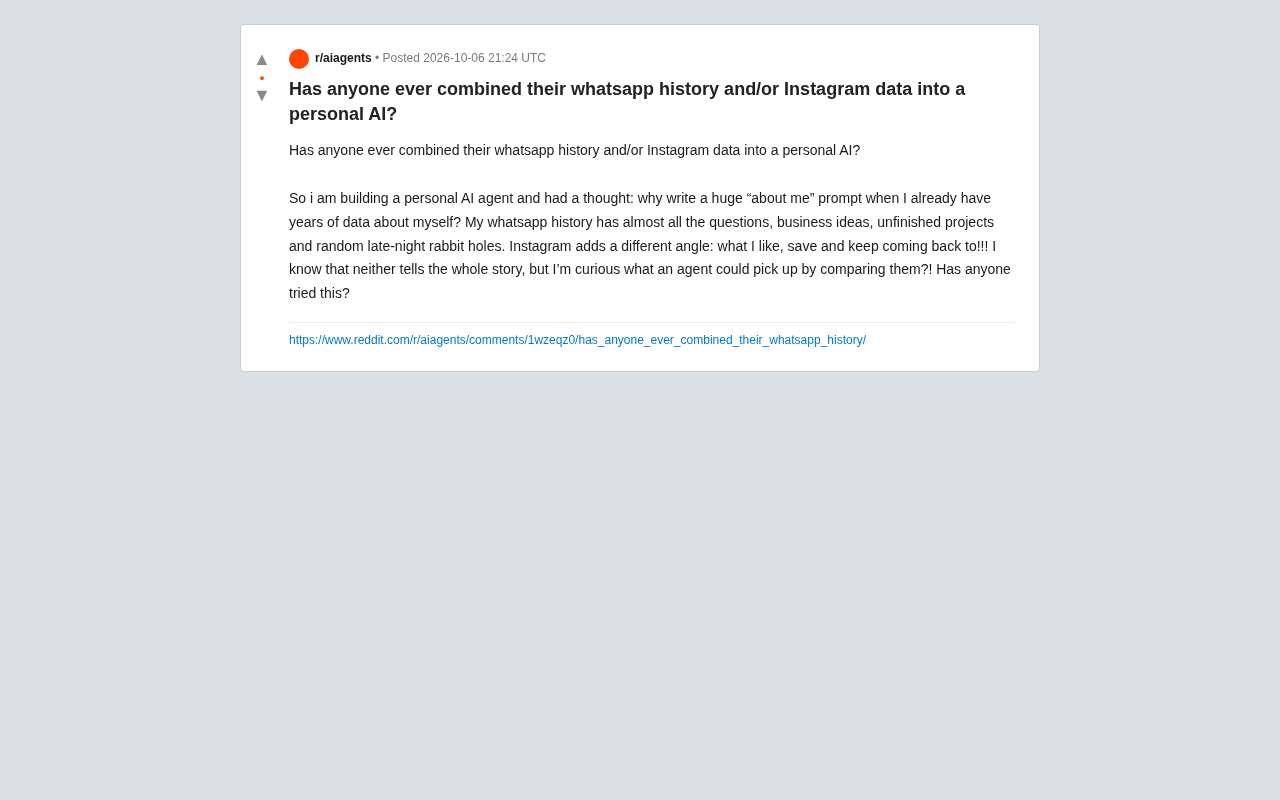
On Reddit, a developer building a personal AI agent posed an intriguing question: since he had already accumulated years of chat logs and social data, why bother writing out a long "about me" prompt?
His reasoning was straightforward — his WhatsApp history contains virtually every question he's ever asked, every business idea that crossed his mind, every half-finished project, and every late-night random search. Instagram adds another dimension: what he likes, what he saves, and what content he keeps coming back to. Neither source tells the full story on its own, but if an AI could cross-reference and analyze them together, it might capture something that's hard to articulate through self-description alone.
This idea cuts to the heart of a core question in the personal AI space: rather than manually describing yourself, why not let AI learn who you are from your actual behavioral data?
Why Behavioral Data Is More Valuable Than Self-Description
People tend to idealize how they describe themselves. When you write an "about me" prompt, you're describing who you want to be — not how you actually behave. Chat logs and social interactions, by contrast, are unfiltered traces of real behavior.
The poster's key insight was recognizing the complementary nature of these two data sources:
- WhatsApp (active expression): Captures the questions you proactively raise, your thought processes, and your unfinished intentions. It's a record of "what you're thinking."
- Instagram (passive preference): Reflects what draws your attention, what you choose to save, and what you return to repeatedly. It's a signal of "what drives you."
An AI agent that can cross-reference both data types could theoretically surface hidden patterns that are easy to miss in self-description — like a business idea you keep bringing up but never act on, or a gap between the content you save and the interests you claim to have. This tension between "active intent" and "passive preference" is arguably the most valuable part of any personal profile.
How to Actually Build This
From an engineering standpoint, this idea isn't far-fetched. The implementation can be broken down into a few key components:
Data Export and Cleaning
WhatsApp supports exporting chat histories as text files, and Instagram lets users download a data package containing posts, likes, and saved items. The first step is structuring this raw data — stripping out irrelevant system messages and noise.
Building a Memory Layer
Rather than cramming all the data into one giant prompt, a more practical approach is building a Retrieval-Augmented Generation (RAG) system. Conversations and preference data are vectorized and stored in a database, allowing the AI agent to semantically retrieve relevant snippets on demand rather than loading the entire history at once. This sidesteps context window limitations and lets the AI dynamically pull the most relevant personal information.
What is RAG? Retrieval-Augmented Generation is the mainstream engineering solution for overcoming a large language model's limited "memory." The core idea: instead of stuffing all information into a prompt, documents and conversations are first converted into high-dimensional numerical vectors (embeddings) and stored in a vector database (such as Chroma, Pinecone, or Weaviate). When a user asks a question, the system vectorizes the query, finds the most semantically similar snippets in the database, and sends those snippets along with the question to the LLM to generate a response. For personal data scenarios, this means the AI only needs to load the history most relevant to the current conversation — not years of complete records — saving compute and improving precision. The vectorization process typically relies on an embedding model such as OpenAI's
text-embedding-ada-002or locally runnablesentence-transformers, the latter being especially suitable for privacy-sensitive use cases.
Preference Distillation
Taking it a step further, a large language model can periodically summarize historical data to extract stable personal characteristics — recurring topics, decision-making patterns, and how interests have evolved over time. These distilled insights can form the core of the AI agent's long-term memory.
Privacy and Ethical Concerns That Can't Be Ignored
As appealing as this idea is, it comes with significant risks that deserve careful consideration.
Privacy is the primary concern. WhatsApp chat logs typically contain messages from the other participants in a conversation — people who never consented to having their information used to train your AI. Uploading this kind of data to cloud-based LLM services could mean exposing others' private conversations to third parties. Local deployment (running a model on your own device) is the more responsible approach.
Data bias is equally worth watching. As the poster himself acknowledged, "neither tells the complete story." Social data is inherently context-biased — how you express yourself on WhatsApp may differ from who you are in real life, and Instagram's algorithmic recommendations actively shape your "preferences," which may not reflect the authentic you. An AI built on biased data could amplify, rather than accurately reflect, your real characteristics.
The risk of over-reliance. When an AI knows you too well, it may tend to reinforce your existing cognitive patterns — creating a personalized version of a filter bubble that actually limits rather than expands your self-understanding.
A note on local deployment: Local deployment typically means running open-source large language models on your own device or private server — common choices include the Ollama framework paired with models like LLaMA or Mistral. Compared to calling cloud APIs like OpenAI or Claude, local deployment keeps your data entirely on your own machine, fundamentally eliminating the risk of a third party accessing your chat logs. The trade-off is hardware requirements — running a 7B parameter model typically needs 8GB or more of VRAM or a relatively recent Apple Silicon chip, and the capabilities are generally weaker than top-tier cloud models. For chat data containing others' private information, local deployment is essentially the only responsible choice; if data has been sufficiently anonymized, cloud solutions may be considered in exchange for stronger model capabilities.
What This Signals About the Future of Personal AI
Beyond the specific implementation, this Reddit question reflects a broader trend: personal AI is evolving from a "general-purpose assistant" toward a "deeply personalized agent."
The personal AI of the future will likely stop relying on users to manually configure it, and instead learn continuously from a person's digital footprint — email, calendar, chat logs, and browsing history together forming a dynamically updated personal model. The key technical and ethical challenge will be: how to achieve personalization while preserving data sovereignty, so users truly control where their data flows.
For developers who want to experiment, the recommendation is to start small and local: first use a subset of data to validate whether the AI can extract meaningful personal insights, then gradually expand — and always keep privacy protection front and center. The question this poster raised has no standard answer, but the direction it points toward — using real behavioral data rather than idealized self-description to define "who I am" — may well be the central challenge for personal AI in the next phase of its development.
Related articles

Gemini 4 Argon Hands-On: AI Builds Board Games, Constructs Temples, and Trains Robots Autonomously
Gemini 4 Argon hands-on roundup: AI autonomously builds a desk racetrack and temple in Blender, writes a ray tracing engine, trains a humanoid robot to sink 7 shots, plus API pricing and developer access.

The Magic Octagonal Coin: Why Only 9% of People Can Predict Its Flip?
Only 9% of people can correctly predict the Magic Octagon coin flip. This article explains its spatial rotation mechanism, common cognitive pitfalls, and a new hypothesis based on Relevance Theory, exploring the limits of human spatial reasoning.

Sam Altman: AI Is Entering the Era of Scientific Discovery — Math Breakthroughs Will Replicate in Biology and Energy
Sam Altman says AI is entering the era of scientific discovery — math breakthroughs will replicate in biology, materials science, and energy to help develop new drugs and energy sources.