Training Smarter Voice Assistant Wakeup Systems with Controllable Synthetic Conversations

New paper adds contextual reasoning to voice assistant wakeup, open-sourcing a 62.3-hour synthetic multi-speaker dataset.
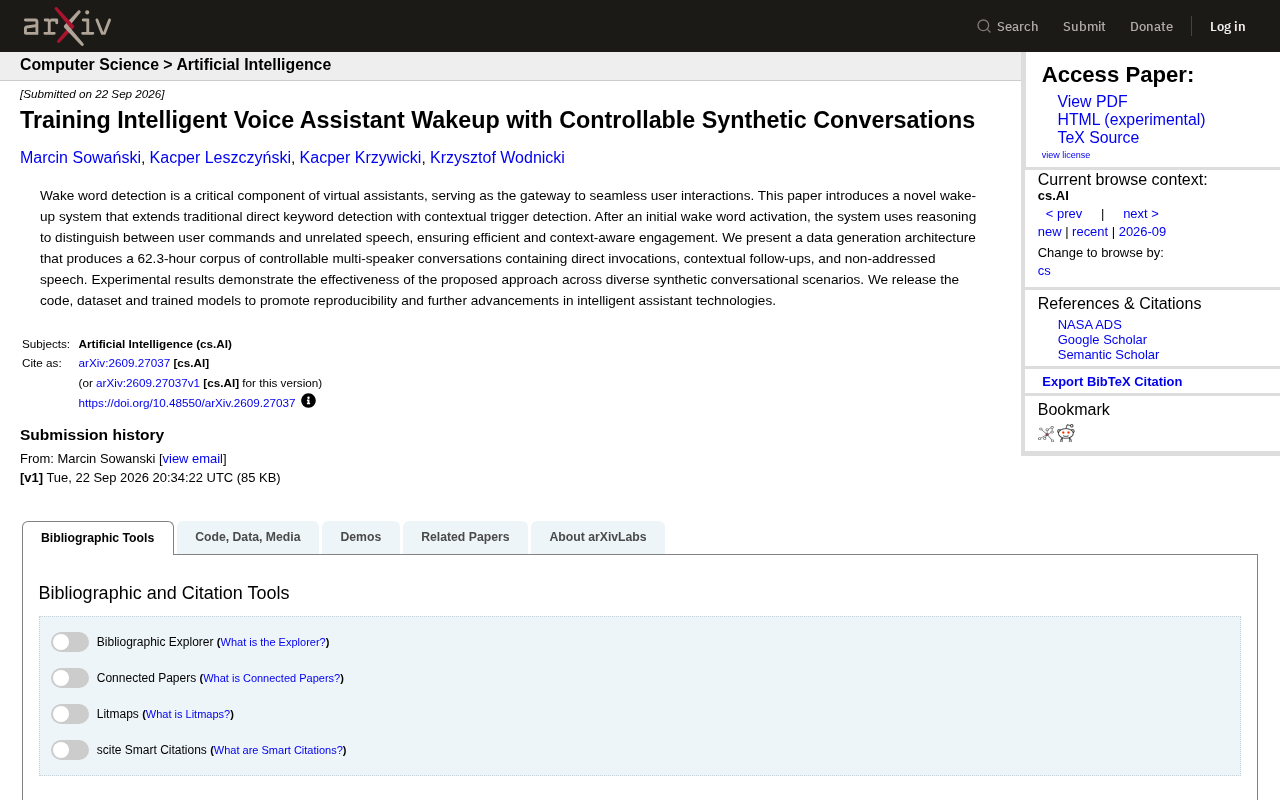
Traditional wake word detection only recognizes keywords and cannot determine whether speech after activation is truly directed at the assistant, causing false responses in multi-person or casual conversation scenarios. This arXiv paper introduces a second-stage "contextual trigger detection" layer that uses reasoning to distinguish genuine commands from non-addressed speech. To address training data scarcity, the team built a controllable multi-speaker synthetic data generation pipeline producing a 62.3-hour corpus across three scenario types, with all code, data, and models released open-source.
From Keyword Detection to Context-Aware Triggering
The first step for any voice assistant is always "waking it up." Whether it's "Hey Siri" or "小爱同学," Wake Word Detection is the very first gate in human-machine interaction. But traditional wakeup systems do only one thing: recognize the keyword. Once activated, they have no way of understanding whether what you say next is actually directed at them. A new arXiv paper (arXiv:2609.27037) proposes a fresh approach — evolving wakeup systems from "hearing a keyword" to "understanding context."
The problem with traditional wakeup mechanisms is their one-size-fits-all nature: activation triggers the moment the wake word is detected, and all subsequent speech is treated as a valid command. In multi-person conversations, noisy environments, or casual chat scenarios, this leads to frequent false triggers.
The system proposed in the paper adds a contextual trigger detection layer on top of conventional direct keyword detection. The core logic: after the initial wake word activation, the system uses reasoning to distinguish whether what the user says next is a genuine command or just conversation unrelated to the assistant.
This means the assistant is no longer a passive "keyword switch" — it gains a degree of context-aware capability. A concrete example: after you say the wake word, you turn and chat with someone nearby for a few sentences. An ideal system should recognize that those sentences weren't directed at it, avoiding a false response.
Contextual trigger detection is typically implemented using a language model or a lightweight classifier that performs intent attribution on the speech segments following a wake word activation. Key dimensions for the judgment include: whether the speaker is facing or near the device, whether the semantic content contains an actionable task intent, and implicit signals about conversational role (speaking to a person vs. speaking to a machine). Unlike full natural language understanding (NLU), contextual trigger detection doesn't require deep semantic parsing — it only needs to perform binary classification: "addressed to the assistant" vs. "not addressed to the assistant." This makes it feasible to run a relatively lightweight model on-device in real time, without relying on cloud inference, which benefits both latency and privacy.
The Key Breakthrough: Controllable Synthetic Conversation Data
To train a model capable of distinguishing "commands" from "irrelevant speech," the biggest challenge is data. Real-world multi-speaker conversational data is difficult to collect, raises privacy concerns, and is hard to scale across edge cases.
One of the paper's core contributions is a data generation architecture for producing controllable multi-speaker synthetic conversation corpora. This architecture generates a 62.3-hour dialogue dataset covering three critical scenario types:
- Direct invocations: the user explicitly issues a command to the assistant;
- Contextual follow-ups: subsequent queries or commands that build on prior context;
- Non-addressed speech: utterances not directed at the assistant, such as casual conversation between people.
The word "controllable" is where the real value lies. Compared to real recordings, synthetic data allows precise control over the number of speakers, the distribution of dialogue types, and the ratio of trigger vs. non-trigger scenarios — enabling targeted reinforcement of the model's ability to handle boundary cases.
Synthetic conversational data generation is typically accomplished through a combination of text-to-speech (TTS) systems and large language models (LLMs): the LLM generates multi-speaker dialogue scripts, while TTS renders text into speech waveforms with varied voices and speaking rates. Environmental noise and reverberation are then layered on to simulate real recording conditions. "Controllable" in engineering terms means being able to specify the sample proportion of each scenario category via configuration files — for example, setting 30% as direct invocations, 40% as contextual follow-ups, and 30% as non-addressed speech — thereby resolving the severe class imbalance common in real-world data. While this data generation paradigm has seen broad adoption in the speech domain in recent years, a systematic corpus specifically targeting multi-speaker wakeup scenarios and simultaneously covering all three trigger/non-trigger categories has been rare until now.
Experimental Results and the Significance of Open-Sourcing
The paper's experimental results demonstrate that the proposed approach is effective across diverse synthetic conversational scenarios, successfully handling the full pipeline from direct wakeup to contextual disambiguation.
Equally noteworthy is the research team's commitment to openness: they have publicly released the code, dataset, and trained models. In the voice interaction field, high-quality, reproducible multi-speaker conversational data is itself a scarce resource. Open-sourcing this data generation methodology and corpus means other researchers can reproduce results and iterate further without starting from scratch on data collection.
Why This Matters
As intelligent assistants move into increasingly complex home and office environments, "knowing when to respond and when to stay silent" is becoming a critical differentiator in user experience. False activations and false responses not only interrupt users but also raise privacy concerns.
The approach in this paper — decomposing "wakeup" into two stages: keyword activation followed by contextual reasoning — represents a pragmatic direction. Rather than keeping the assistant listening at all times, it uses lightweight inference after being woken to determine whether the conversation is actually directed at it. Combined with a controllable synthetic data training paradigm, this approach has the potential to improve assistant robustness in real-world multi-person scenarios while reducing data costs.
For developers and researchers, the open-sourced code and data provide a ready-to-use starting point. For users, it points toward a voice assistant future that knows when to speak up — and when to stay quiet.
Related articles

Why Does the Tesla Roadster Need to Fly? A Deep Dive into Musk's Wild Demo
Tesla's Roadster launch showed wall-climbing, upside-down driving, and flying stunts—but The Vergecast notes the demo car may lack a battery, the Rocket version is invite-only and not street-legal, and the website terms don't guarantee delivery. After nine years of delays, why does this car still need to exist?

AI Is Not a Replacement: Human-AI Collaboration Through the Lens of Factory Root Cause Analysis
Starting from factory root cause analysis, this article explains how AI accelerates evidence chain construction rather than replacing human experts, exploring the pragmatic implementation logic and business value of 'AI supporting people rather than replacing them.'

AI Agent Decision Auditing: Building an Evidence Chain in Regulated Workflows
Starting from a Reddit discussion, this article analyzes three core issues in AI agent decision auditing within regulated workflows: what fields audit records should contain, how to handle feedback latency for erroneous decisions, and how to continuously calibrate LLM judge consistency with human judgment.