TRIP: Feature Deep Dive & Deployment Guide for the Open-Source Self-Hosted Travel Planning Tool

TRIP is an open-source self-hosted travel planner with POI mapping, GPX tracks, and AI integration via MCP Server.
TRIP (Tourism and Recreational Interest Points) is a privacy-first, open-source self-hosted travel planning tool that helps users manage points of interest on interactive maps and plan multi-day itineraries. Version 1.47 introduces GPX track display, MCP Server integration for AI-powered interactions, API Key support for automation, booking attachments, and Markdown notes. With no telemetry or ads, it exemplifies the growing trend of self-hosted software that combines data sovereignty with cutting-edge AI capabilities.
TRIP: A Privacy-First Self-Hosted Travel Planning Tool
In a travel app market flooded with ads, tracking, and data collection, open-source projects often offer a breath of fresh air. The self-hosted travel planning tool TRIP (Tourism and Recreational Interest Points) recently celebrated its one-year anniversary with the release of version 1.47, introducing a host of new features including Trip API Key, MCP Server, booking attachments, and Markdown support.
TRIP's core positioning is as a minimalist map tracking and itinerary planning tool. It helps users mark and manage points of interest (POI) on an interactive map, consolidating all those must-visit places gathered from books, vlogs, and short videos into one organized system for better trip planning. The project is released under the MIT license, fully open-source and free, available on GitHub.
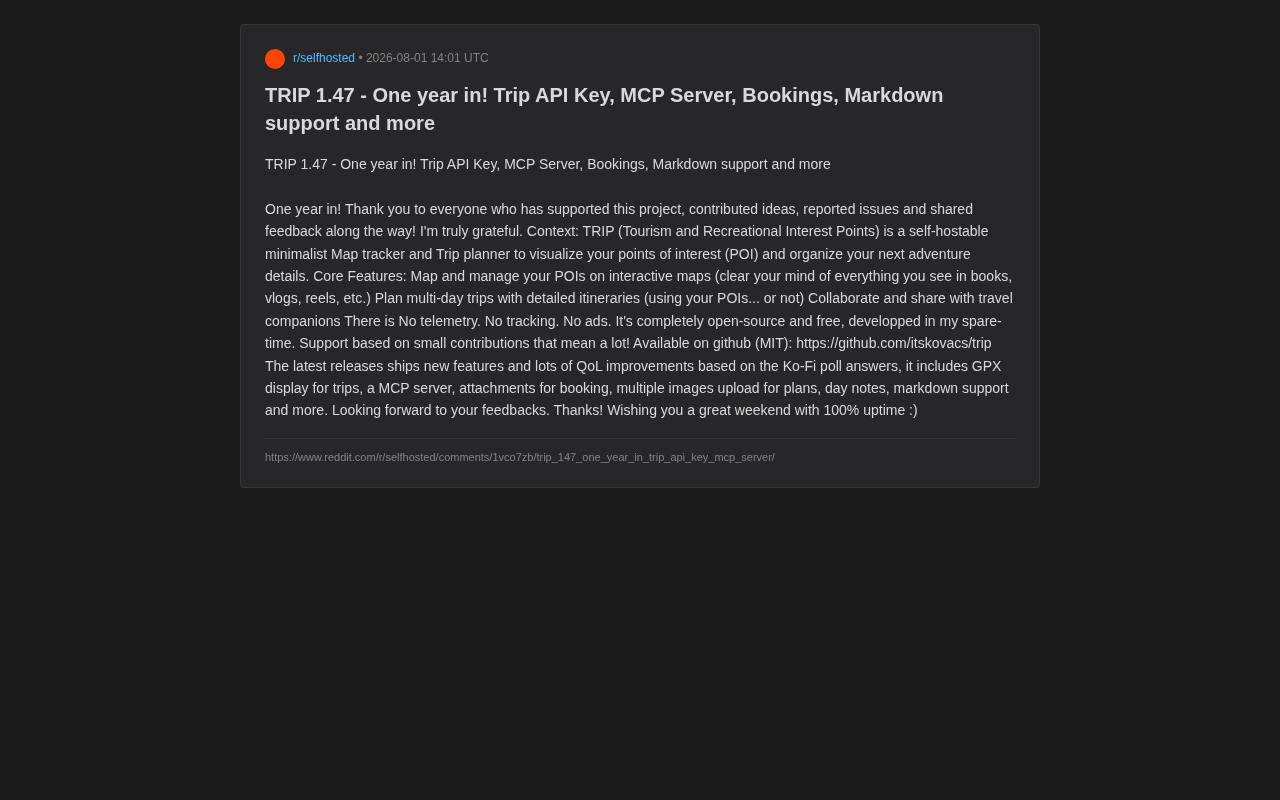
Notably, the developer explicitly emphasizes that the project has no telemetry, no tracking, and no ads. It's developed entirely in spare time and sustained only by small community donations. This pure open-source spirit is particularly rare in an environment overrun with commercialized products.
Core Features: From Collecting Inspiration to Finalizing Itineraries
TRIP's feature design addresses real pain points for travelers, encompassing three core capabilities:
Point of Interest (POI) Map Management
Users can mark and manage their points of interest on an interactive map. POI (Point of Interest) is a foundational concept in geographic information systems and navigation, referring to any meaningful specific location on a map—restaurants, attractions, gas stations, hotels, etc. In digital travel planning, the core challenge of POI management lies in extremely fragmented data sources—users might spot a café on Instagram, discover a hidden gem in a YouTube travel vlogger's video, or bookmark a hiking trail on social media. This information is scattered across different platforms with no unified spatial management approach.
TRIP solves exactly this information fragmentation problem. It enables users to visually present all the places they want to visit on a map, essentially building a personalized geographic knowledge base that anchors scattered inspiration to specific geographic coordinates for easy review and organization.
Multi-Day Itinerary Planning
TRIP supports creating multi-day itineraries with detailed schedules. Users can plan routes based on previously marked POIs or independently create itinerary entries. This flexibility serves both meticulous planners and those who prefer spontaneous arrangements.
Collaboration and Sharing
Travel is often a group activity. TRIP has built-in capabilities for collaborating and sharing with travel companions, supporting multiple people jointly planning a trip. Whether it's a family vacation or a trip with friends, itinerary coordination can be completed on a single platform.
Version 1.47 New Features in Detail
As an anniversary release, version 1.47 incorporates extensive new features and experience improvements based on feedback from Ko-Fi community voting:
GPX Track Display
The new version supports displaying GPX track data within itineraries. GPX (GPS Exchange Format) is an XML-based open standard format introduced by TopoGrafix in 2002 for storing geographic data collected by GPS devices, including waypoints, routes, and tracks. It has since become the universal data exchange format in outdoor sports and navigation—mainstream sports watches (Garmin, Suunto), cycling computers, and hiking apps (Komoot, AllTrails) all support GPX export.
For hikers, cyclists, road trippers, and others with specific route needs, TRIP's GPX support means they can import actual recorded activity tracks or pre-planned routes into the system, visually inspecting route direction, elevation changes, and other information during the planning phase—greatly enhancing the practicality of route planning.
MCP Server Integration
The most notable addition in this update is the introduction of MCP Server (Model Context Protocol Server). MCP is an open communication protocol standard released by Anthropic in late 2024, designed to address the fragmented integration between large language models (LLMs) and external data sources and tools.
Before MCP, connecting each AI application with external tools required custom API adapters, creating N×M integration complexity. MCP reduces this to N+M by defining a unified client-server architecture—any AI client supporting MCP can communicate with any MCP Server. An MCP Server is essentially a lightweight middleware service that exposes an application's data and capabilities as standardized Tools, Resources, and Prompts for AI models to invoke.
TRIP's MCP Server integration means users can interact with their travel data directly through MCP-compatible AI clients like Claude or Cursor—for example, querying saved POIs in natural language, generating itinerary suggestions based on preferences, or having AI help optimize multi-day route arrangements. This is a textbook example of traditional utility applications embracing the AI ecosystem, demonstrating how open protocols enable small projects to rapidly access powerful AI capabilities.
API Key Support
Complementing MCP and automation needs, TRIP introduces a Trip API Key mechanism. An API Key is a lightweight authentication method—essentially a unique string generated by the server to identify and authorize programmatic access requests. Compared to more complex authentication flows like OAuth, API Keys are simple to implement and well-suited for server-to-server communication and automation scripts.
In TRIP's context, API Keys enable users to write scripts that automatically add POIs, sync data through automation platforms like IFTTT, or allow the MCP Server to securely access the user's travel database. This provides the foundation for programmatic access and third-party integration, making it easy for developers to build automated workflows.
Booking Attachments and Multi-Image Upload
The new version allows adding booking-related attachments to itineraries. Users can directly associate flight tickets, hotel reservations, admission tickets, and other booking confirmations with corresponding itinerary nodes. Multi-image upload is also supported, making each planning entry richer and more visual.
Markdown and Daily Notes
TRIP now supports Markdown formatting and daily notes functionality. Users can record each day's arrangements, reminders, and reflections in a structured way, fully leveraging Markdown's advantages in formatting and information organization.
Why Choose a Self-Hosted Travel Planning Tool
TRIP's growing attention reflects a clear trend: users' emphasis on data sovereignty and privacy is driving a renaissance in self-hosted software.
Self-hosting refers to running applications on servers under the user's own control, rather than relying on third-party SaaS services. This philosophy is rooted in the free software movement but has seen significant growth in recent years due to frequent privacy breach incidents and "SaaS fatigue." The r/selfhosted community on Reddit has over 400,000 members, and the Awesome-Selfhosted list catalogs thousands of self-hostable open-source projects. The proliferation of Docker and containerization technology has dramatically lowered the technical barrier to self-hosting—users need only a Raspberry Pi or a low-cost VPS to run complex web applications.
In the travel app space, commercial products (such as TripIt or the now-defunct Google Trips) typically have privacy policies that allow platforms to analyze user itinerary data for ad targeting, driving privacy-conscious users toward self-hosted alternatives. Compared to commercial travel apps, self-hosted solutions offer these advantages:
- Complete data control: Itinerary information won't be used for ad targeting or sold to third parties
- No ad interference: A clean user experience focused purely on functionality
- High customizability: Open-source code allows modifications based on personal needs
- Long-term availability: No dependency on a company's business viability, no risk of sudden shutdown
From a technical evolution perspective, TRIP's proactive MCP Server integration is particularly representative. It demonstrates that even small personal open-source projects are actively incorporating AI capabilities into their products, transforming tools from "passive recording" to "intelligent assistance." This "self-hosted + AI protocol" combination may become the standard paradigm for next-generation personal utility software—users maintain complete control over their data while enjoying cutting-edge AI capabilities.
Who Is It For
TRIP is worth trying for the following types of users:
- Privacy-conscious travelers who don't want commercial platforms accessing their itinerary data
- Tech enthusiasts who enjoy tinkering with self-hosted services
- Information organizers who collect travel inspiration from multiple channels and need unified management
- Forward-thinking users who want to combine AI tools with travel planning
- Outdoor sports enthusiasts—hikers or cyclists—who need GPX track management
Conclusion
TRIP has come a long way in its first year, growing from a minimalist map tracker into a comprehensive self-hosted travel planning tool integrating POI management, itinerary planning, collaborative sharing, and AI integration. The version 1.47 update includes practical features like GPX and Markdown support alongside forward-looking additions like MCP Server.
The project's value lies not only in its features but in how it demonstrates serving real user needs in a pure, commercially unencumbered way. Amid the dual trends of awakening personal data sovereignty awareness and democratizing AI capabilities, projects like TRIP represent an ideal form of software: open, controllable, and intelligent. Interested readers can visit its GitHub repository (MIT license) to deploy and experience it themselves.
Related articles

How AI Data Centers Are Reshaping Electricity Pricing: Cost Allocation and Energy Market Transformation
Surging AI data center power demand is reshaping electricity pricing. This article analyzes grid impacts, three pricing pathways, and implications for consumer bills and energy transition.

Chiplab: AI Tests Firmware on Virtual Chips Without Physical Development Boards
Chiplab enables AI coding assistants to compile, run, and debug embedded firmware on high-fidelity virtual chips via MCP protocol, supporting STM32 and Nordic platforms without physical hardware.

Muse Glimmer Local Testing: Meta's Open-Source 30B Multimodal Model Runs on a Single GPU
Meta releases Muse Glimmer, a 30B open-source multimodal model running on a single 24GB GPU. Tested at 233 tokens/sec with speculative decoding on RTX 5090, Apache 2.0 licensed with GGUF support.