TrnRT: An Open-Source LLM Inference Engine on AWS Trainium
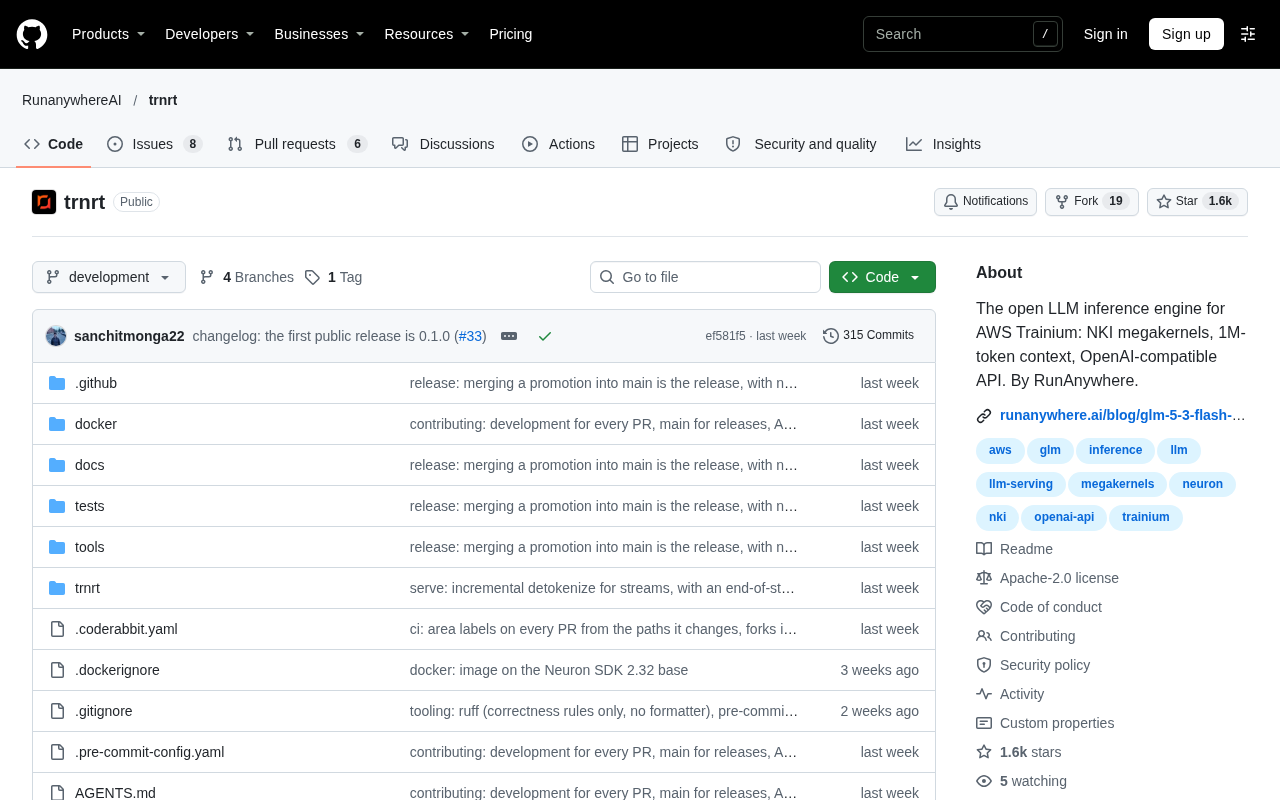
Open-source project TrnRT provides an LLM inference engine for AWS Trainium chips, filling the non-GPU inference gap.
TrnRT is an open-source project unveiled on Hacker News that aims to bring LLM inference to AWS's custom Trainium chips. Because Trainium's architecture differs significantly from GPUs, mainstream frameworks such as vLLM and TensorRT-LLM cannot be directly ported. TrnRT is positioned as an inference runtime for this chip, handling model loading, KV Cache management, and batch scheduling. Its open-source form makes it easy for users to review the implementation and customize it for their own models, and for teams already using Trainium for training on AWS it can reduce cross-platform migration costs. However, the project is still early-stage with limited community discussion, and its model support, compatibility with the Neuron SDK, and throughput performance all remain to be verified; testing on non-critical workloads is recommended first.
AWS Trainium is Amazon's custom AI training chip, previously primarily aimed at model training scenarios. An open-source project called TrnRT has appeared on Hacker News, attempting to fill in the other half of the puzzle: enabling LLM inference to also run on Trainium.
Why Trainium Needs a Dedicated Inference Engine
Trainium's architecture differs significantly from GPUs, and existing inference frameworks (such as vLLM and TensorRT-LLM) are primarily built around NVIDIA's GPU ecosystem and cannot be directly ported. TrnRT's positioning is as an inference runtime layer for Trainium, connecting components such as model loading, KV Cache management, and batch scheduling to the underlying chip capabilities.
Being open source means users can review the implementation themselves and customize it for their own models. For teams already using Trainium for training on AWS and hoping to keep training and inference within the same hardware ecosystem, tools like this can reduce the cost of cross-platform migration.
AWS Trainium is Amazon's custom-purpose accelerator that uses the Neuron instruction set architecture (similar to GPU SIMD units but customized for tensor operations) and relies on the Neuron SDK for compilation and scheduling. Unlike the CUDA ecosystem, where operator libraries, communication libraries, and inference frameworks are deeply coupled, Trainium's software stack is relatively closed, and kernels from mainstream frameworks cannot be directly reused. This means inference engines need to redesign KV Cache layouts and batching strategies for its memory hierarchy (such as high-bandwidth on-chip caches) and collective communication primitives, which is the fundamental reason projects like TrnRT exist.
Open-Source Approach and Ecosystem Significance
According to the project announcement on Hacker News, TrnRT is provided as open source. Compared with closed-source inference services, the value of an open-source inference engine lies in observability and modifiability—teams can identify at which layer performance bottlenecks occur and can adapt it for specific model structures.
However, the project is still at an early stage, and community discussion is limited. The Trainium inference ecosystem itself is still taking shape, and whether TrnRT can build a sufficient contributor base depends on the openness of AWS's official toolchain and users' actual demand for non-GPU inference paths.
The AWS Neuron SDK is the official entry point for accessing Trainium, including the compiler (neuron-cc), runtime libraries, and frontend support such as PyTorch/XLA. Third-party inference engines that want to interface with Trainium usually need to call Neuron's runtime APIs or compile computation graphs through the XLA backend. How TrnRT is compatible with the Neuron SDK (whether it directly calls the low-level runtime or goes through the compilation path) will significantly affect its supported operator coverage and performance ceiling, and this is also one of the key indicators for evaluating the project's maturity.
Several Issues Worth Watching
For potential users, the key things to confirm include: which model architectures are supported, how it is compatible with the AWS Neuron SDK, and batching and throughput performance. This information will directly determine whether TrnRT is an experimental project or a production-ready solution. The attention the project has received on HN is not yet sufficient to generate adequate usage feedback, so teams with needs are advised to validate it first on non-critical workloads.
The performance of LLM inference engines is typically measured by several core metrics: time to first token (TTFT), time per output token (TPOT), throughput (tokens/s), and GPU memory/off-chip memory usage. For non-GPU hardware like Trainium, it is also important to examine whether its batching scheduler supports continuous batching and PagedAttention-style KV Cache management, as these mechanisms directly determine resource utilization in high-concurrency scenarios. The above metrics are not yet clear in TrnRT's early documentation, so users are advised to rely on actual measurements.
Related articles

The Road to Orbit: How Launch Megastructures Will End the Rocket Era
From mass drivers and skyhooks to launch loops and orbital rings, SFIA's long-form video maps the launch megastructure spectrum and shows how traffic volume drives technology choice.

Gordon Ramsay vs. the Michelin Father-Son Duo: A Galician Culinary Quest
Gordon Ramsay heads to Galicia, Spain, for a culinary showdown with two-Michelin-star chef Pepe Vieira. From Coast of Death goose barnacles to traditional stone-oven bread, explore Galicia's unique food culture and ingredient stories.

The 15-Year Programmer Who's Been Unemployed for Two Years: The Tech Worker's Dilemma in the AI Era
A US senior software engineer with 15 years of experience has been unemployed for two years, exhausted his savings, and sought help on Hacker News. This article analyzes the structural causes of long-term unemployment among tech workers, strategies for addressing resume gaps, and the redefinition of experience value in the AI era.