Troopr AI Scrum Master: Auto-Generating Standup Reports from Jira/GitHub Data

Troopr AI Scrum Master auto-generates standup reports from Jira, GitHub, and Slack work data.
Troopr AI Scrum Master automatically reads team members' activity data from Jira, GitHub, and Slack to generate daily standup reports, eliminating verbal recall and information distortion. It flags inconsistencies between reported progress and actual data, and continuously learns team collaboration patterns to become more accurate over time. The article also explores important considerations around privacy, micromanagement risks, and the limitations of equating data trails with work value.
When Standups Meet AI: What Problem Is Troopr Trying to Solve
The Daily Standup is practically standard for every agile team, yet it's often criticized as a breeding ground for empty formalities: team members take turns recounting what they did yesterday, what they'll do today, and what's blocking them. The result is often superficial verbal reporting that wastes time and fails to capture real progress.
Standups originated from the Scrum framework, one of the most iconic ceremonies in putting the Agile Manifesto into practice. Scrum was formally introduced by Jeff Sutherland and Ken Schwaber in the 1990s, with the core philosophy of addressing requirement uncertainty through short iterations (Sprints), frequent inspection, and adaptation. Standups were originally designed as a synchronization mechanism time-boxed to 15 minutes or less, aimed at helping team members quickly align on progress and surface blockers—not deliver detailed work reports. In practice, however, many teams have degraded standups into status reporting sessions for managers, betraying the original intent of "team self-organization and coordination."
Troopr AI Scrum Master, which recently appeared on Product Hunt, aims to fundamentally change this process. Its core proposition is refreshingly direct—instead of having people write standup reports, let AI automatically generate them from actual work artifacts. The product received 93 upvotes on its launch day, ranking #8, and is categorized under Productivity, Developer Tools, and Artificial Intelligence.
From "People Reporting" to "Data Speaking"
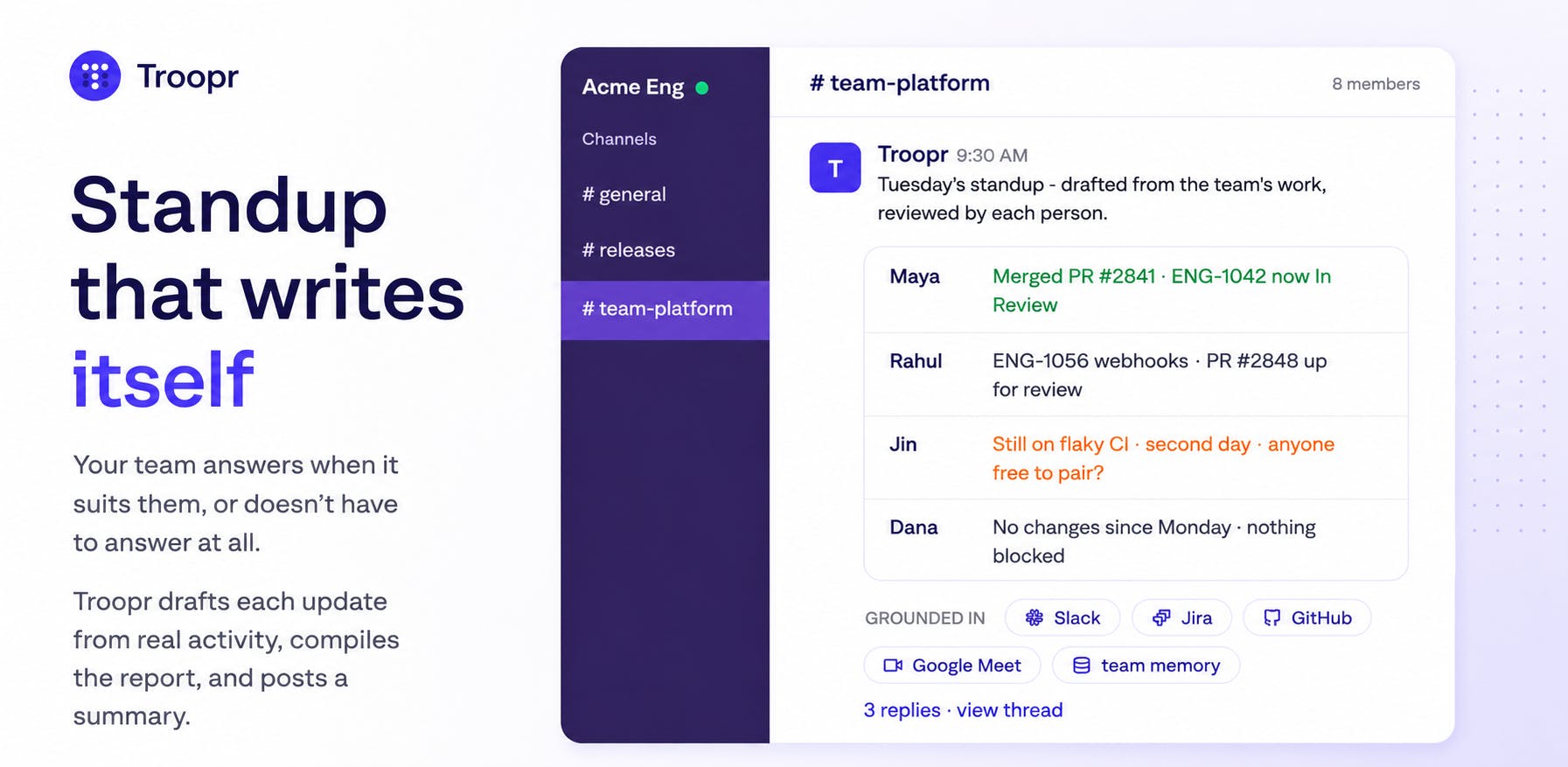
Troopr's operating logic works like this: it joins the team's standup workflow and automatically reads each person's actual activity records across Jira, GitHub, and Slack, then generates that day's progress update for each member. In other words, your code commits, issue transitions, task status changes, and chat discussions become the raw material for reports—no longer relying on members' verbal recall.
This combination of three tools isn't arbitrary. Jira is Atlassian's project management tool supporting Scrum and Kanban boards, used by over 100,000 companies worldwide to manage requirements, defects, and Sprint cycles. GitHub is the world's largest code hosting platform with over 100 million developers, where Pull Requests, Issues, and Commit records form the core code collaboration workflow. Slack is an enterprise instant messaging tool whose channel-based communication model naturally preserves work discussions in text form. Together, these three tools cover virtually the entire chain of a development team's workflow—from requirement definition to code implementation to communication coordination—making them the ideal data aggregation sources for Troopr.
This design addresses two pain points of traditional standups: first, information distortion—people tend to omit or embellish during verbal reporting; second, time cost—organizing report content itself is a burden for everyone. When AI pulls facts directly from the toolchain, both objectivity and efficiency of reporting improve.
Troopr's Three Key Capabilities
1. Cross-Tool Work Artifact Aggregation
Modern development teams have their work scattered across multiple platforms: requirement management in Jira, code in GitHub, communication in Slack. No single tool can reflect a person's complete work picture. Troopr's value lies in integrating these fragmented signals into a coherent progress narrative.
For Scrum Masters or project managers, this means gaining an overall team status view without switching between platforms one by one.
2. Automatic Anomaly Flagging (Flags What Doesn't Add Up)
This is where Troopr goes a step beyond ordinary reporting tools. It doesn't just generate reports—it also flags inconsistencies. For example, a task marked as "in progress" on Jira with zero corresponding commit records on GitHub, or work someone verbally claims to have completed but with no supporting evidence in the actual data.
This "fact-checking" capability essentially provides managers with a layer of risk alerting. It elevates standups from pure information broadcasting to a lightweight progress audit mechanism.
3. Continuous Accumulation of Team Memory
Troopr emphasizes that it "remembers your team," building a memory model of how the team works. The official claim is: every standup makes it more accurate.
Behind this is an incremental learning approach—in the machine learning domain, this corresponds to the Incremental Learning or Online Learning paradigm, where the model isn't trained once and done, but continuously updates its parameters as new data flows in. In team collaboration scenarios, this means the AI needs to establish work rhythm baselines for each member (e.g., someone typically commits 3-5 times per day, enters testing phase in the latter half of a Sprint), identify team-level collaboration patterns (e.g., front-end and back-end integration typically begins on day three of a Sprint), and use these to determine what's "normal" versus "abnormal."
This capability is similar to dynamic baseline detection in APM (Application Performance Monitoring) tools, but the subject shifts from system metrics to human work behavior. By continuously observing team members' work patterns, task rhythms, and collaboration habits, the AI gradually understands what "normal" looks like, enabling more precise judgments about whether progress meets expectations and whether anomalies warrant attention. This personalized team context is a moat that generic AI tools find difficult to replicate.
Questions Worth Considering
Efficiency Gains vs. Privacy Boundaries
Troopr's power comes precisely from its deep reading of work data, but this naturally creates tension around privacy and trust. When AI continuously monitors everyone's commit records, task statuses, and even chat content, will team members feel excessively surveilled? Does this "transparency" enhance collaboration efficiency, or does it effectively reinforce micromanagement?
Micromanagement is a widely criticized management style in organizational theory, referring to managers who obsess over every detail of subordinates' work and frequently intervene in execution. Research by Harvard Business School's Teresa Amabile shows that micromanagement significantly reduces employees' intrinsic motivation and creativity. In software engineering, this issue is particularly sensitive—knowledge workers' output is highly dependent on autonomy and psychological safety. When AI tools can track each person's code commit frequency and task flow speed in real-time, they objectively provide an unprecedented data foundation for micromanagement. The tool itself is neutral, but how organizations use this data—for team self-improvement or for performance evaluation—will determine its impact on team culture.
For teams adopting such tools, finding the balance between automated auditing and employee autonomy will be an organizational culture challenge that cannot be avoided during implementation.
Data Doesn't Equal the Whole Truth
While Troopr's selling point is "generating reports from real work," it's important to note that work artifacts don't fully equate to work value. Many valuable contributions—such as architecture discussions, code reviews, and helping colleagues debug issues—don't always leave clear records in Jira or GitHub. If teams over-rely on data-driven reporting, they may actually overlook soft contributions that are difficult to quantify.
Here it's worth introducing Goodhart's Law, famous in management and economics: "When a measure becomes a target, it ceases to be a good measure." If team members realize that AI evaluates their work progress based on GitHub commit counts and Jira status changes, they may tend to increase commit frequency (e.g., splitting one complete commit into multiple small ones) or frequently update task statuses to "feed" the system. This behavioral distortion has been repeatedly validated in KPI-driven management systems. Therefore, mature teams need to be clear: data-driven reporting is a communication tool, not an evaluation tool—avoid directly linking AI-generated progress reports to performance reviews.
As such, Troopr is better positioned as a supplementary tool for standups, rather than a complete replacement for human judgment.
Conclusion: AI Is Reshaping Team Collaboration Processes
Troopr AI Scrum Master represents a clear trend—AI is moving beyond single-point content generation toward understanding and automating entire workflows. It transforms the most routine and easily formalized ceremony in agile development—the standup—into a system driven by real data and capable of continuous learning.
For development teams plagued by standup inefficiency, tools like this are undoubtedly appealing. But their ultimate value still depends on whether teams can find the right balance between automation convenience and human initiative, between transparency and privacy boundaries. AI can write excellent standup reports, but how to make good use of those reports remains a human challenge.
Related articles

How AI Data Centers Are Reshaping Electricity Pricing: Cost Allocation and Energy Market Transformation
Surging AI data center power demand is reshaping electricity pricing. This article analyzes grid impacts, three pricing pathways, and implications for consumer bills and energy transition.

Chiplab: AI Tests Firmware on Virtual Chips Without Physical Development Boards
Chiplab enables AI coding assistants to compile, run, and debug embedded firmware on high-fidelity virtual chips via MCP protocol, supporting STM32 and Nordic platforms without physical hardware.

Muse Glimmer Local Testing: Meta's Open-Source 30B Multimodal Model Runs on a Single GPU
Meta releases Muse Glimmer, a 30B open-source multimodal model running on a single 24GB GPU. Tested at 233 tokens/sec with speculative decoding on RTX 5090, Apache 2.0 licensed with GGUF support.