Trump Gives AI Data Centers a Pass to Pollute — Former EPA Officials Warn of Health Risks
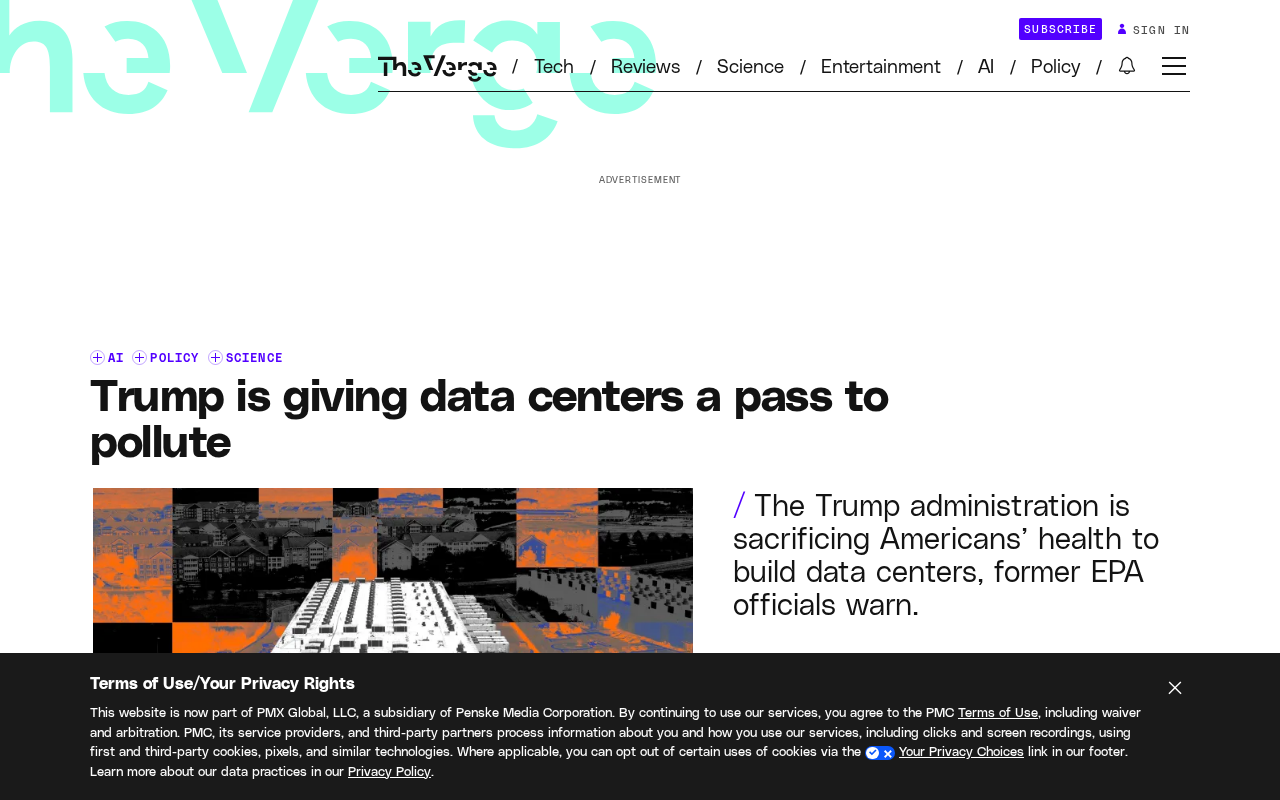
Former EPA officials warn Trump's deregulation push for AI data centers threatens public health near these facilities.
As AI data center construction accelerates, the Trump administration has been relaxing environmental standards on air and water pollution in the name of boosting compute capacity. A group of former EPA officials released a report this week warning of health risks to communities near these facilities, and proposed a "Data Center Health Protection" framework as an alternative — while acknowledging the appeal may be futile given the current political climate. The core conflict: data centers' massive energy demands rely on fossil fuel power generation, emitting NOx and PM2.5; their cooling systems also consume vast amounts of water. The fact that it's former, not current, officials raising these concerns itself reveals the structural resistance to reform within today's regulatory environment.
The Collision Between AI Data Center Expansion and Environmental Regulation
As the AI industry enters a phase of explosive growth, the speed of data center construction has become a key battleground for tech giants. But this compute arms race is generating intense conflict with environmental protection. According to a group of former U.S. Environmental Protection Agency (EPA) officials who spoke at a briefing and released a new report this week, the Trump administration is weakening environmental regulations under the banner of accelerating AI data center construction — posing potential health risks to the American public.
The core concern among these officials is that a series of environmental standards designed to control air and water pollution are being loosened or bypassed to clear the way for rapid data center deployment. Data centers are far from the harmless "cloud" they're often imagined to be — behind them lie enormous energy demands and supporting power generation infrastructure, which typically means significantly more pollutant emissions.
Former EPA Officials' Appeal and the Reality They Face
This group of former EPA officials is urging the president to adopt a framework called "Data Center Health Protection," which would establish a baseline for protecting the health of nearby residents while still advancing AI infrastructure development. The report itself acknowledges, however, that this appeal may be "futile" in the current political climate.
This sense of powerlessness reflects a deeper policy tension: on one hand, AI is seen as a strategic priority for national competitiveness, giving the government strong incentive to accelerate project approvals by streamlining reviews and relaxing oversight; on the other hand, data centers are often sited near communities, and their energy consumption and emissions have real public health implications for local air quality and water resources.
Why Data Centers Have Become a Pollution Concern
Understanding this controversy requires looking at the energy economics of data centers. The power demands of large-scale AI training and inference clusters are staggering. To meet them, operators and grid managers may restart or extend the operational lifespan of fossil fuel power plants that were slated for retirement — meaning more nitrogen oxides, particulate matter, and other pollutants entering the atmosphere.
In addition, data center cooling systems consume enormous quantities of water, potentially worsening water scarcity in certain regions. When environmental review processes are compressed and emissions standards are relaxed, these externalized costs may ultimately be borne by residents living near data centers — paid in health consequences. The former EPA officials' report is an attempt to bring these "hidden costs" back into the public conversation.
The Hard Balance Between Industrial Development and Public Health
At its core, this debate is about the trade-off between speed and safety. Those who favor deregulation argue that cumbersome environmental approvals will slow America's lead in AI; environmental advocates counter that the short-term speed gains achieved by sacrificing air and water quality may generate long-term social and healthcare costs.
Notably, it is former EPA officials — not current regulators — who are speaking out. That detail alone speaks to the structural resistance within the current government framework when it comes to pushing for stricter environmental standards for data centers. Whether the proposed "Data Center Health Protection" framework can actually be implemented depends far more on political will than on technical feasibility.
For practitioners and the public who care about the sustainable development of the AI industry, this episode serves as an important reminder: the growth of compute does not come without cost. The "greening" of data centers should not be mere marketing language — it requires substantive regulatory frameworks and genuine technological investment to back it up. How to hold the line on environmental and public health standards without stifling innovation will remain an unavoidable challenge in AI infrastructure development.
Related articles
Anthropic CEO Calls for Hitting the Brakes on AI Development: A Three-Step 'Pace the Frontier' Plan
Anthropic CEO Dario Amodei calls for slowing AI development with a three-step 'pace the frontier' plan, including opening model access to third-party evaluators like METR.

Insufficient Source Material: Unable to Generate Article on Sylvan Esso
The source material provided covers music duo Sylvan Esso — unrelated to AI/tech and incomplete. No viable article could be produced; publication not recommended.
"LLMs Are Real, AI Is Fake": A Debate Worth Having
Hacker News post 'LLMs are real, AI is fake' sparks debate: why LLMs are concrete and verifiable while 'AI' is often marketing hype. What this means for practitioners.