Trump's Gamble on Jensen Huang's Comeback: The Risky Bet Behind Nvidia's CEO Turmoil
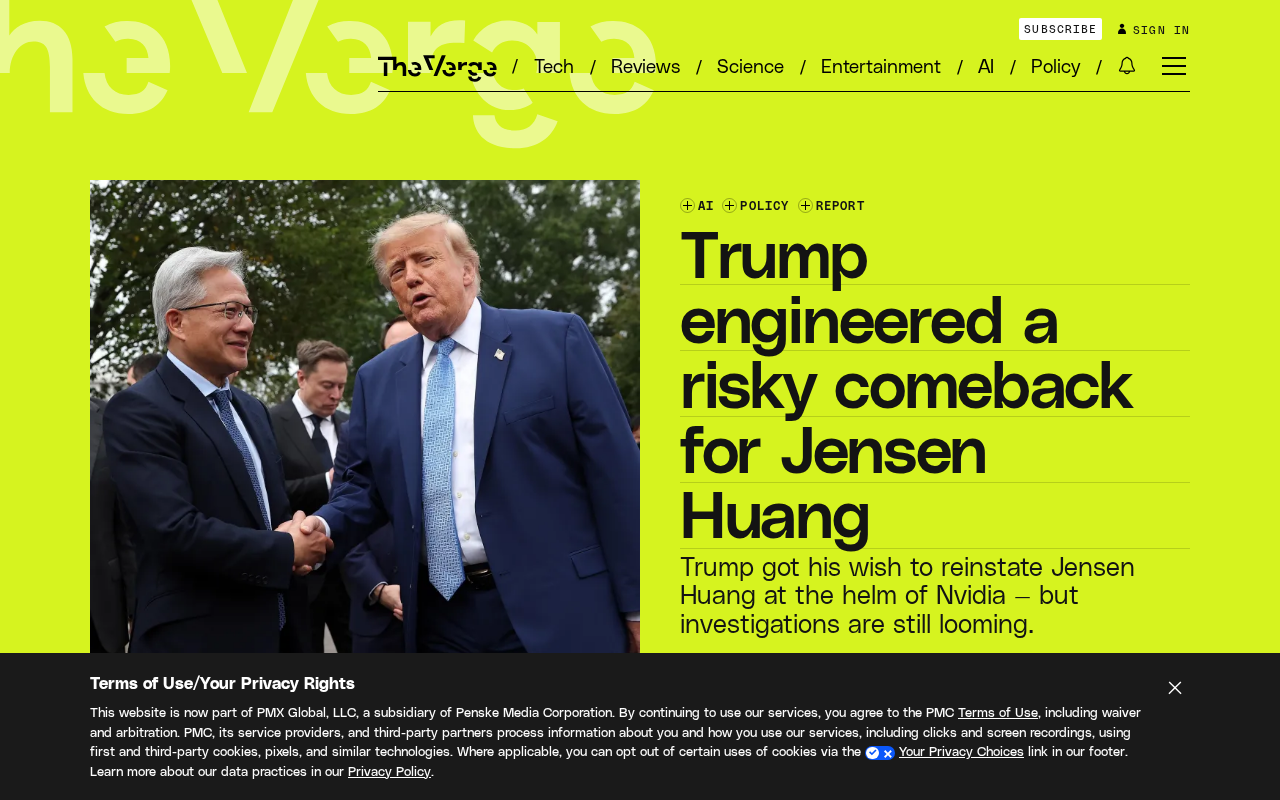
Trump publicly predicts Jensen Huang's return after the Nvidia CEO resigned over spy rumors, exposing a risky blend of politics and business.
Nvidia's board accepted Jensen Huang's resignation as CEO after reports of an affair and Chinese spy rumors. Trump then predicted on radio that Huang would "get back on his feet," which the report frames as risky comeback engineering. The article examines three risk areas: the rumor investigation, the board's stance, and the political-business boundary. As a core AI chip supplier, Nvidia's CEO change affects supply chains and market confidence. Huang is tightly bound to the brand; a return may restore his position, but rebuilding trust remains hard. Trump's endorsement paves the way but may be seen as political interference in governance.
Title
Trump's Gamble on Jensen Huang's Comeback: The Risky Bet Behind Nvidia's CEO Turmoil
Meta Description
After Nvidia's board accepted Jensen Huang's resignation as CEO, Trump predicted on a radio show that he would get back on his feet. This article analyzes the CEO crisis sparked by rumors, the political risks of Trump's endorsement, and what to watch in Nvidia's governance and trust rebuilding.
Article Content
Just as Nvidia's board accepted Jensen Huang's resignation as CEO, Trump offered a telling assessment on Stephen A. Smith's radio show: Huang would "get back on his feet." That seemingly casual remark actually set the stage for a comeback fraught with political and commercial risk.
A CEO Resignation Ignited by Rumors
According to the original report, Nvidia's board accepted Huang's resignation as CEO only after reports emerged alleging an extramarital affair with a woman described as a Chinese spy. The chain of events is sensitive enough on its own: one of the world's most valuable chip companies and a core supplier of AI compute saw its leader depart amid rumors with national security implications—and the shockwaves won't stay confined to corporate governance.
The report did not disclose further details about the rumors or explain the board's specific investigative process. What is confirmed is that the resignation came after the reports, and the board acted with considerable speed. That speed suggests the urgency of the situation went well beyond a routine personnel change.
Nvidia's corporate governance follows a CEO-responsibility system under board leadership. The board typically comprises independent and internal directors responsible for overseeing management, approving major strategies, and making personnel decisions. In cases where a CEO resigns amid rumors, the board must often weigh legal risk, shareholder interests, and company reputation. Accepting the resignation and initiating a transition process may indicate the board believed the incident posed a material threat to operations or reputation. However, accepting a resignation does not equal permanent removal—the board retains the right to reappoint once investigations clarify the facts. This governance mechanism provides procedural room for Huang's potential return, but also requires the board to carefully handle conflicts of interest and disclosure obligations to avoid shareholder litigation risk.
Trump's Public Endorsement and the "Comeback" Signal
Trump's remarks on the radio show deserve close reading. He did not condemn Huang or demand that Nvidia cut ties; instead, he predicted the other party would "get back on his feet." In a context where politicians usually keep their distance from business scandals, such a statement looks more like paving the way for a return in advance than simple personal consolation.
The report uses "engineered a risky comeback" to describe Trump's role, suggesting the return is not happening naturally but has been shaped and designed through political intervention. The risk: if the rumors are confirmed or escalate further, both the endorser and the returning executive will suffer reputational blowback; if the rumors cannot be substantiated, a swift return could be interpreted as political interference in corporate governance.
Why Nvidia's CEO Transition Matters Globally
Nvidia's position in AI chips means this is not merely an internal company matter. From training large models to inference deployment, a vast amount of AI infrastructure runs on Nvidia's hardware and software stack. Uncertainty at the CEO level directly affects supply chain expectations, customer confidence, and capital market pricing logic.
Huang's personal identity is tightly bound to the Nvidia brand—a rarity in the tech industry. His departure creates a narrative void of "Nvidia without Jensen Huang," while a return would reinforce the impression of irreplaceability. Trump's statement is, to some extent, a public confirmation of that irreplaceability.
Nvidia's core position in AI chips hinges on its CUDA parallel computing platform. CUDA allows developers to use GPUs for general-purpose computing, and after more than a decade of accumulation, it has formed a massive software ecosystem and developer community. Most mainstream deep learning frameworks (such as TensorFlow and PyTorch) rely heavily on CUDA optimization, making Nvidia's hardware and software stack highly coupled. Therefore, CEO-level changes not only affect the company's strategic direction but may also impact long-term maintenance commitments to the CUDA ecosystem, developer confidence, and customer technology choices. On the supply chain side, Nvidia's GPU products depend on TSMC's advanced processes; a CEO transition could affect long-term capacity planning negotiations with foundries, which in turn feeds into the stability of global AI compute supply.
Three Things to Watch in This Risky Bet
First, where the rumors lead. The original report only mentioned allegations of an "alleged Chinese spy" without providing evidence-level information. What happens next depends on whether relevant investigations or judicial proceedings are initiated.
Second, the board's stance. Accepting a resignation is one action; permitting a return is another. The board needs to find a balance between governance procedures and external pressure—and that balance is not entirely determined by Trump's endorsement.
Third, the boundary between politics and business. Trump's intervention came through media statements rather than administrative means, which preserves room for maneuver but makes it hard to strip the political coloring from the event. For a chip company dependent on global markets, that coloring is itself a risk.
After the Comeback, How to Rebuild Trust
Even if Huang does return as Trump predicted, the problems he faces won't automatically disappear. The report depicts a moment when trust was punctured by rumors: the board accepted a resignation, the market digested the news, and the public formed certain impressions. A return can restore a position, but not necessarily the narrative.
For Nvidia, the real test is whether it can isolate the incident from company operations and keep customers and partners focused on the product roadmap. For Trump, if this maneuver succeeds, it will become a case study of political influence penetrating business decisions; if it fails, it will be a high-profile miscalculation. The report's characterization of "risky" is apt.
One-line Summary
After Nvidia CEO Jensen Huang resigned amid spy rumors, Trump publicly predicted his return, revealing a risky bet where politics and business intertwine.
Paragraph Summary
Nvidia's board accepted Jensen Huang's resignation as CEO following reports of an extramarital affair and Chinese spy rumors. Trump then predicted on a radio show that Huang would "get back on his feet," and the report framed this as risky comeback engineering. The article analyzes three layers of risk: where the rumor investigation leads, the board's stance, and the boundary between politics and business. As a core AI chip supplier, Nvidia's CEO change affects supply chains and market confidence; Huang is tightly bound to the brand, and while a return could restore his position, rebuilding trust remains difficult. Trump's endorsement paves the way for a return but could also be read as political interference in corporate governance.
Related articles

Jensen Huang Returns to Nvidia: The Power Game Behind an "Aggro Reset"
Nvidia's board reappointed Jensen Huang as CEO less than two weeks after his scandal-driven resignation. This analysis explores the board's decision-making, Trump's political intervention, media power failure, and market reaction behind the dramatic return.

Why Voice AI Can't Understand Kenyans' Everyday Conversations
Swahili speech recognition hits 3.24% error on read text, but everyday Kenyan speech mixes English, Sheng slang, and accents—leaving mainstream voice AI struggling.

Data Centers Build Their Own Natural Gas Plants: AI Compute's Breakout Around a Decade-Long Grid Wait
Grid interconnection approvals can take a decade, so xAI and others are building off-grid natural gas plants to power AI clusters. This article analyzes the drivers, costs, and impact of behind-the-meter generation on AI infrastructure.