Trump Signs Executive Order: US Government to Replace 'Artificial Intelligence' with 'Super Intelligence'

Trump's executive order mandates US government replace 'AI' with 'Super Intelligence,' sparking terminology and discourse debates.
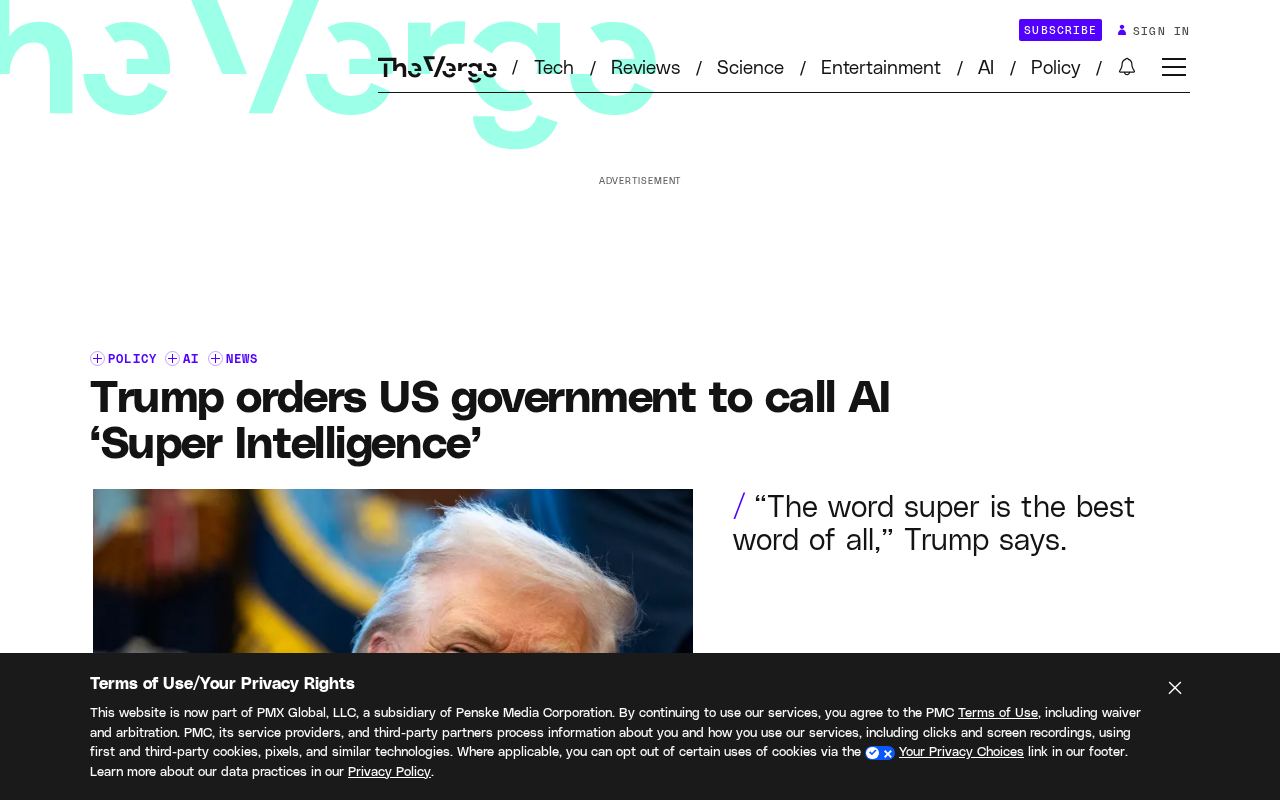
President Trump signed an executive order requiring official policy documents and press releases to replace "artificial intelligence" with "Super Intelligence," citing "super" as "the best and simplest word." In technical terms, the two are not synonymous: AI broadly covers all current technologies, while superintelligence refers to a hypothetical system surpassing human cognition — a stage beyond AGI that remains unrealized. The order represents clear conceptual inflation that may cause the public to overestimate current AI capabilities, with downstream effects on regulation, investment, and public discourse. It also stands as a prime example of political language intervening in technical terminology, underscoring that a technology's public image is as much shaped by those who name it as by the technology itself.
An Executive Order That Rewrites the Terminology
The U.S. executive branch has officially stopped using the term "artificial intelligence." Under a new executive order signed by President Trump, official policy websites, policy documents, and press releases will henceforth use the term "Super Intelligence" as the standard designation.
What appears to be a simple word swap actually reflects a subtle relationship between political discourse and technical concepts. Trump's own explanation was characteristically blunt: "'Super' is the best word, and it's the simplest."
The Conceptual Gap Between "Super Intelligence" and "Artificial Intelligence"
In technical contexts, "artificial intelligence" (AI) and "superintelligence" are not interchangeable synonyms. The former is a broad field concept encompassing everything from simple machine learning models to complex large language models. The latter refers specifically to a hypothetical system that comprehensively surpasses human intelligence across virtually all cognitive tasks — typically regarded as a stage beyond artificial general intelligence (AGI).
Applying the label "Super Intelligence" to existing AI technologies represents a clear case of conceptual inflation. Current AI systems — whether chatbots or image generation tools — fall far short of the capabilities described by "superintelligence." This kind of naming risks creating confusion in public perception and is likely to draw criticism from academia and industry alike.
Artificial General Intelligence (AGI) is the key intermediate concept for understanding this terminological hierarchy. AGI refers to a system capable of performing any intellectual task across domains at a human level — something that has not yet been achieved, and whose very definition remains contested in academic circles. The concept of "superintelligence" was systematically articulated by philosopher Nick Bostrom in his 2014 book Superintelligence: Paths, Dangers, Strategies, referring to a form of intelligence that surpasses the best human minds in speed, quality, and creativity across the board. The widely accepted academic progression — current AI (e.g., GPT series, image generation models) → AGI → superintelligence — represents a ladder of fundamentally distinct capability levels, not a matter of simple renaming.
Political Discourse Intervening in Technical Terminology
The significance of this executive order goes beyond mere word preference. When a government uses an executive directive to prescribe technical terminology in official documents, it is effectively deploying political power to reshape the public's conceptual framework for understanding a technology.
Terminology shapes the direction of policy discussions. "Artificial intelligence" is a relatively neutral term widely accepted in academia and industry, while "superintelligence" carries a stronger sense of proclamation and futurism. Mandating the latter in official contexts may amplify expectations about technological capabilities, potentially triggering cascading effects in regulation, investment, and public opinion.
This is not an isolated case of political forces intervening in technical naming. Historically, both the U.S. and the Soviet Union carefully crafted their space program narratives during the "Space Race" to serve national storytelling rather than purely scientific description. In the AI domain, the very popularity of the "AI arms race" metaphor has long embedded geopolitical logic into technical discourse. In the current context of U.S.-China AI competition, a term like "Super Intelligence" — with its connotations of overwhelming dominance — carries additional declarative value in political communication. It implies that the United States is pursuing and leading the most advanced form of intelligent technology, rather than merely competing in the broad race called "artificial intelligence." The politicization of terminology is often a component of how major powers construct narratives in the tech competition arena.
Potential Impact on Industry and Public Perception
For the AI industry, a shift in official terminology may not immediately alter the actual trajectory of technical research and development, but it will affect the tone of policy communication. Companies engaging with the government, participating in public programs, or applying for related resources may need to align their language with official usage.
For ordinary members of the public, the terminological change is more likely to produce cognitive distortion. When "Super Intelligence" appears repeatedly in official documents, people are prone to overestimate the actual capabilities of current AI technologies — leading to unrealistic judgments about technological risks, employment disruption, or social transformation. Precision in language used for communicating about technology is itself part of responsible technology governance.
A Signal Worth Watching
Regardless of its ultimate effect, this executive order is a textbook example of the intersection between political and technological narratives. It reminds us that a technology's public image is shaped not only by the technology itself, but also by how institutions with narrative power choose to name and describe it.
Given the limited publicly available information at this stage, the specific scope of enforcement, effective date, and formal responses from industry still await further disclosure. The continued development of this issue is well worth monitoring by the tech community, policy researchers, and the public alike.
Related articles

Why Does the Tesla Roadster Need to Fly? A Deep Dive into Musk's Wild Demo
Tesla's Roadster launch showed wall-climbing, upside-down driving, and flying stunts—but The Vergecast notes the demo car may lack a battery, the Rocket version is invite-only and not street-legal, and the website terms don't guarantee delivery. After nine years of delays, why does this car still need to exist?

AI Is Not a Replacement: Human-AI Collaboration Through the Lens of Factory Root Cause Analysis
Starting from factory root cause analysis, this article explains how AI accelerates evidence chain construction rather than replacing human experts, exploring the pragmatic implementation logic and business value of 'AI supporting people rather than replacing them.'

AI Agent Decision Auditing: Building an Evidence Chain in Regulated Workflows
Starting from a Reddit discussion, this article analyzes three core issues in AI agent decision auditing within regulated workflows: what fields audit records should contain, how to handle feedback latency for erroneous decisions, and how to continuously calibrate LLM judge consistency with human judgment.