Tulu: Autonomous Marketing Operations and Attribution Analytics for SMBs
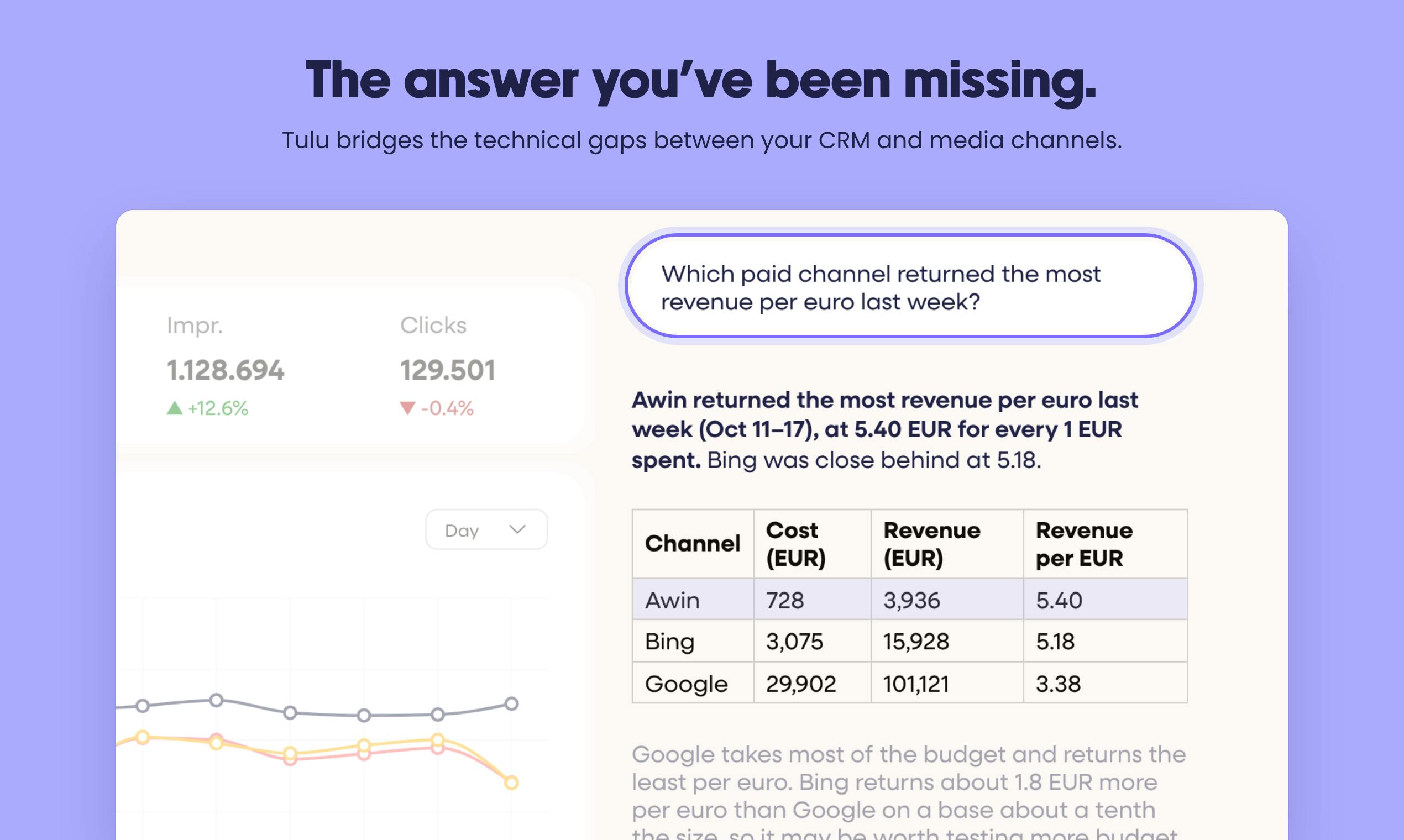
Tulu uses AI to automate UTM management and attribution analysis, helping SMBs say goodbye to manual marketing operations.
Tulu is an autonomous marketing operations and attribution analytics tool for SMBs that uses AI to automate UTM parameter management, data organization, and attribution analysis, delivering actionable marketing conclusions without manual work. Core features include linking spend to revenue, WhatsApp alerts, offline spend integration, and shared team views. It received 95 votes and 19 comments on Product Hunt, ranking #7 for the day. Its differentiation lies in shifting attribution tools from analytics dashboards to operations assistants, though attribution model details and pricing remain unclear.
In the reality where SMB marketing teams are generally short-staffed and budget-constrained, "manually managing UTM parameters and pulling spreadsheets" remains a daily routine. Tulu, a new product ranked #7 on Product Hunt, aims to use AI-driven autonomous marketing operations and attribution analytics to hand these tedious tasks over to the system.
From Manual Operations to "Autonomous Operations": Product Positioning
Tulu's positioning is clear: to provide SMBs with autonomous marketing operations and analytics capabilities. The official tagline bluntly declares "say goodbye to manual work"—businesses no longer need to wrestle with UTM parameters, spreadsheets, or other miscellaneous tasks to get the answers they need.
The value of this angle lies in the fact that marketing attribution has long been a weak spot for small and medium-sized businesses. Large enterprises have dedicated marketing analytics teams and paid tools, while SMBs often have a handful of people juggling ad placements, content, and data organization. Attribution analysis either gets simplified to "looking at platform backend data" or is simply abandoned. Tulu hopes to productize this capability.
UTM parameters are query strings appended to the end of a URL (e.g., ?utm_source=google&utm_medium=cpc&utm_campaign=spring_sale), used to tag traffic source, medium, and campaign name in analytics tools like Google Analytics. Marketers typically need to manually create and manage UTM links for every ad, every email, and every social media post to ensure accurate attribution data. However, manual operations are highly error-prone (such as parameter typos or inconsistent naming), and maintenance costs rise sharply as the number of channels and campaigns grows. Tulu automates UTM management precisely to eliminate this repetitive labor and reduce data distortion caused by human error.
Core Capabilities: The Spend-to-Revenue Chain and WhatsApp Alerts
According to the product description, Tulu's key capabilities are concentrated in several areas:
- Linking spend to revenue: Clearly showing where marketing spend generated revenue, helping judge the actual flow of budget.
- WhatsApp instant alerts: When situations genuinely require human intervention, notifications are pushed directly to WhatsApp instead of making people sit in dashboards staring at numbers.
- Offline spend integration: Supporting the inclusion of offline marketing spend in statistics to avoid fragmentation between online and offline data.
- Shared views and team alignment: Enabling the entire team to have a consistent understanding of marketing performance through shared views.
Combined, these features point toward a "less dashboard, more conclusions" approach. For teams without dedicated data analysts, alert-based interaction is closer to actual work habits than complex report configurations—WhatsApp is also the primary daily communication channel for many SMB teams.
Marketing attribution refers to using data analysis to determine which marketing touchpoints played a role in a user's conversion path, and attributing revenue or conversions to the corresponding channels, campaigns, or keywords. Common attribution models include last-click, first-click, linear attribution, and machine learning-based multi-touch attribution. For small and medium-sized businesses, attribution analysis is often difficult to implement due to scattered data and complex tools. Tulu claims to provide "linking spend to revenue," which essentially simplifies the attribution process—directly connecting ad spend to final revenue to help judge the actual flow of budget. However, the specific attribution model (such as whether it supports multi-touch or considers time decay) has not been disclosed, which affects the credibility of the conclusions.
Differentiation Space in the Attribution Tools Landscape
Marketing attribution itself is not a new category, but products targeting SMBs and emphasizing "autonomous operations" are rare. Many attribution tools on the market have sufficient functional depth, but their learning costs and configuration barriers are high, which ironically keeps SMBs out.
Tulu chooses to automate the front-end dirty work like UTM management and data organization, while condensing outputs into actionable conclusions like "where to increase budget." This product philosophy—leaning from "analytics tool" toward "operations assistant"—is key to its differentiation among similar products. However, it should be noted that the product's currently disclosed information is still primarily feature descriptions; the specific attribution model, the scope of data source integration, and the actual depth of AI's role all remain to be further verified.
Autonomous marketing operations refers to using AI and automation technologies to let systems autonomously execute repetitive marketing tasks (such as UTM management, data organization, and budget adjustment recommendations), rather than merely providing data visualization. Traditional marketing analytics tools (such as Google Analytics and Tableau) require manual report configuration, data interpretation, and action-taking, while "autonomous operations" emphasizes the system proactively providing actionable conclusions (e.g., "this channel should increase budget") or even directly triggering actions. Tulu's positioning is precisely to transform attribution analysis from "a capability requiring specialized learning" into "a question the system answers for you," thereby lowering the barrier for SMBs. However, it remains unclear whether the current product has genuine autonomous decision-making capabilities (such as automatically adjusting budgets) or merely provides recommendations.
Market Feedback and Areas to Watch
On Product Hunt, Tulu received 95 upvotes and 19 comments, ranking #7 for the day. For a vertical tool targeting SMBs, this level of attention indicates that "marketing attribution automation" indeed hits a pain point for some users.
There are also questions worth watching. Offline spend integration involves manual entry and data standardization, and its effectiveness depends on product design details; the value of WhatsApp alerts is highly dependent on the accuracy of alert rules, as excessive false positives would become noise. Additionally, the SMB market is price-sensitive, and whether this type of tool's pricing strategy can match the target audience's willingness to pay will directly affect its growth potential.
For SMB marketing teams currently suffering from UTM and spreadsheets, Tulu offers a direction worth watching: turning attribution from "a capability requiring specialized learning" into "a question the system answers for you." Whether it can deliver on its "autonomous operations" promise ultimately depends on the completeness of data integration and the credibility of its conclusions.
Product Hunt is a platform for launching and discovering new products, where users can upvote and comment on products, with daily rankings by vote count. A high ranking typically indicates that a product has gained some attention among early adopters, but vote counts are influenced by launch timing, community operations, and other factors, and cannot fully represent product maturity or market acceptance. Tulu's 95 votes, 19 comments, and #7 ranking for the day indicate that it has hit a pain point for some users, but as an early signal, it still needs to be evaluated alongside subsequent user retention and paid conversion to assess its true value.
One-line Summary
Tulu uses AI to automate UTM management and attribution analysis, helping SMBs say goodbye to manual marketing operations.
Paragraph Summary
Tulu is an autonomous marketing operations and attribution analytics tool for SMBs, designed to use AI to automate UTM parameter management, data organization, and attribution analysis, enabling businesses to obtain actionable marketing conclusions without manual operations. Its core features include linking marketing spend to revenue, sending key alerts via WhatsApp, integrating offline spend, and sharing views to align teams. The product received 95 votes and 19 comments on Product Hunt, ranking #7 for the day, indicating a certain level of market attention. Its differentiation lies in shifting attribution tools from "analytics dashboards" to "operations assistants," lowering the barrier for SMBs. However, details of the attribution model, the scope of data source integration, and pricing strategy remain unclear, and actual effectiveness remains to be verified.
Related articles

A New Paradigm for Text Editing in Compose: TextFieldState Replaces the Old API
Jetpack Compose introduces the TextFieldState API to fix dropped characters and cursor jumps from async input. The old value/onValueChange callbacks will be deprecated in 1.13. This article covers InputTransformation, OutputTransformation, four state hoisting patterns, and new formatted text editing capabilities.

Remote Compose: A New Document-Driven Paradigm for Cross-Platform UI on Android
Remote Compose transmits compact binary documents instead of screen pixels, enabling efficient UI rendering on remote surfaces like Wear OS and widgets. This article covers its document creation API, expression animations, size optimization techniques, and Wear OS progress.

How Crashlytics Eliminates Android Memory and Responsiveness Issues
Through the Chroma Clip case study, this article explains how Firebase Crashlytics uses Application Exit Info, Profiling Manager, GWP ASAN, and ARM MTE to pinpoint ANRs, OOMs, memory limit terminations, and native memory corruption—solving the challenge of stack traces that don't point to the real culprit.