TurboGPT: A Minimalist Experiment in Training a 22KiB Transformer in 13 Seconds

TurboGPT trains a 22KiB Transformer in 13 seconds — its value is educational transparency, not practical performance.
TurboGPT is an open-source project built around minimalism, claiming to train a Transformer model just 22KiB in size in under 13 seconds. Compared to mainstream models with hundreds of billions of parameters, its parameter count may be just a few thousand — roughly seven to eight orders of magnitude smaller. That scale makes it practically useless for real language tasks, but its true value lies in education and technical validation: the model is small enough to run on a laptop, with Transformer mechanisms like self-attention, positional encoding, and feed-forward networks fully visible and debuggable. The project echoes the community's ongoing interest in minimum viable implementations like nanoGPT, and aligns with edge computing's push for lightweight models. For learners who want to genuinely understand how large models work — rather than just call an API — this kind of "runs and makes sense" implementation offers a uniquely accessible entry point.
When Model Training Goes Minimalist
In an era where training runs routinely consume millions of dollars in compute and models balloon to hundreds of billions of parameters, a project called TurboGPT on Hacker News is heading in exactly the opposite direction. Its pitch is simple and direct: train a Transformer model that's only 22KiB in size, in just 13 seconds.
Posted as a Show HN, the project hasn't attracted massive attention yet (10 points, 1 comment), but it touches on a topic that's gaining increasing traction: the educational and training value of ultra-small-scale models. When the mainstream narrative is always chasing "bigger," some people have started seriously asking, "how small is small enough?"
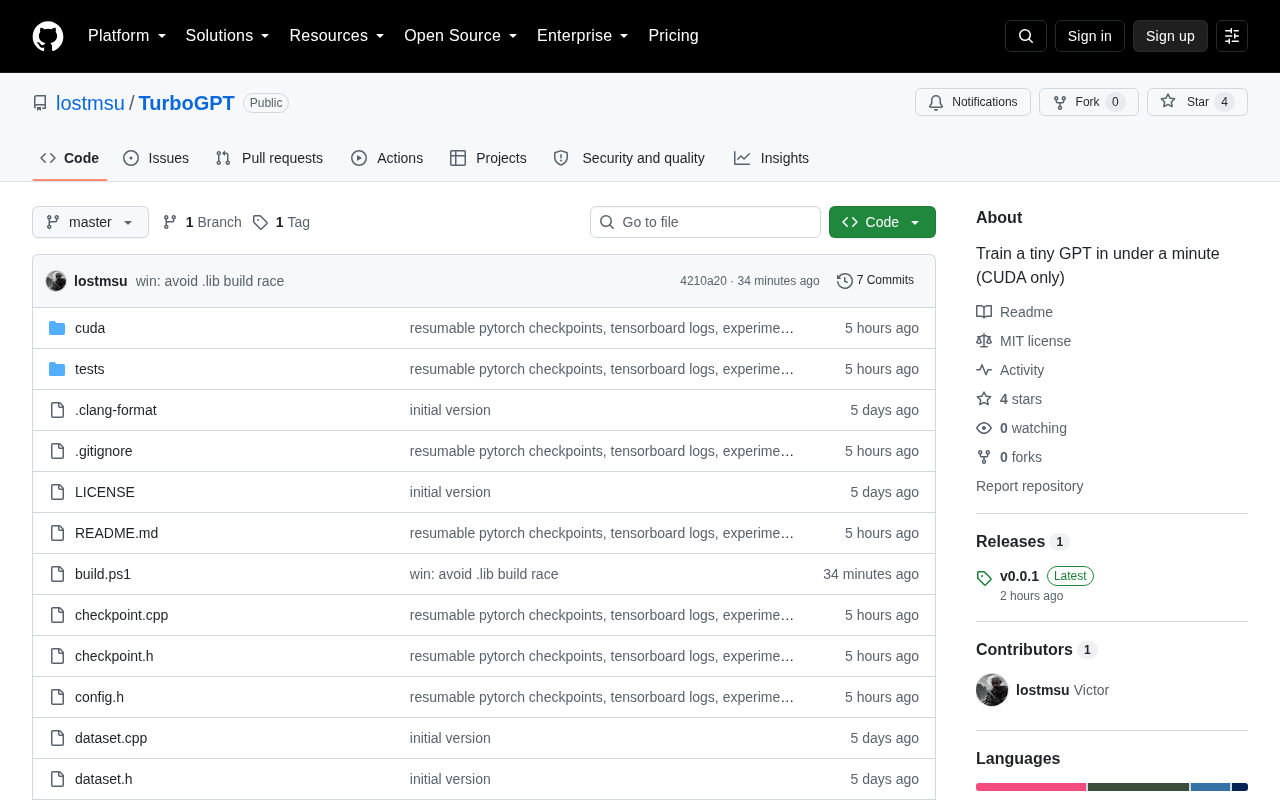
What 22KiB and 13 Seconds Actually Mean
To appreciate TurboGPT's significance, you need to put those two numbers in context.
A 22KiB model is smaller than a typical website favicon. This implies an extremely limited parameter count — possibly just a few thousand to tens of thousands — which is seven or eight orders of magnitude smaller than GPT-3's 175 billion parameters. And a 13-second training time means the entire process can run on an ordinary personal computer, with no GPU required.
This configuration obviously isn't designed to solve real natural language tasks. It's better understood as a minimal, reproducible, observable, and teachable Transformer implementation — one that distills the core mechanisms of the Transformer architecture (self-attention, positional encoding, feed-forward networks) down to a scale that completes in seconds.
Three Dimensions of Value in Minimal Models
From an engineering and educational perspective, projects like this typically offer several advantages:
- Extremely low barrier to entry: Beginners can run, modify, and observe results on their own laptops, with no waiting for long training runs or renting cloud compute.
- Transparency and debuggability: The model is small enough that the behavior of every layer and the effect of every parameter change can be fully tracked — invaluable for understanding the inner workings of Transformers.
- Rapid iteration: A 13-second feedback loop means you can run hundreds of experiments in an afternoon, testing architectural hypotheses at will.
The Transformer architecture was introduced by Vaswani et al. in the 2017 paper Attention Is All You Need. Its core innovation was replacing the then-dominant recurrent neural network (RNN) with a self-attention mechanism, which allows the model to attend to all positions in a sequence simultaneously when processing each token, regardless of distance. Positional encoding injects word-order information into the model, compensating for the fact that attention itself is position-agnostic. The feed-forward network applies a nonlinear transformation to features at each position. Stacked together, these three modules form a single Transformer layer. Modern large language models like the GPT series are essentially dozens to hundreds of these layers chained together and trained on massive text corpora. TurboGPT's value lies precisely in preserving this complete structure with minimal parameters, allowing learners to observe the mechanism in action without needing high-end hardware.
Why "Small" Is Being Taken Seriously Again
TurboGPT is not alone. In recent years, interest in minimum viable implementations has been steadily growing across the community — from Andrej Karpathy's nanoGPT and minGPT to countless "implement a Transformer from scratch" tutorials.
The reasoning isn't hard to follow. Large models are undeniably powerful, but for most developers, they're a black box you can't see into. Micro-projects like TurboGPT offer something different: a dissection specimen. You can see exactly what a Transformer is doing, rather than just calling an API.
This "small and transparent" philosophy also resonates with broader trends in edge computing and on-device AI. When models need to run on resource-constrained hardware, figuring out how to deliver useful functionality in the smallest possible footprint is itself an engineering challenge worth taking seriously.
Andrej Karpathy is a co-founder of OpenAI and one of the most influential figures in deep learning education. His minGPT and nanoGPT projects reproduce the GPT training pipeline in minimal code — nanoGPT can train a Shakespeare-style text generator on a single consumer GPU, with a core implementation of under 300 lines. The popularity of these projects reflects a deep community desire for "understandable AI." When mainstream model training costs tens of millions of dollars, most developers and students never get the chance to experience a full training run. Minimum viable implementations fill that gap: they don't chase state-of-the-art performance; their primary goal is "runs and makes sense," serving as a teaching sandbox for large model fundamentals.
Teaching Tool or Toy?
To be clear-eyed about it: a model that's 22KiB and trained in 13 seconds has essentially zero practical utility. It can't generate coherent long-form text, and it has no meaningful language understanding capability. Judging it as a product would be unfair.
Its real purpose is closer to educational demonstration and technical validation. Projects like this typically present the complete Transformer training pipeline in minimal code, letting readers trace — line by line — how backpropagation, gradient updates, and attention computation work together. For anyone trying to understand the fundamentals of large models from the ground up, a "runs on your machine, makes sense at a glance" implementation may be more valuable than a lengthy paper.
A Signal Worth Watching
Details on TurboGPT are still limited — the specific architecture, implementation language, and project particulars are yet to be fully disclosed by the author. But the signal it sends is clear: beyond the compute arms race, there are still developers dedicated to pushing the boundaries of AI interpretability and accessibility.
Using radical simplicity to reveal the essence of a complex system is both an engineering aesthetic and an underrated learning path. For readers interested in the underlying principles of AI, projects like this are worth keeping an eye on. They may not produce impressive outputs — but they can show you, with genuine clarity, how the very first building block of a large language model gets assembled.
Related articles

A Single Prompt Triggers a Global PHP Security Storm: Is AI a Savior or a Hidden Risk?
A single AI prompt triggered a global PHP security crisis affecting Wikipedia and the Internet Archive. This article reviews the incident, analyzes the OpenAI-Amazon controversy, and explores the security paradox of lowered vulnerability discovery barriers in the AI era and developer response strategies.

When AI Is Taken Away: How Reliance on Shortcuts Undermines Your Problem-Solving Resilience
A study of 1,222 people found that after using AI to answer questions, once AI was removed, people gave up on more problems than a control group that never used AI. The article analyzes the impact of AI reliance on learning resilience and metacognition, and explores design implications for AI learning tools.

Carta and NewView Partner to Let Startup Employees Cash Out Equity Early
Carta and NewView Capital partner to simplify startup tender offers, helping employees sell equity early. Analysis of the mechanism, liquidity pain points, and impact.