Twenty: An Open-Source AI-Native CRM and Salesforce Alternative

Twenty is an AI-native open-source CRM that aims to challenge Salesforce with self-hosting and data sovereignty.
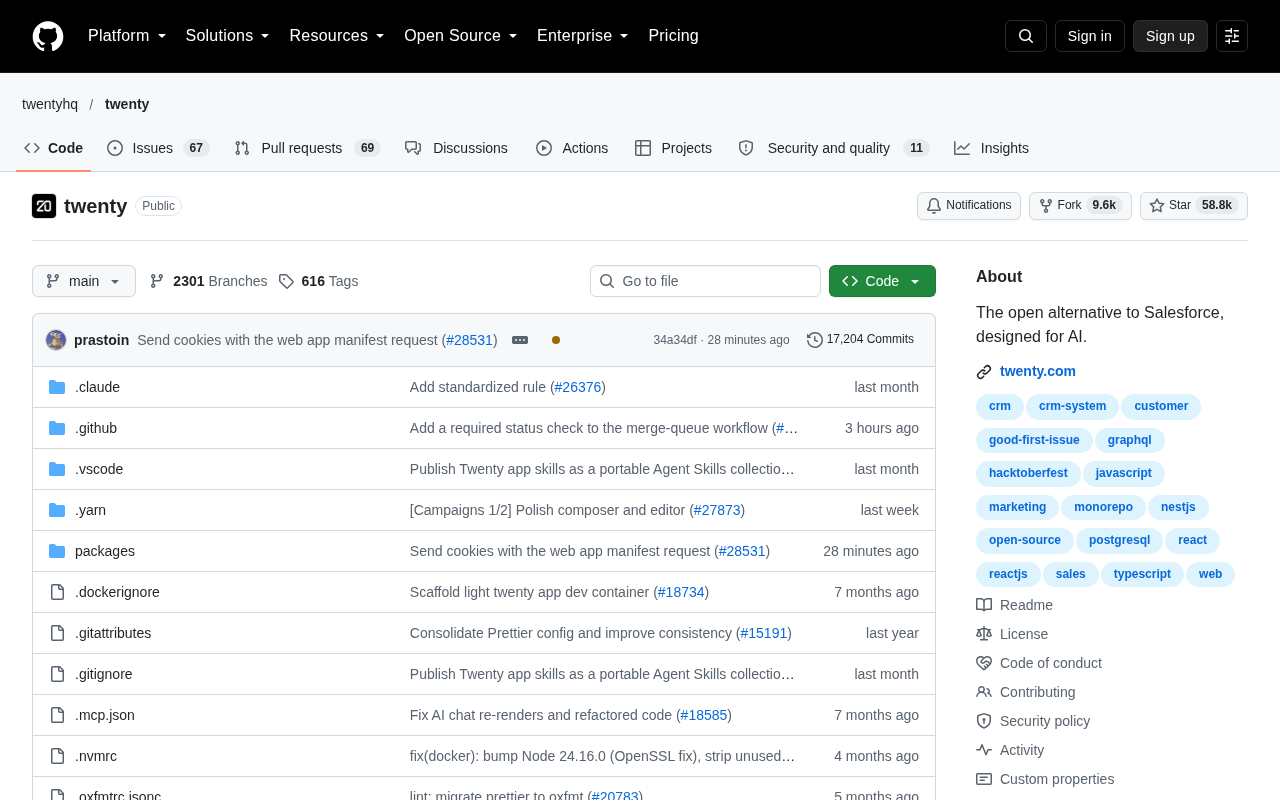
Twenty is a GitHub open-source CRM with 58,780 stars, written in TypeScript and positioned as "the open-source Salesforce alternative designed for AI." Unlike traditional CRMs that bolt AI on afterward, Twenty designs its data and interaction layers for AI invocation, reducing integration friction. Self-hosting restores data control but adds operational burden. High stars reflect developer interest, not production adoption; teams should pilot it on a small scale rather than replacing core sales systems outright.
Salesforce has long dominated the CRM market, but its high licensing fees and closed ecosystem have led many teams to look for alternatives. The Twenty project on GitHub (twentyhq/twenty) is entering this space under the banner of "open source, AI-native." The project has already gained 58,780 stars and 9,642 forks, with 105 new stars in a single day—a clear sign of its popularity.
Why CRM Needs an "AI-Native" Rebuild
The core logic of traditional CRM is "record management": contacts, opportunities, and sales pipelines—essentially structured data tables. AI capabilities are usually added on the periphery, such as a chat box or a predictive scoring module, while the underlying data model was never designed for intelligent querying and automated reasoning.
Twenty positions itself as "the open-source Salesforce alternative designed for AI." This means its data layer and interaction layer are designed with AI invocation scenarios in mind from the start, rather than being bolted on afterward. For teams that want to truly embed AI sales assistants, lead scoring, and automated follow-ups into business processes, this native design reduces integration friction.
"AI-native" means that AI capabilities are a core component of the product from the outset of its architectural design, rather than a feature module added later. The opposite is "AI-enabled" or "AI bolt-on": the data model, permission system, and interaction flows are still built in the traditional way, with only an outer layer that connects to large model APIs. An AI-native CRM typically means data is semantically searchable, entity relationships are explicitly modeled, and operations can be invoked by agents—so capabilities such as automated follow-ups and lead scoring run directly on business data instead of relying on extra data-sync pipelines. This difference directly affects integration cost and response latency.
Tech Stack and Engineering Signals
The project uses TypeScript as its primary language, a reasonable choice for a CRM product with heavy front-end interaction, and one that lowers the barrier to secondary development. Judging by community size, 58k+ stars have moved it past the "personal toy project" stage into the range of a持续 contributor ecosystem. The 9.6k forks indicate that many teams are trying self-hosting or customization.
What is worth noting is the narrative of "open-source Salesforce alternative" itself. The pain points driving customers away from Salesforce center on customization costs, data sovereignty, and vendor lock-in, and open-source solutions map directly to all three. Twenty's challenge is not whether its feature list is long enough, but whether it can provide a sufficiently smooth migration path and a stable self-hosting experience.
Vendor lock-in in SaaS CRMs such as Salesforce manifests on multiple levels: proprietary data models and object naming, platform-specific development languages such as Apex, and an app marketplace tied to its ecosystem. Migration costs come not only from data export but also from rebuilding business processes, integration scripts, and reporting logic. One of the core selling points of open-source alternatives is placing data formats and business logic on open standards so that teams do not have to start from scratch when changing vendors. This is also a metric to examine when evaluating such projects: whether the data model is public, whether export and import are lossless, and whether standard APIs and webhooks are supported.
Self-Hosting and Data Sovereignty
For small and mid-sized teams and organizations focused on compliance, CRM stores the most sensitive customer data. In the SaaS model, data resides on third-party servers, and export and deletion are subject to the vendor. Twenty's open-source nature means it can be deployed on your own infrastructure, returning control of data to the team.
The cost of this path is operational burden: databases, backups, and upgrades all need to be handled in-house. Whether Twenty can make the self-hosting experience as simple as "one-click deployment" determines whether it can move from the developer community to a broader base of business users. The current high star count reflects developer interest more than anything else; commercialization remains to be seen.
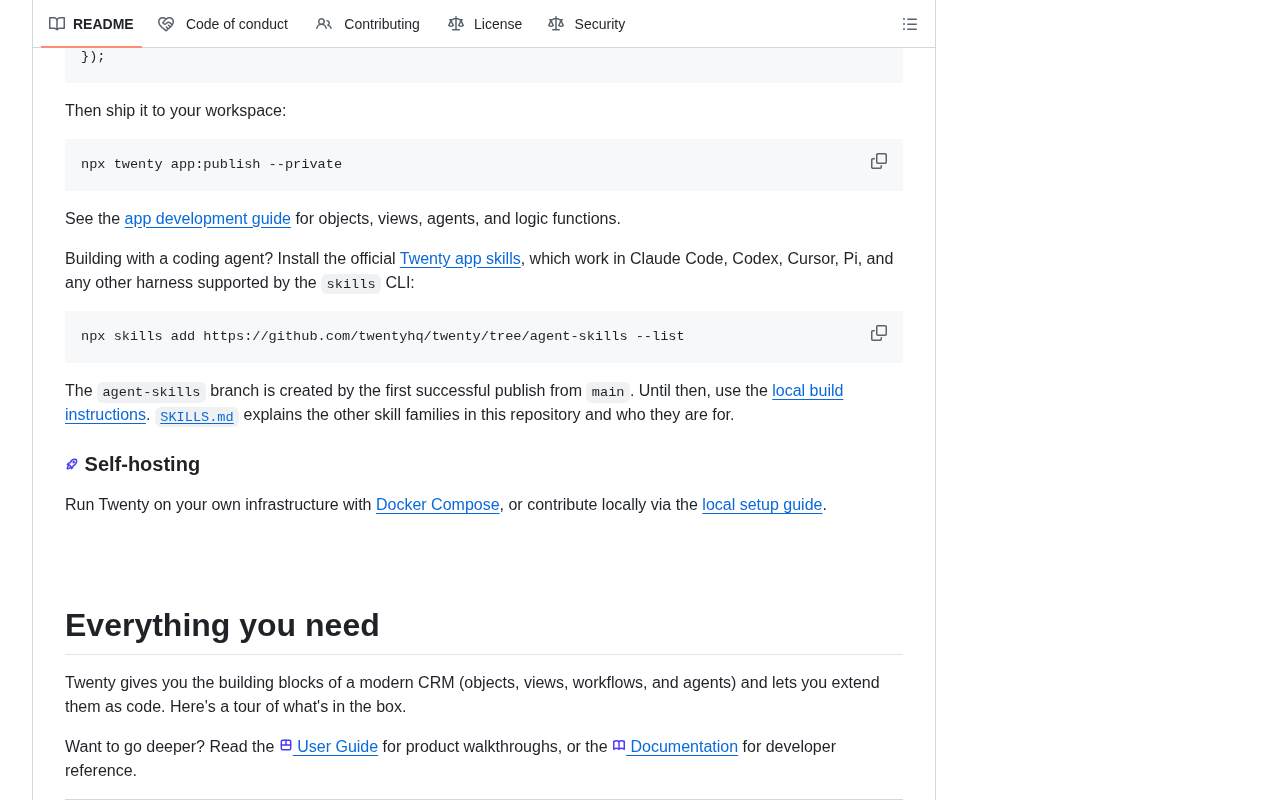
Self-hosting means deploying software on an organization's own servers or private cloud rather than using a vendor-hosted SaaS instance. The data sovereignty it brings includes: controllable physical location, autonomous access auditing, and the ability to meet compliance requirements such as GDPR and data cross-border transfer rules. The cost is that the team must take on database operations, backup and recovery, version upgrades, and security patches, which usually requires DevOps capabilities. Containerization and Docker Compose or Kubernetes deployment options can lower the barrier considerably, but there is still a gap between "one-click deployment" and "production-grade reliability," especially in high availability and disaster recovery, which teams need to fill in themselves.
Competitive Landscape and Rational Expectations
Open-source CRM is not a new concept. SuiteCRM, Odoo, and others have existed for years, but none has shaken Salesforce's position. Twenty's differentiation lies in its AI-native design orientation and modern tech stack, which have attracted the attention of a new generation of developers.
58k stars is a strong signal of community recognition, but stars do not equal production adoption. When evaluating such projects, pay attention to release cadence, issue response speed, documentation completeness, and whether enterprise support options are available. For teams currently selecting a CRM, Twenty is worth adding to the shortlist for a small-scale pilot, but replacing a core sales system without validation is not recommended.
The combination of AI and CRM is still in its early stages. Twenty provides an open technical foundation that lets teams experiment with their own intelligent sales processes at low cost. This "modifiable AI CRM" is itself its core value proposition compared with SaaS giants.
One-line Summary
Twenty is an AI-native open-source CRM that aims to challenge Salesforce with self-hosting and data sovereignty.
Paragraph Summary
Twenty is an open-source CRM project on GitHub with 58,780 stars, written in TypeScript and positioned as "the open-source Salesforce alternative designed for AI." The article notes that AI capabilities in traditional CRMs are mostly bolt-ons, whereas Twenty reserves design for AI invocation in its data and interaction layers, reducing integration friction. Open source and self-hosting give teams control over customer data again, but bring the burden of database operations, backups, and upgrades. The author believes the high star count reflects developer interest rather than production adoption, and recommends that teams evaluating it pay attention to release cadence, issue response, documentation completeness, and enterprise support, and start with a small-scale pilot rather than directly replacing their core sales system.
Related articles

Why Does the Tesla Roadster Need to Fly? A Deep Dive into Musk's Wild Demo
Tesla's Roadster launch showed wall-climbing, upside-down driving, and flying stunts—but The Vergecast notes the demo car may lack a battery, the Rocket version is invite-only and not street-legal, and the website terms don't guarantee delivery. After nine years of delays, why does this car still need to exist?

AI Is Not a Replacement: Human-AI Collaboration Through the Lens of Factory Root Cause Analysis
Starting from factory root cause analysis, this article explains how AI accelerates evidence chain construction rather than replacing human experts, exploring the pragmatic implementation logic and business value of 'AI supporting people rather than replacing them.'

AI Agent Decision Auditing: Building an Evidence Chain in Regulated Workflows
Starting from a Reddit discussion, this article analyzes three core issues in AI agent decision auditing within regulated workflows: what fields audit records should contain, how to handle feedback latency for erroneous decisions, and how to continuously calibrate LLM judge consistency with human judgment.