Twilio Co-Founder Jeff Lawson Bets on Fusion Energy: Inertia Heads to TechCrunch Disrupt

Twilio co-founder Jeff Lawson launches fusion energy startup Inertia, heading to TechCrunch Disrupt 2026.
Twilio co-founder Jeff Lawson has announced the founding of nuclear fusion energy company Inertia and will appear as co-founder and CEO on the Smart Systems Stage at TechCrunch Disrupt 2026. Fusion energy has long been considered a "holy grail" due to its near-limitless clean energy potential, and the sector has heated up significantly as private capital flows in and technology approaches diversify. Lawson's crossover is emblematic of a broader trend: a founder who succeeded in cloud communications software turning to a deep tech energy sector with high barriers and long development cycles — reflecting the larger shift in tech investment from pure software toward deep tech. Inertia's technology roadmap, funding, and team have yet to be publicly disclosed.
From Communications Giant to the Energy Frontier
Jeff Lawson is a name many in tech know well. As co-founder of the communications platform Twilio, he played a central role in building cloud communications infrastructure. Now, this serial entrepreneur has set his sights on a grander and far more challenging frontier — nuclear fusion energy. His new company, Inertia, represents his next major bet.
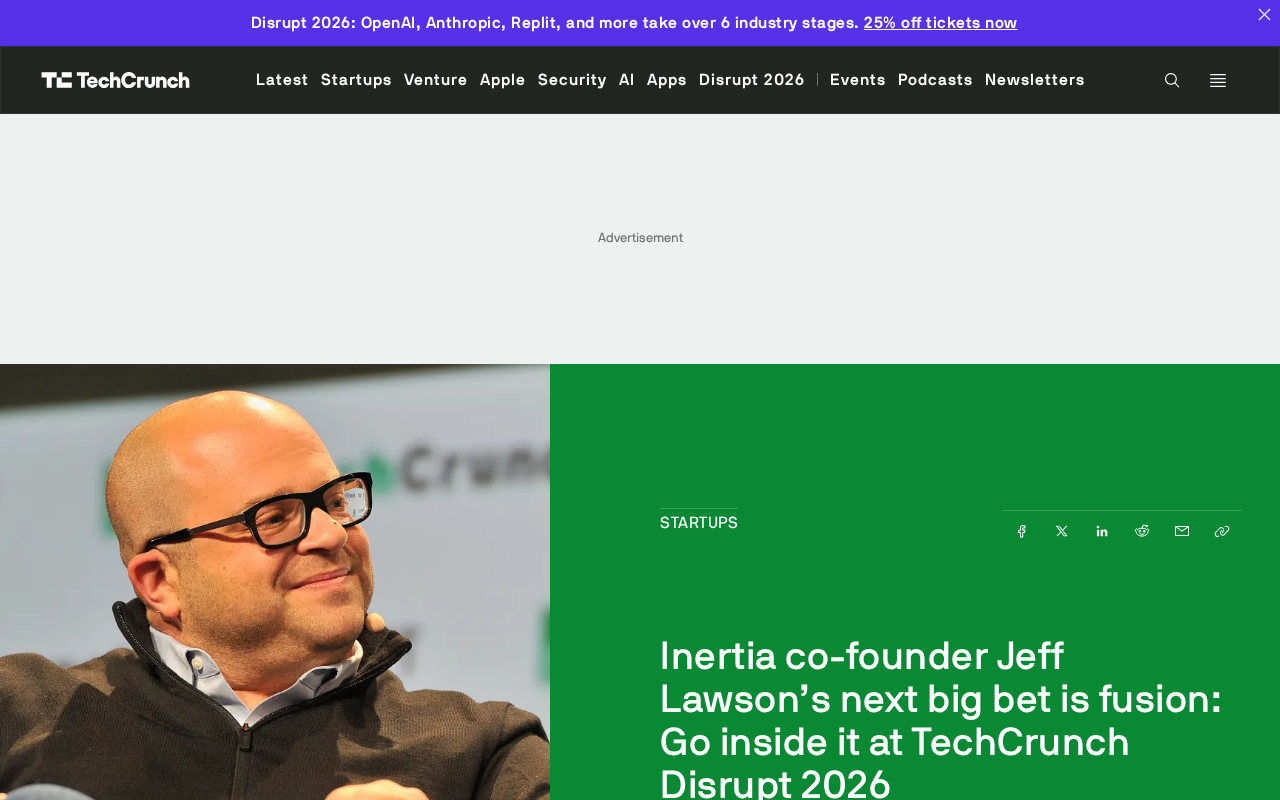
According to TechCrunch, Lawson will take the stage at TechCrunch Disrupt 2026 as co-founder and CEO of Inertia, appearing on the Smart Systems Stage to share his vision for the commercial prospects of fusion energy.
Why Nuclear Fusion
Nuclear fusion has long been considered the "holy grail" of energy — a potential source of near-limitless, clean, and safe electricity that produces no long-lived radioactive waste. Over the past several years, a wave of investment and technological progress has fueled a boom in fusion startups, with a growing number of entrepreneurs from software and internet backgrounds crossing over into this deep hardware space.
Lawson's pivot carries a certain symbolic weight. A founder who found success in the software platform world choosing to enter an energy sector with extremely high barriers to entry and long R&D cycles reflects a broader shift in the current tech investment climate: away from pure software applications and toward "deep tech" domains like energy and materials.
The basic principle of nuclear fusion involves fusing light atomic nuclei (such as deuterium and tritium) under extreme temperatures and pressures to form heavier nuclei — releasing enormous amounts of energy in the process, as opposed to fission, which splits heavy nuclei apart. Deuterium, the primary fuel for fusion reactions, can be extracted from seawater, making it nearly inexhaustible. The reaction itself emits no greenhouse gases and produces none of the highly radioactive, long-lived waste associated with uranium fission, positioning it as the ultimate clean energy solution. The challenge, however, lies in sustaining plasma at temperatures exceeding 100 million degrees Celsius while achieving net energy output — where energy produced exceeds energy input — an enormously difficult engineering problem. Government-led projects like ITER (International Thermonuclear Experimental Reactor) have consumed hundreds of billions of dollars and decades of work and are still under construction. In recent years, private fusion companies such as Commonwealth Fusion, Helion, and TAE Technologies have compressed projected commercialization timelines to the 2030s by adopting approaches like high-temperature superconducting magnets and novel confinement configurations, attracting substantial capital from the tech world — including from Microsoft and OpenAI's founders.
What to Watch on the Smart Systems Stage
TechCrunch Disrupt is one of the most prominent annual gatherings in the tech startup world, and its Smart Systems Stage focuses on the cutting edge of integrating intelligent technologies with physical systems. Placing a fusion energy discussion on this stage signals the organizers' interest in the intersection of energy and intelligent systems — and for good reason: modern fusion devices rely heavily on sophisticated control systems, real-time data processing, and AI-driven optimization.
For practitioners and investors tracking deep tech startups, Lawson's talk may shed light on Inertia's chosen fusion technology pathway, its commercialization timeline, and its funding strategy.
AI and machine learning are playing an increasingly critical role in modern fusion research — and this is the deeper logic behind a fusion topic appearing on the "Smart Systems Stage." The behavior of plasma inside a fusion reactor is extraordinarily complex and difficult to predict; traditional control algorithms struggle to respond in real time to plasma instabilities such as "disruption" events. In 2022, DeepMind partnered with EPFL to successfully apply reinforcement learning to control plasma shape in real time within a tokamak device, marking a significant breakthrough for AI in fusion control. Beyond that, fusion devices generate massive volumes of sensor data, and machine learning can be applied to anomaly detection, parameter optimization, and accelerating experimental design. For startups like Inertia, software and data capabilities represent a genuine competitive advantage over traditional energy institutions.
What We Know So Far
Publicly available information remains limited — Inertia's specific technology approach, funding scale, and team composition have not yet been disclosed. TechCrunch has noted that event tickets are available at a discount of up to $200 for registrations before September 25.
From a broader perspective, Lawson's bet is emblematic of a wave of tech leaders collectively pivoting toward energy deep tech in recent years. Whatever the ultimate outcome, these kinds of crossover ventures are injecting new talent, capital, and methodologies into the push for fusion commercialization. Whether the gap between the laboratory and the power grid can truly be bridged remains to be seen.
Related articles

NVIDIA's 30,000 Developers Use Cursor, Code Commit Volume Triples
Cursor engineer Chris Diaz breaks down five organizational gaps blocking enterprise AI coding scale—strategy, risk tiering, governance, metrics, and operating model. NVIDIA's 30,000 developers use Cursor daily, tripling code commits while defect rates stay flat. The key: rewrite the SDLC, not add tools.

Ponytail: Giving AI Coding Agents a Senior Engineer's Mindset
Ponytail is a free GitHub tool that injects a senior engineer's mindset into AI coding agents, making them ask whether code is even necessary first. According to TamilDeck, it can compress 200 lines of AI-generated code to 30, cutting token costs, with support for Cursor rules and Claude Code skill integration—though security review still requires human oversight.

Complete Guide to Connecting Cursor AI to the GitHub MCP Server
A step-by-step guide to connecting Cursor AI to the GitHub MCP server: create a personal access token, configure mcp.json, store the token in the ENV block, and verify with a PR query.