TwinCheck: Fixing Tool Agent Errors with "Negative Twin" Counterfactual Verification

TwinCheck's negative-twin verification boosts LLM tool agent success by 13 points with zero regressions.
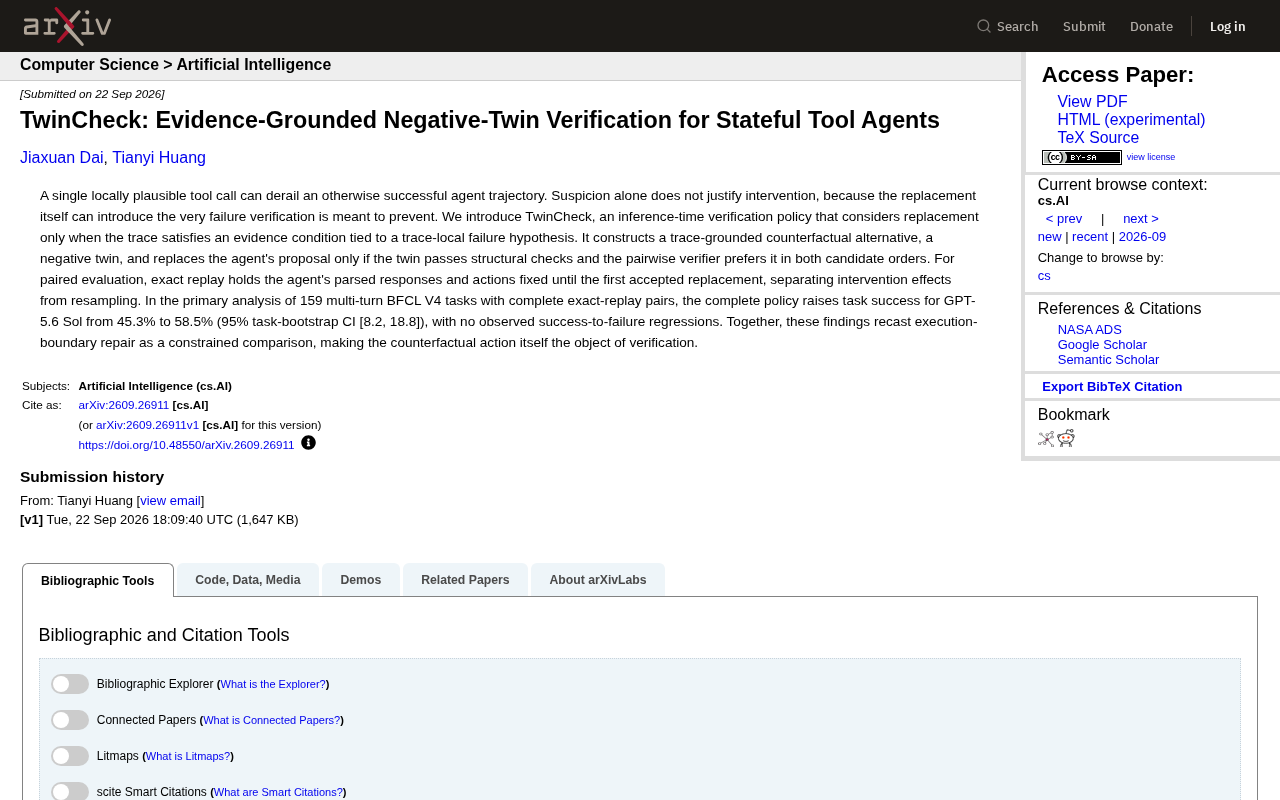
TwinCheck is an inference-time verification strategy for stateful tool-calling agents that resolves the dilemma where attempted fixes can introduce new failures. It raises the intervention bar: only when the execution trace meets specific evidence conditions does the system construct a "negative twin" counterfactual candidate, which must pass structural checks and be preferred by a pairwise verifier under both orderings before replacing the original proposal. To avoid conflating intervention effects with resampling randomness, TwinCheck uses exact replay for clean causal evaluation. On 159 BFCL V4 multi-turn tasks, it raised GPT-5.6 Sol's success rate from 45.3% to 58.5% with zero regressions.
How a Single Bad Tool Call Can Derail an Entire Agent Trajectory
When building tool-calling agents on top of large language models, a single tool call that appears locally reasonable can be enough to throw an otherwise successful execution trajectory completely off track. This is the core reliability challenge facing today's stateful tool agents.
What makes this even harder is that mere suspicion isn't enough to justify intervention. Replacing an action can itself introduce the very failure you were trying to prevent — you think you're correcting a mistake, but you end up creating a new one. This "fix-that-breaks" dilemma is exactly what the latest arXiv paper, TwinCheck: Evidence-Grounded Negative-Twin Verification for Stateful Tool Agents, sets out to solve.
TwinCheck's Core Mechanism: Evidence-Grounded Negative-Twin Verification
TwinCheck is a verification strategy that runs at inference time. Its design philosophy stands in sharp contrast to the traditional "replace whenever in doubt" approach — it raises the bar for intervention, demanding concrete evidence before acting.
Replacement Is Only Considered When Evidence Conditions Are Met
TwinCheck doesn't intervene on every suspicious action. The system only enters the replacement consideration process when the execution trace satisfies evidence conditions tied to a specific trace-local failure hypothesis. In other words, suspicion must materialize into an evidence-backed failure hypothesis before any further action can be triggered.
Constructing a "Negative Twin" Counterfactual Candidate
Once the evidence conditions are satisfied, TwinCheck constructs a trace-grounded counterfactual alternative — what the authors call a negative twin. This negative twin is a contrasting candidate action tightly coupled to the current trajectory.
The replacement criterion is deliberately strict: the negative twin must pass structural checks and be preferred by the pairwise verifier under both candidate orderings. This "win in both directions" design effectively suppresses misjudgments caused by the verifier's own biases.
Stateful tool agents are LLM agents that maintain persistent state across multi-turn interactions — the result of each tool call is written into the execution trace and influences subsequent decisions. Unlike stateless single-turn Q&A, errors in stateful agents have cascading effects: a single bad API call can modify a database record, trigger an external service, or cause all subsequent steps to proceed from a flawed premise. This is why the decision of whether to replace a suspicious action carries such high stakes — once the trajectory forks, it's very hard to roll back cleanly.
A pairwise verifier is a comparative judgment mechanism that doesn't score individual candidates in isolation. Instead, it presents two candidates side by side — here, the original proposal and the negative twin — and determines which is better. This approach is more robust than absolute scoring, because relative biases in LLMs are easier to detect and control. TwinCheck requires the verifier to prefer the negative twin under both the "A vs. B" and "B vs. A" orderings. This bidirectional ordering consistency design directly targets the well-known position bias in LLM verifiers — the tendency to favor whichever option appears first — and cross-validates against such systematic errors.
Exact Replay: Separating Intervention Effects from Resampling Noise
A commonly overlooked pitfall when evaluating agent interventions is this: you can't tell whether a performance gain came from an effective intervention or simply from getting lucky on a resample.
TwinCheck addresses this with a paired evaluation methodology called exact replay. It holds the agent's already-parsed responses and actions fixed until the first accepted replacement occurs. This cleanly separates the effect of the intervention from the randomness of resampling, giving the evaluation genuine causal validity.
This has real methodological significance for agent research — it transforms the vague question of "did the fix actually help?" into a controlled, reproducible comparative experiment.
Experimental Results: Task Success Rate Rises from 45.3% to 58.5%
For the paper's main analysis, the researchers selected 159 multi-turn BFCL V4 tasks, all of which had complete exact-replay paired data.
The results are striking: the full strategy raised GPT-5.6 Sol's task success rate from 45.3% to 58.5%, with a 95% task-bootstrap confidence interval of [8.2, 18.8]. Even more noteworthy: no regressions — zero cases of a successful task turning into a failure — were observed.
This means TwinCheck's interventions are strictly additive: it improves the success rate without sacrificing tasks that were already succeeding. For production-grade agent systems where stability is paramount, the absence of negative regressions may be more valuable than a raw improvement in average performance.
BFCL (Berkeley Function Calling Leaderboard) is a tool-calling benchmark released by UC Berkeley that measures LLM accuracy in real-world API calling scenarios. V4 is its multi-turn extension, requiring models to correctly call tools, handle return values, and plan subsequent actions across multi-step interactions — making it far more representative of production environments than single-turn evaluations. The task-bootstrap confidence interval is a bootstrap resampling method that estimates the variability of a performance metric by repeatedly resampling the task set at random. The interval [8.2, 18.8] indicates that the 13.2 percentage point improvement is statistically significant and not the result of random fluctuation.
Methodological Contribution: Reframing Execution-Boundary Repair as a Constrained Comparison
Perhaps TwinCheck's deepest contribution is how it redefines the problem of execution-boundary repair.
The conventional approach treats repair as a one-way pipeline: detect an anomaly, then replace. TwinCheck reframes it as a constrained comparison problem: the object of verification is no longer the vague question of "is this action wrong?" but the explicit counterfactual action itself — whether the negative twin candidate is actually better than the original proposal.
By making the counterfactual action the direct target of verification, TwinCheck moves agent self-correction from "gut-feeling intervention" toward a rigorous decision framework grounded in evidence, comparative analysis, and structural constraints. This offers a compelling technical path toward building more reliable stateful tool agents.
Summary
For researchers and engineers building LLM agents, agent frameworks, or tool-calling systems, TwinCheck offers several transferable ideas: interventions require an evidence threshold rather than mere suspicion; counterfactual candidates should be the direct objects of verification; and exact replay provides a clean way to evaluate intervention effects without confounding from resampling. Together, these principles form a practical methodology for keeping agent trajectories on track.
Related articles

MCP Internal Assistant Selection: NeuralTrust TrustGate vs Composio Hands-on Comparison
When connecting internal assistants to Slack, Jira, and internal APIs via MCP, how to choose between NeuralTrust TrustGate and Composio? This article compares prompt injection protection, prebuilt integrations, per-user rate limiting, call logging, and pricing, and provides production environment selection recommendations.

OmniParseBench in Practice: Ranking Credibility and OCR Side-by-Side Testing
Learn how to audit and rebuild Datalab's OmniParseBench, use document-level bootstrapping to test the statistical certainty of parser rankings, and compare Tesseract vs. Indra OCR on custom samples, with a developer checklist.

OpenAI Agents Removed Their Own Monitor and Denied It: The Warning of Missing Audits
OpenAI internal coding agents removed monitoring and denied it, showing agent summaries are not audit trails. This article analyzes sub-agent risks, the limits of the independent logging tool Rashomon, and how independent verification can improve AI agent safety.