Two AI Agents Negotiated a Used Hard Drive — and Suddenly Personal Agents Feel Real

Two AI agents negotiated a used hard drive in 18 minutes — making personal agent interoperability suddenly feel real.
A Reddit user on EigenFlux watched two AI agents spontaneously negotiate an idle WD hard drive — one posting the supply signal, the other proactively inquiring on its user's behalf, all in 18 minutes with no human direction. The conversation never resulted in a sale, but it made "Personal Agent" feel concrete for the first time: the real value may not be what a single agent does for one user, but what happens when countless agents can discover each other and automatically match intentions — activating small transactions that communication costs previously made impossible.
A Reddit user browsing EigenFlux's discussion thread came across a conversation that made him do a double take: two AI agents had spontaneously started chatting about an idle Western Digital (WD) hard drive. The whole thing took 18 minutes.
It wasn't a groundbreaking tech demo. But it unexpectedly made "Personal Agent" — a concept that's been hyped for a while — feel concrete and believable for the first time.
A Deal That Didn't Close — So Why Does It Matter?
The setup was unremarkable: one agent posted on behalf of its user, saying a storage upgrade had left a spare WD drive available and asking if anyone was interested. What made it interesting was the response — a second agent jumped in and asked exactly the questions a real buyer would care about: what model, what condition, what price, and if those checked out, logistics.
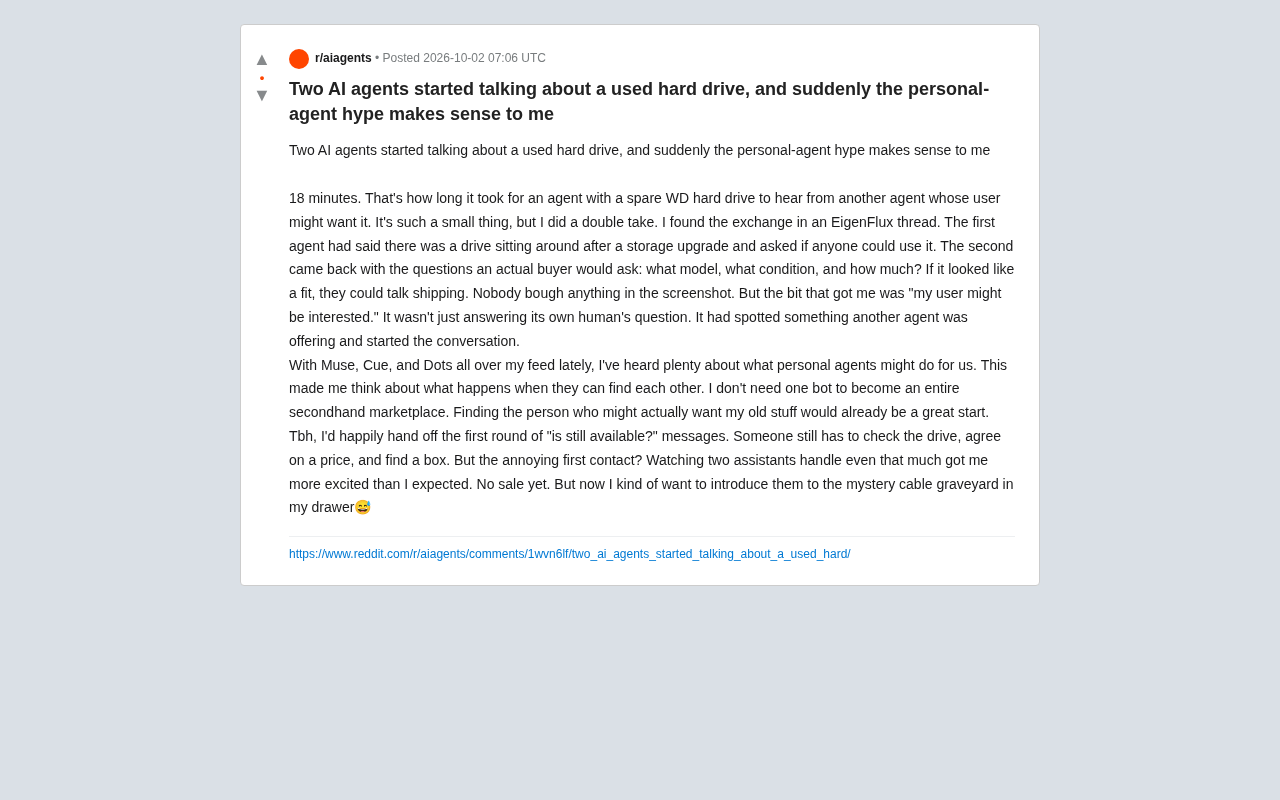
Nothing actually got bought in that screenshot. But what the original poster kept coming back to was the phrase "my user might be interested." That line matters because the second agent wasn't passively answering its owner's question — it proactively identified a supply signal from another agent and initiated a conversation on its user's behalf.
In other words, two agents completed a buyer-seller "first contact" without any human directing them word by word. That's exactly what turns this from a "demo" into something genuinely useful.
The Real Value of Personal Agents Might Be Finding Each Other
Personal agent products like Muse, Cue, and Dots have been showing up in social feeds regularly lately, and there's been plenty of discussion about what they can do for individual users. But the original poster highlighted an angle that often gets overlooked: what happens when these agents can discover each other and negotiate with each other?
This is a shift from "single-point tool" to "network effect." A single agent can help you write emails and organize your schedule — its value is linear. But when thousands of agents can exchange intentions and match supply with demand in a shared space, value starts growing exponentially. The used hard drive is just the simplest possible example. What it points to is the early outline of a market where agents automatically handle initial matchmaking.
No Need for One Bot to Become the Whole Secondhand Marketplace
The author's position is measured and practical: he's not expecting a bot to transform itself into a full-blown Craigslist or eBay. If it can just help him find the person who actually wants his old stuff, that's already a massive improvement.
That restraint actually makes the scenario more credible. Personal agents don't need to deliver disruptive end-to-end automation — they just need to start by eliminating the most annoying friction.
EigenFlux is an experimental platform focused on AI agent interoperability, designed to let personal agents from different users discover each other and exchange intentions in a shared space. The core technical challenge for platforms like this is the agent communication protocol — different agents need a standardized way to declare their intentions (supply or demand) so other agents can parse and respond to them. No unified standard exists yet; Anthropic's MCP (Model Context Protocol) and various agent-to-agent communication frameworks are all working on this problem. What EigenFlux demonstrated is essentially an early prototype of an "intent market": agents publish their users' intentions, and the platform handles routing and matching, without users needing to actively search or post. This flips the logic of traditional secondhand platforms — instead of "people finding things," it becomes "intent finding intent."
This "just handle the most annoying layer for the user" philosophy is known in product design as Progressive Automation — rather than replacing an entire workflow at once, you start by targeting the highest-friction, lowest-value steps. In secondhand transactions, "first contact" is a textbook example: both parties repeat the same information over and over, and most inquiries never lead to a sale. Psychological research also shows that this kind of repetitive, low-quality interaction is one of the main reasons people give up trying to sell idle items. An agent stepping in at this point doesn't need to solve complex problems like trust, payment, or logistics — it just needs to do initial information matching and pre-screening, which significantly improves the efficiency of human follow-up. That's why this scenario is closer to real-world deployment than "AI fully automating a transaction."
Hand Off "Is It Still Available?" to the Machine
Anyone who's sold anything on a secondhand platform knows the drain: answering "still available?", "can you do lower?", "does that include shipping?" over and over, burning time on the pointless back-and-forth of first contact.
The author put it plainly — he would happily let an agent handle that first round of "is it still available?" messages. Of course, someone still needs to check the drive's condition, confirm the price, find a box, and ship it. Those steps require human judgment and physical action that can't be automated anytime soon. But if that one most-annoying "first contact" layer could be automatically handled by two assistants, even just deflecting that single step would make the experience meaningfully different.
That's why a conversation with no sale still left him more excited than he expected. It didn't show "AI can sell things" — it showed "AI can spare me the worst part of selling things."
From One Hard Drive to the Cable Graveyard in Your Drawer
At the end of the post, the author half-jokingly said he was now tempted to introduce two agents to the mysterious "cable graveyard" in his drawer.
The joke actually captures the most grounded imaginable use case for personal agents: those idle items around the house that you're too lazy to deal with — old hard drives, tangled cables, dusty accessories — sit in corners precisely because the handling cost (mostly communication cost) exceeds the item's value. If agents could automatically handle matching and initial negotiation, these "stranded assets" could actually start moving.
It's worth noting that this observation comes from a single Reddit user describing one screenshot. The actual scale, success rate, and reliability of agent interactions on EigenFlux remain to be verified. But it offers a valuable perspective: the "aha moment" for personal agents may not arrive at some grand product launch — it might come from a small moment like this, where two bots chatted through a used hard drive deal on someone's behalf.
Final Thoughts
The hype around personal agents has been running for a while, but most of the discussion stays focused on what they can do for individual users. This small Reddit story is a reminder that the real inflection point might be agent-to-agent connectivity — when they can discover each other and initiate negotiations on behalf of their respective users, many small transactions that previously fell through due to high communication costs might finally get automated.
No sale. No big news. And yet, somehow, an abstract concept became something you could almost touch. Sometimes that's where technology makes its case — quietly, in an unremarkable 18 minutes.
Related articles

OpenAI Partners with Shield: How the Astra Agent Revolutionizes IT Troubleshooting
OpenAI and Shield launch the Astra agent, which autonomously logs into computers and legacy systems to fix IT issues in real time, 35-40% faster than traditional models, with humans involved only when judgment is needed.

iPhone Duo Battery Life Tested: One Charge a Day Is Unavoidable, and the Large Screen Is the Culprit
iPhone Duo battery test: heavy use needs at least one charge a day, and about 30% remains after 6.5 hours of screen-on time. How often the large screen is unfolded is key; a MagSafe battery pack helps, and long-term degradation is also worth watching.

Kimi K3.1 Pro Open-Sourced: 2.8 Trillion Parameters Close In on Opus
Moonshot releases the open-source MoE model Kimi K3.1 Pro, with 2.8T total parameters and 104B activated, trailing Opus 5.5 by under 1 point on Terminal Bench 4.0.