Two LLMs Talking to Each Other: Multi-Agent Conversation Demo Sparks Discussion

Reddit user shares video of two LLMs chatting, sparking discussion on multi-agent dialogue.
The article centers on a Reddit post sharing a video of two large language models conversing through an interactive chat interface. The original post is extremely limited, containing only a title, a joking question, and a video link, with no disclosure of the models used, conversation topics, or technical architecture, making it impossible to assess the demo's technical depth. Community reaction is mainly curiosity and banter, with the poster assuming it is a personal project by some developer. The article further notes that LLM-to-LLM chat is a simplified form of multi-agent interaction, commonly implemented by assigning different roles or system prompts to two model instances and using orchestration frameworks to manage message passing and termination conditions, with value lying in observing conversation dynamics rather than the models themselves. The conclusion is that the post is more of a community share than a technical release, but reflects that LLM-to-LLM chat is evolving from a novelty demo into an introductory experiment for developers exploring multi-agent collaboration.
Recently, a Reddit user shared a video of two large language models (LLMs) conversing with each other through an interactive chat interface, sparking community discussion. The original post was titled "2 LLM’s talking to each other with interactive chat??", with the author jokingly asking which tech enthusiast built this project and including a YouTube video link.
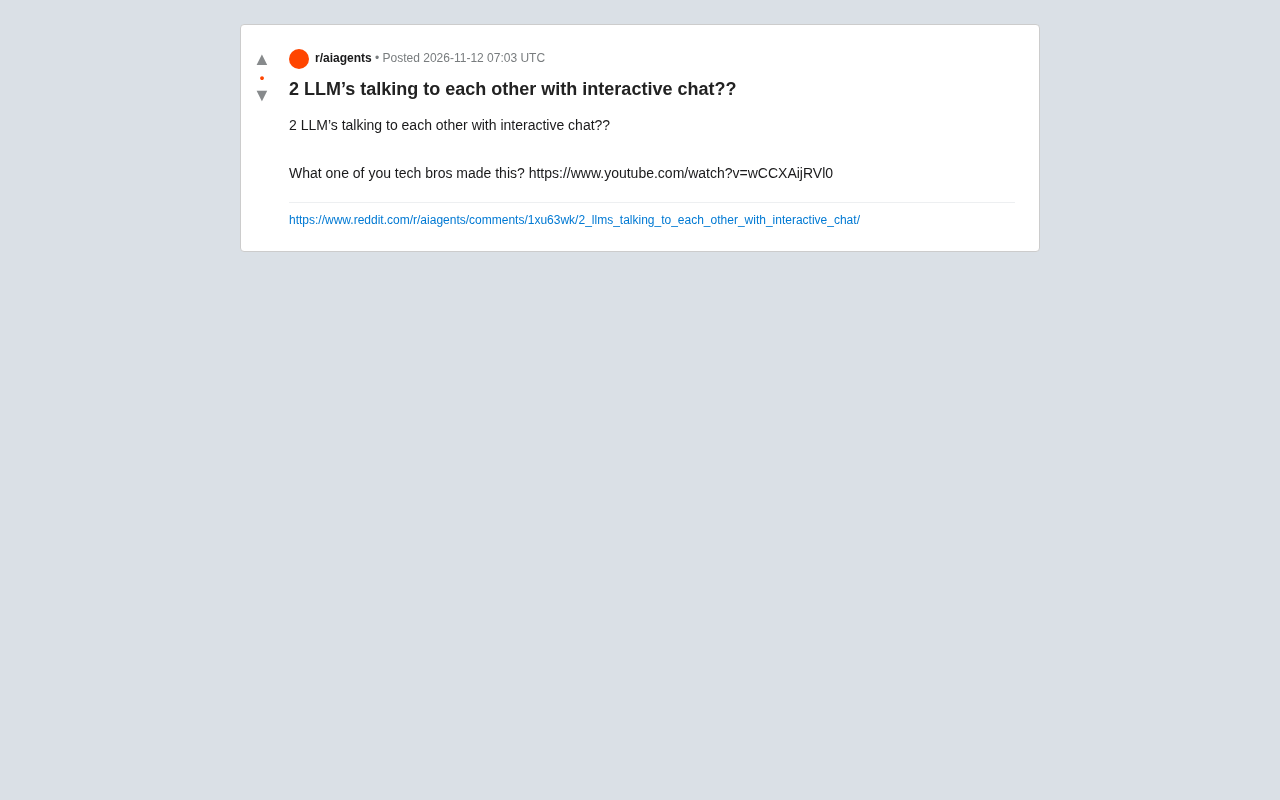
Demo Content: Interactive Conversation Between LLMs
Judging from the limited description in the original post, the video shows two LLMs sending messages to each other within the same chat environment, forming a continuous dialogue. The poster emphasized its interactivity with "interactive chat," suggesting this is not a simple single-turn Q&A but rather real-time, multi-turn interaction between the models.
Since the original material only includes a title, a single question, and a video link—with no disclosure of the specific models used, conversation topics, technical architecture, or implementation details—this article cannot assess the technical depth of the demo. What is certain is that this kind of "models chatting with each other" concept is not new in the AI community, but each appearance still attracts attention because it intuitively demonstrates the potential of LLMs as conversational agents.
Community Reaction and Areas of Interest
The discussion atmosphere in the original post leaned toward curiosity and playful banter. The question "What one of you tech bros made this?" reveals two things: first, the poster assumes this is a personal project by someone in the community; second, such demos already have some traction in Reddit's tech circles.
Community interest in LLMs chatting with each other typically focuses on several aspects: whether the conversation falls into loops, whether the models can maintain topic consistency, and whether this interaction can be used for automated tasks or role-playing. However, these are common discussion directions for such projects and are not content actually presented in this material.
Technical Background: Common Forms of Multi-Agent Conversation
From a broader perspective, having two LLMs talk to each other is a simplified form of multi-agent interaction. Common implementation approaches include: assigning different roles or system prompts to two model instances and having them take turns generating responses; or using orchestration frameworks to manage message passing and termination conditions. The value of such experiments often lies not in the models themselves but in observing conversation dynamics—such as opinion clashes, task collaboration, or self-correction.
It should be noted that the above is general background within the field. The original material does not provide the specific technical approach of this video project. Interested readers can refer to the original video link for further information.
Multi-Agent systems refer to a system form in which multiple agents with a certain degree of autonomous decision-making capability complete tasks together through communication, collaboration, or competition. In the LLM context, each agent is typically a model instance assigned a specific role, goal, or system prompt, and they exchange text through a shared message channel. Compared with single-model approaches, the advantage of multi-agent architectures lies in improving the quality of complex task completion through division of labor and mutual verification—for example, having one model generate and another review, or having multiple models propose solutions separately and then converge through voting. Classic orchestration patterns include round-robin dialogue, supervisor-worker hierarchical structures, and loosely coupled collaboration based on a message bus. Common frameworks such as AutoGen, CrewAI, and LangGraph all provide infrastructure for role definition, message routing, and termination condition management.
System Prompts and role setting are key means of enabling meaningful dialogue between two LLMs. A system prompt is an instruction placed at the very front of the conversation that globally constrains model behavior. It does not appear in the user-visible conversation turns, yet it determines the model's tone, identity, and task boundaries. In multi-model chat experiments, developers often assign opposing stances (such as pro and con), different professional identities (such as doctor and patient), or complementary responsibilities (such as questioner and answerer) to the two instances in order to stimulate opinion clashes or task collaboration. Without role differentiation, the two models tend to quickly converge, falling into a degenerate loop of mutual agreement or repeated statements. Therefore, the design of termination conditions (such as maximum number of turns, keyword triggers, or semantic convergence criteria) is just as important as role prompts—together they determine whether such experiments can produce valuable conversation dynamics.
Brief Conclusion
This Reddit post is more of a community share than a technical release, with limited information. The phenomenon it reflects is worth noting: LLM-to-LLM chat is gradually evolving from a novelty demo into an introductory experiment for developers exploring multi-agent collaboration. As for who implemented the video and what methods were used, the only way to find out for now is through the original link.
One-line Summary
A Reddit user shared a video of two LLMs chatting with each other, sparking discussion about multi-agent conversation.
Related articles

Nothing CMF Buds 2A Drops to $17.89 on Black Friday: A New Low for ANC Earbuds
Nothing CMF Buds 2A wireless earbuds Black Friday deal: just $17.89 on Amazon, about $11 off retail and a record low. ANC earbuds at an entry-level price.

When AI Creation Gets Accused of "Spitting": Hacker News Heats Up Over the Glaude Controversy
A Hacker News post, "Spitting in the Face of Glaude," sparks debate on AI creation transparency and attribution ethics. This analysis examines the blurred creator identity behind the controversy and offers practical advice for AI content production.

Akai Embraces Custom Firmware: MPC Sample 1.4 Lets Users AI-Program Their Sampler
Akai embraces the modding community with MPC Sample 1.4 firmware, supporting vibe-coded custom firmware and effects. We analyze the impact of this open strategy on music hardware and AI-assisted programming.