Two-Stage Post-Training: Streaming Embodied Models Break Through the Expert Ceiling

Proposes a two-stage post-training framework: distill to integrate expert capabilities, then use RL on failed trajectories to break the teacher ceiling.
This study addresses distribution mismatch in SFT, sparse rewards in RL, and MOPD's difficulty surpassing teacher ceilings in post-training embodied foundation models by proposing a two-stage framework. The first stage uses multi-teacher on-policy distillation (MOPD) for dense expert supervision on the model's own trajectories; the second combines RL with teacher distillation acting only on failed trajectories, with the distillation objective built from conditional flow matching velocity regression and weights tied to sampling noise. Experiments show it outperforms joint SFT, surpasses teacher aggregated success rates, and achieves higher success with fewer interactions, significantly improving sample efficiency.
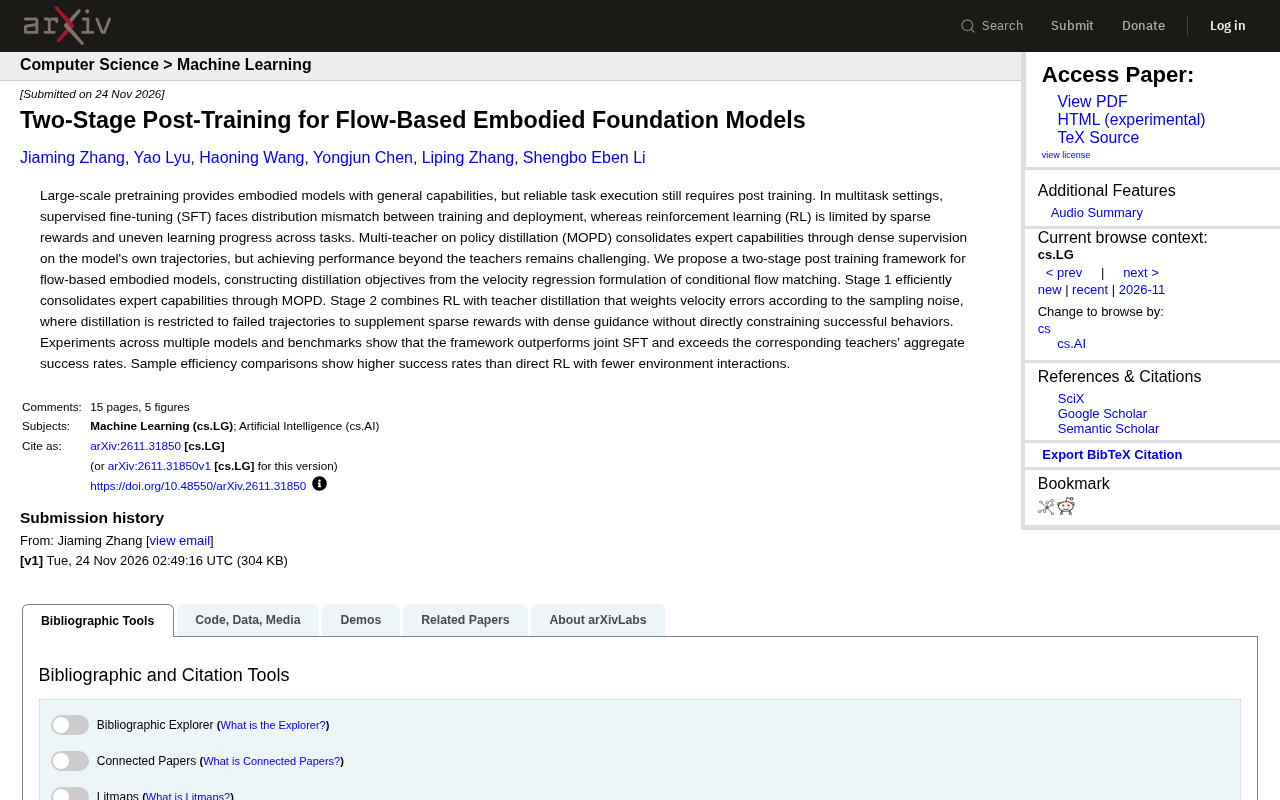
Large-scale pre-training gives embodied models general capabilities, but to ensure reliable task execution, a post-training phase is indispensable. However, in multi-task settings, traditional supervised fine-tuning (SFT) faces a distribution mismatch between training and deployment, while reinforcement learning (RL) is limited by sparse rewards and uneven learning progress across tasks. Multi-teacher on-policy distillation (MOPD) integrates expert capabilities through dense supervision on the model's own trajectories, but surpassing the performance ceiling of the teacher models remains difficult. To address these bottlenecks, researchers propose a two-stage post-training framework for streaming embodied foundation models. It constructs the distillation objective from the velocity-regression form of conditional flow matching, achieving breakthroughs that surpass the aggregated success rate of teachers across multiple models and benchmarks.
Bottlenecks of Existing Post-Training Methods
Embodied foundation models often require post-training for specific scenarios when executing tasks. While SFT is simple and direct, a natural gap exists between the training data distribution and the deployment environment, making the model prone to failure in unseen states. RL faces the challenge of sparse rewards—in long-horizon tasks, the success signal may only appear at the end of a trajectory, leading to low learning efficiency. More troublesome is that during multi-task training, different tasks converge at vastly different rates, and simple joint optimization easily leads to underfitting on difficult tasks.
MOPD offers a compromise: multiple teacher models provide dense supervision on trajectories generated by the student model itself, thereby mitigating distribution shift. But this approach is essentially still imitation of teacher capabilities, and the student model struggles to escape the "capability envelope" of the teachers to achieve transcendence.
On-Policy Distillation is a training paradigm distinct from traditional offline distillation. Traditional distillation typically has the student model learn on the data distribution produced by teachers, whereas on-policy distillation has the student model receive per-state supervision from teachers on trajectories generated by its own policy. The benefit is that the distribution of supervision signals matches the state distribution the model encounters during actual deployment, thereby mitigating the distribution shift between training and inference. In the multi-teacher setting (i.e., MOPD), multiple teachers can each provide their own guidance for the same state, and the student must integrate these signals. However, this paradigm is still fundamentally bounded by the teachers' capabilities, because the supervision signals always come from teachers, and the student can hardly discover better strategies that the teachers have not explored.
Design Logic of the Two-Stage Framework
The core innovation of this framework lies in embedding the distillation objective into the velocity-regression form of flow matching. Conditional Flow Matching learns the transformation from noise to data by regressing a velocity field, and the researchers found that the velocity error itself can serve as a natural supervision signal—it not only tells the model "which way to go," but also adjusts the strength of distillation according to the weight of the sampling noise.
The first stage follows the MOPD approach, using multi-teacher on-policy distillation to let the model receive dense expert guidance on its own trajectories, quickly integrating existing capabilities. The goal of this stage is to "gain a firm foothold" and absorb as much of the teachers' strengths as possible.
The second stage introduces a combination of RL and teacher distillation. The key design is that distillation acts only on failed trajectories, and the weight of the velocity error is tied to the sampling noise. This means that when the model fails on a task, the teacher provides dense guidance signals to supplement the sparse RL reward; when the model already succeeds, the teacher no longer imposes constraints, avoiding limiting the model's exploration of better strategies. This "guide only where it fails" strategy preserves the exploration space of RL while alleviating the learning difficulties caused by sparse rewards.
Conditional Flow Matching is a class of generative modeling methods whose core idea is to learn a velocity field that transforms a simple noise distribution along a continuous-time path into the target data distribution. During training, the model regresses the instantaneous velocity from noise to data, and the target velocity is typically given analytically by the linear interpolation path between noise and data. Compared with diffusion models, which require simulating a multi-step denoising process, flow matching has a more direct training objective and more efficient sampling. In embodied foundation models, flow matching is often used to model the generation of action sequences. The key insight of this paper is that the velocity regression error not only measures generation quality but can also be weighted by the magnitude of the sampling noise, thereby turning it into a dense supervision signal for distilling teacher knowledge.
Sparse rewards and credit assignment are classic challenges for reinforcement learning in long-horizon tasks. In embodied tasks such as robotic manipulation, the success signal often provides only a binary reward at the end of the trajectory, with no feedback for intermediate steps, making it difficult for the model to determine which action contributes most to the final outcome—this is the credit assignment problem. Sparse rewards make RL exploration extremely inefficient, especially in multi-task joint training, where differences in reward density and convergence speed across tasks further exacerbate learning imbalance. The design of the second stage in this paper directly targets this pain point: when a trajectory fails, the dense velocity error signal provided by the teacher can be viewed as an auxiliary reward that supplements the sparse RL reward, thereby accelerating learning.
Experimental Performance and Efficiency Advantages
Experiments across multiple models and benchmarks show that this two-stage framework not only outperforms joint SFT but also exceeds the aggregated success rate of the corresponding teacher models. In other words, after absorbing the capabilities of multiple teachers, the student model surpasses the teacher ensemble through RL fine-tuning in the second stage. This result breaks the conventional belief that "distillation can only approach the teacher's ceiling."
The comparison in sample efficiency is also noteworthy: compared with directly applying RL, this framework achieves higher success rates with fewer environment interactions. This is particularly important for real robot scenarios—environment interaction is costly, and sample efficiency directly determines whether a method can be deployed.
Implications for Post-Training of Embodied Intelligence
The value of this work lies in providing a reusable post-training paradigm: first integrate expert knowledge through distillation, then use RL to break through the boundaries of imitation, while the design of intervening distillation only at failures cleverly balances guidance and exploration. For streaming models, aligning the distillation objective with the velocity-regression form also avoids introducing additional complex loss terms.
Of course, practical deployment of the framework still faces challenges, such as the selection and scheduling of multiple teachers, the criteria for determining failed trajectories, and robustness validation in real physical environments. Overall, however, this two-stage approach offers a new path for post-training embodied foundation models that balances both efficiency and performance.
One-line Summary
Proposes a two-stage post-training framework: first distill to integrate expert capabilities, then use RL on failed trajectories to break through the teacher ceiling.
Paragraph Summary
To address distribution mismatch in SFT, sparse rewards in RL, and the difficulty of MOPD surpassing the teacher ceiling in post-training embodied foundation models, this study proposes a two-stage post-training framework. The first stage follows multi-teacher on-policy distillation (MOPD), letting the model receive dense expert supervision on its own trajectories to quickly integrate existing capabilities; the second stage combines RL with teacher distillation, where distillation acts only on failed trajectories, and the distillation objective is constructed from the velocity-regression form of conditional flow matching, with velocity error weights tied to sampling noise. Experiments show that the framework not only outperforms joint SFT but also surpasses the aggregated success rate of the corresponding teacher models, achieving higher success rates with fewer environment interactions and significantly improving sample efficiency.
Related articles

Nothing CMF Buds 2A Drops to $17.89 on Black Friday: A New Low for ANC Earbuds
Nothing CMF Buds 2A wireless earbuds Black Friday deal: just $17.89 on Amazon, about $11 off retail and a record low. ANC earbuds at an entry-level price.

When AI Creation Gets Accused of "Spitting": Hacker News Heats Up Over the Glaude Controversy
A Hacker News post, "Spitting in the Face of Glaude," sparks debate on AI creation transparency and attribution ethics. This analysis examines the blurred creator identity behind the controversy and offers practical advice for AI content production.

Akai Embraces Custom Firmware: MPC Sample 1.4 Lets Users AI-Program Their Sampler
Akai embraces the modding community with MPC Sample 1.4 firmware, supporting vibe-coded custom firmware and effects. We analyze the impact of this open strategy on music hardware and AI-assisted programming.