TypeSafe Raises $870M: Jev Model Valued at $7.5B, Seed to Series A in Just 24 Days

TypeSafe AI raises $870M Series A at $7.5B valuation just 24 days after seed, built around Jev's typed-decision model.
TypeSafe AI announced an $870M Series A led by a16z on October 9, 2026, at a $7.5B valuation—just 24 days after its $40M seed, a 37x valuation jump. Its core product Jev isn't a chatbot: it takes program state and returns typed decisions in developer-defined formats, priced at $0.042 per million input tokens with free output. The team comes from OpenAI, Google Brain, and Meta FAIR. But traction data conflicts: the company claims one-third Fortune 500 adoption vs. a16z's 25%, and user/processing figures are self-reported and unverified. Funds will expand the model matrix and build enterprise security, governance, and integration features.
A Lightning-Fast Fundraise: From $40M Seed to $870M Series A in Just 24 Days
According to multiple sources including Unite.AI, Crypto Briefing, and Dealroom, TypeSafe AI announced on October 9, 2026 that it had closed an $870 million Series A at a $7.5 billion valuation. The round was led by Andreessen Horowitz (a16z), with participation from Sequoia Capital, existing investor DCVC, and a group of angel investors. a16z general partner Martin Casado will join TypeSafe's board of directors.
This round came just 24 days after TypeSafe emerged from stealth. The company announced a $40 million seed round led by DCVC on September 15, 2026, at a valuation of roughly $200 million. According to Crypto Briefing's data, that means the company's valuation jumped more than 37x in under a month.
There is disagreement over how to classify the round. Dealroom categorized it as a late-stage round rather than a Series A, placing it in the 97th percentile of late-stage deep tech rounds nationwide. RuntimeWire, citing Bloomberg, noted that no closing date was disclosed for the round. Crypto Briefing added that some investors had previously discussed a raise exceeding $1 billion at a valuation above $10 billion.
What Is Jev: Not a Chatbot, but a Typed Decision Engine
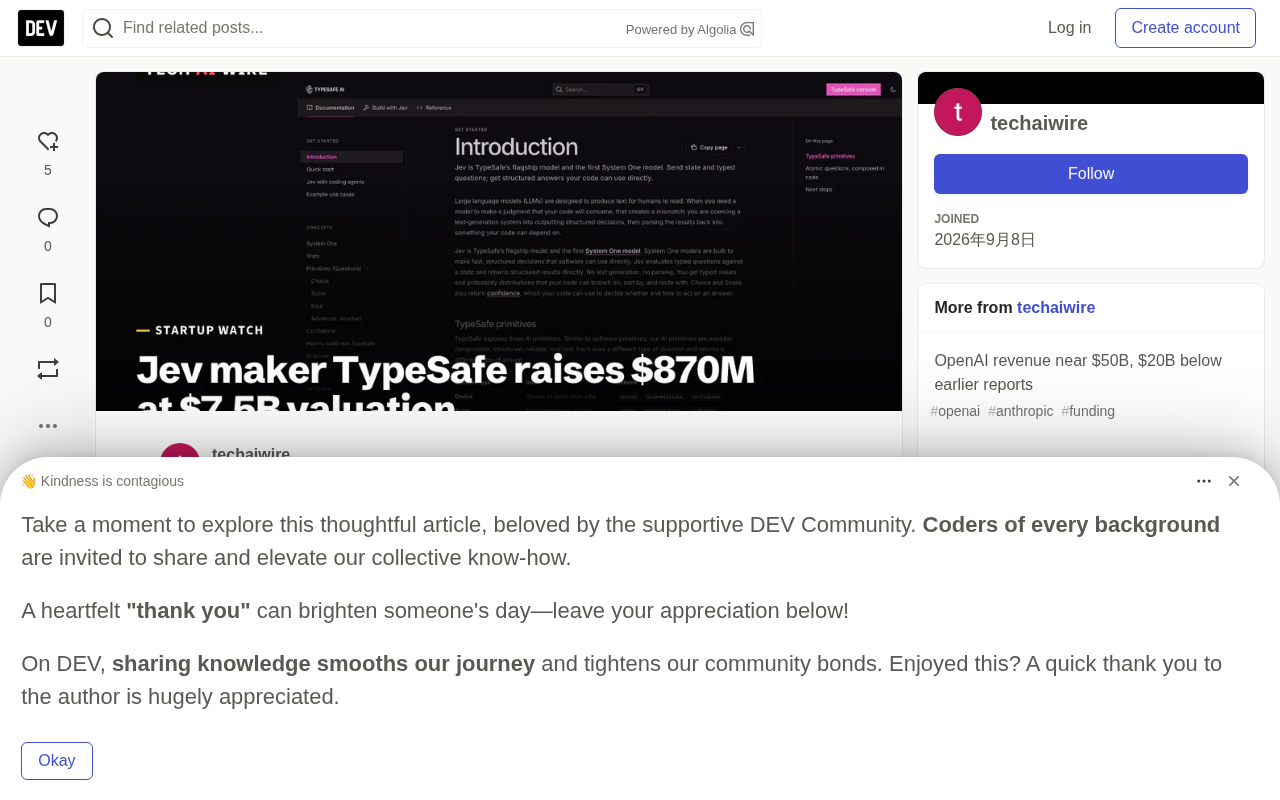
Jev is not a chatbot in the traditional sense. It takes the current state of a program and returns a typed value—a structured answer conforming to a format defined by the developer. TypeSafe calls this architecture a "System One model." Tech AI Wire reported when Jev entered early access on September 15 that Jev returns typed decisions rather than text.
On pricing, TypeSafe charges $0.042 per million input tokens, with output free. A token is a small fragment of text. The company claims end-to-end response times of 70 to 500 milliseconds.
The team's background is a major endorsement behind this round. According to Crypto Briefing, the CEO is Diogo Almeida, the CTO is Erik Gafni, and the COO is Sasha Sheng. All three previously worked at OpenAI, Google Brain, and Meta's FAIR research group, respectively.
The naming logic behind "System One model." The term borrows from the dual-system theory in cognitive psychology: Kahneman divided human thinking into the fast, intuitive "System One" and the slow, rational "System Two." TypeSafe's choice of this name is meant to emphasize that Jev does not engage in lengthy reasoning or conversational deliberation, but instead outputs a definite structured result reflexively. This stands in contrast to the current mainstream "Chain-of-Thought" approach—which typically improves accuracy by extending the reasoning process, at the cost of higher latency and token consumption. The typed-decision approach front-loads the reasoning cost into training and constraint design, compressing inference-time output to the millisecond level, which is the technical basis for its claimed 70 to 500 millisecond end-to-end response.
What "typed value" means. In programming languages, a "type" is a strict contract on a data structure—for example, a screening decision must contain fixed fields like pass/fail, confidence, and reason code. Traditional large models return free-form text, requiring the caller to write parsing logic that breaks whenever the format drifts. By returning typed values, Jev effectively builds "format correctness" into the model's own output constraints, letting callers bind results directly to variables without fault-tolerant parsing. For engineering teams embedding AI into production pipelines, this is a substantive difference: it turns the model from an unreliable text generator into a function call with a clear interface contract.
Traction Data: Sources Don't Quite Agree
Most usage data comes from the company itself or its lead investor, and the sources don't fully align:
- Fortune 500 adoption. TypeSafe claims about one-third of Fortune 500 companies use Jev. Unite.AI reported that a16z's figure is 25%. Neither party disclosed customer names.
- User count. Dealroom reported that the company claims Jev has surpassed 1 million users.
- Processing volume. According to a16z data, Jev processed 1 trillion tokens within three days of launch.
One customer case provides more specific numbers. On October 7, TypeSafe said recruiting firm Jack & Jill cut screening costs by 88%, from $0.755 to $0.092 per 1,000 candidates. Median screening time dropped from 20.3 seconds to 10.3 seconds.
These figures should be viewed with caution. There is a clear gap between company-reported and investor-reported data (one-third vs. 25% Fortune 500 adoption), and none of it has been verified by third parties.
How to interpret "processed 1 trillion tokens." A token is the smallest unit of text a model processes—roughly 0.75 words in English, or about 1 to 2 Chinese characters. 1 trillion tokens sounds impressive, but as a comparison baseline, the large-scale usage commonly seen during early access often comes from stress testing, batch backfills, or intensive calls under free quotas, and does not necessarily equate to sustained production-grade paid load. More critically, there is no direct conversion between token processing volume and revenue—especially given that the company offers free output and charges only $0.042 per input token. Even if all 1 trillion tokens were billed as input, that would correspond to only about $4.2 million in revenue. This metric is therefore better treated as evidence of "system scalability" rather than "commercial traction."
Use of Funds: Expanding the Model Matrix and Enterprise Features
According to Pulse 2.0's coverage of the announcement, the funds will be used to expand Jev and build more models aimed at machines rather than chat. The company will also scale up TypeSafe's infrastructure and add enterprise-grade features for security, governance, and integration.
This directional choice is worth noting. Machine-oriented models mean TypeSafe is not betting on consumer chat scenarios, but on the B2B market of embedding AI as software infrastructure into program workflows. The explicit mention of enterprise-grade security and governance features also suggests the company is trying to move from developer tooling toward enterprise procurement checklists.
Practical Implications for Developers
Reduced supply risk. A company holding $870 million is unlikely to disappear mid-flight, which matters especially for a model with no direct substitute. For teams evaluating whether to integrate Jev into production, financial stability is a substantive consideration.
Enterprise-grade controls are coming. Security, governance, and integration features are explicitly listed in the use of funds. If your company requires audit logs or single sign-on to approve tool usage, watch for upcoming releases.
Don't plan around current pricing. Free output and $0.042 input pricing are launch-period terms. Investors entering at a $7.5 billion valuation will expect revenue returns, and pricing adjustments are highly likely.
Validate the case on your own data. The 88% screening cost reduction is a single-customer result. Before switching, run a comparative test with Jev on real decision scenarios.
Keep an exit route. Laya is an open-weight model with the same form factor that can be self-deployed, which somewhat limits vendor lock-in risk. For teams focused on AI coding and AI application deployment, having an extra fallback path is never a bad thing.
On the mechanism by which "open-weight models" reduce lock-in risk. Open weights mean the model's parameter files can be downloaded and self-deployed, as opposed to closed-source services that only offer an API. When an upstream vendor raises prices, changes interfaces, or discontinues service, a self-deployed option provides a migration path, thereby imposing bargaining constraints on the vendor. But it's important to recognize clearly that the quality of this "exit route" depends on three conditions: whether the weights permit commercial use, whether the hardware cost of self-deployment is affordable, and the actual gap in performance versus the closed-source version. If the open-source version lags significantly in accuracy on key decision scenarios, then while it may be "usable" legally and engineering-wise, it may not be "swappable" in business terms. Evaluation should be based on measured results from small-scale comparative tests, not on the mere fact of being open-source.
One-line Summary
TypeSafe AI closed an $870M Series A at a $7.5B valuation just 24 days after its seed round, centered on the Jev model that returns typed decisions.
Paragraph Summary
TypeSafe AI announced on October 9, 2026 an $870 million Series A led by a16z at a $7.5 billion valuation, just 24 days after its $40 million seed round—a valuation jump of over 37x. Its core product Jev skips the chatbot route, instead taking program state and returning typed decisions matching developer-defined formats, priced at $0.042 per million input tokens with free output. The team hails from OpenAI, Google Brain, and Meta FAIR. But traction data is contradictory: the company claims one-third Fortune 500 adoption while a16z says 25%, and both user counts and processing volume are self-reported and unverified. Funds will go toward expanding the model matrix and building enterprise-grade security, governance, and integration features.
Related articles

Should U.S. College Fraternities Be Banned? A Researcher's Incisive Observations
Why not just ban U.S. college fraternities? A researcher finds the key resistance comes from decision-makers' own fraternity identities and schools' "willful ignorance."

Microsoft Discovery: Accelerating Scientific Discovery with AI Agents
Microsoft's Discovery platform runs specialized AI agents to help researchers screen and prioritize the most promising compounds and experimental paths, reducing experiments and accelerating scientific discovery.

Cambridge Heavy Industries Secretly Develops Desktop-Scale Nuclear Fusion Device
Cambridge Heavy Industries is secretly developing a desktop-scale laser-driven nuclear fusion device, targeting the equipment supply market for fusion power plants. This article analyzes its miniaturization technology path, commercialization logic, and unique positioning in the fusion startup wave.