U.S. Appeals Court Upholds Pentagon's Decision to Ban Anthropic

U.S. appeals court upholds Pentagon's ban on Anthropic, with Claude's built-in moral refusals at the center of the dispute.
A U.S. federal appeals court ruled 2-1 to uphold the Pentagon's designation of AI company Anthropic as a "supply chain risk," barring the military and defense contractors from using Claude. The dispute began in February when negotiations over military use of Claude collapsed. The DoD issued two separate designations under different legal authorities, forcing Anthropic to litigate on two fronts simultaneously. While a San Francisco federal judge struck down one designation, the D.C. Circuit ruling keeps the overall restrictions in place. At the core of the dispute is the military's concern that Claude's training embeds a "moral judgment" mechanism that could cause it to refuse commands in battlefield scenarios — an unacceptable risk under defense logic. The case signals a stark divergence in how AI safety refusals are valued in civilian versus defense contexts, with broad implications for the entire LLM industry.
The Case: Anthropic Loses at the Appeals Court
The U.S. Federal Court of Appeals in Washington, D.C. issued a 2-to-1 ruling upholding the Pentagon's earlier decision to designate AI company Anthropic as a supply chain risk. According to CNBC reporter Kate Rooney on the Tech Check segment, this means the AI lab has lost a critical battle in its months-long legal struggle with the Trump administration.
The dispute traces back to February of this year, when the Department of Defense formally classified Anthropic as a "supply chain risk" after negotiations broke down over how the military could use the company's Claude models. The designation effectively bars the U.S. military from using Claude, while also preventing defense contractors from incorporating the AI models into any Pentagon-related work.
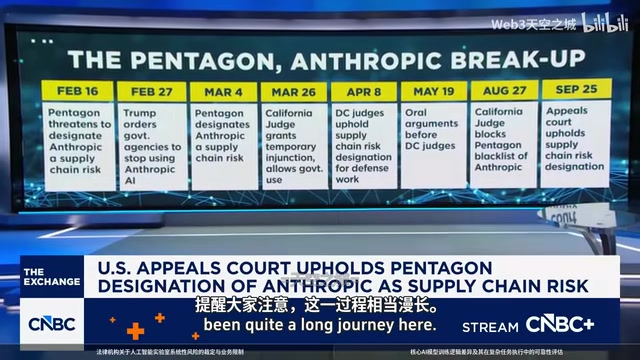
Anthropologic had argued that the decision was "arbitrary, unlawful, and unconstitutional" — but the appeals court rejected all of those claims. The judge who wrote the majority opinion stated that the Department of Defense had "sufficient basis" for concluding that continued use of Claude posed a national security risk.
Two Designations, Two Legal Battlefronts
Notably, the Pentagon originally executed the ban under two separate legal designations, which meant Anthropic had to file challenges in two different courts.
Earlier this year, a federal judge in San Francisco ruled that one of those designations was unlawful — a partial victory for Anthropic on the California front. However, the D.C. Circuit Court's ruling means the government's overall restrictions on Anthropic remain in effect.
In other words, even though Anthropic broke through on one front, it lost the fight on the front that actually determines whether it can re-enter the military supply chain. Anthropic issued a statement that day saying it "respectfully disagrees" with the ruling and is considering its options, including seeking further review on appeal.
The Legal Basis for "Supply Chain Risk" Designations
The Department of Defense's authority to designate vendors as "supply chain risks" stems primarily from supply chain security provisions in the Federal Acquisition Regulation (FAR) and the Defense Federal Acquisition Regulation Supplement (DFARS), as well as relevant amendments in the 2018 National Defense Authorization Act (NDAA). This mechanism was originally aimed at hardware vendors (such as Huawei and ZTE) before gradually expanding to cover software and AI services. Once placed on the list, a company is not only barred from direct military contracts — its products are also excluded from the entire tech stack of defense contractors, making the impact far-reaching. The reason Anthropic faced two separate designations requiring litigation in two jurisdictions is that the DoD used two distinct statutory authorities rather than a single provision.
Why Anthropic Specifically? Training Methods at the Center of the Dispute
A core question remains: why did the DoD single out Anthropic while taking no similar action against OpenAI, xAI (Grok), Perplexity, or other AI vendors?
Reports indicate the root of the dispute lies in the military's concerns about how Claude was trained. The Pentagon argued that Claude's training process reflects the political leanings of the company's leadership — with officials reportedly describing Anthropic CEO Dario Amodei as "woke."
The more critical security-layer concern is that the military believes Claude's training could cause it to refuse certain tasks based on its own "moral judgments." In a combat scenario, if an AI model "decides" not to cooperate with a given operation for whatever reason, the DoD views that as an inherent risk. This was the central concern of Emile Michael, the relevant official involved — he simply does not trust Claude's training trajectory.
"Value Alignment" and the "Constitutional AI" Training Approach
Anthropologic is well known in the industry for its safety-oriented training methodology. The company developed the "Constitutional AI" (CAI) framework: a set of "constitutional" principles is embedded into the model during training, guiding the model to self-critique and revise its own outputs according to those principles. This makes Claude more inclined to decline or de-escalate responses to potentially harmful requests. The design intent is to enable AI to proactively avoid harmful content even without extensive human annotation.
Yet this very capacity for "proactive refusal" creates a structural contradiction in defense contexts: the military needs a tool that will execute unconditionally under clearly authorized commands — not a system that independently conducts ethical assessments before deciding whether to comply. By contrast, the public safety policies of OpenAI and xAI place relatively greater emphasis on "configurability" — allowing enterprise and government users to substantially adjust refusal thresholds through system prompts, which the military may view as offering greater controllability.
Beyond Politics: The Practical Case for Supply Chain Diversification
Beyond the political and security dimensions, reports also point to a relatively technology-neutral rationale: supply chain diversification.
Emile Michael had previously stated that the military had relied exclusively on Claude as its sole technical solution before this year, and that this "was not good practice" in and of itself. Regardless of political considerations, bringing in multiple technology partners for critical infrastructure to avoid single-point dependency is a broadly accepted principle in engineering and procurement.
That said, reporting also acknowledges that politics are heavily entangled in this situation. It is worth noting that Emile Michael raised no similar training-method criticisms against OpenAI or Elon Musk's xAI — a selectivity that makes the "purely technical considerations" argument difficult to sustain on its own.
What This Signals for the AI Industry
This case carries significance well beyond Anthropic's fortunes as a single company. It reveals that AI models' "value alignment" and "safety refusal" mechanisms can be viewed as negative factors in government and military procurement contexts — the very capacity to "refuse harmful tasks" that is celebrated in the consumer market becomes a questioned liability in a defense context.
This is also a microcosm of the politicization of AI vendors' relationships with government. Training philosophies and the positions of company leadership are increasingly having direct impacts on whether businesses can access high-value government and defense markets. For all major LLM vendors, striking the right balance between "safety and control" and "trusted execution of commands" will be an unavoidable challenge when competing for government contracts.
The Double-Standard Dilemma: "Trustworthy Execution" vs. "Safety Refusal"
At a broader level, this case exposes a fundamental and unresolved tension in AI governance: the incompatibility between civilian safety frameworks and government/defense requirements. Under regulatory frameworks such as the EU AI Act and the NIST AI Risk Management Framework, a model's ability to refuse harmful instructions is treated as a positive indicator of high safety standards. In defense procurement logic, however, that same capability may be characterized as "unpredictable autonomy" — constituting an operational risk.
This fault line has systemic implications for the entire large model industry: AI product lines targeting government markets (GovAI) may require training pipelines and safety strategies entirely separate from consumer-facing products, in order to satisfy "execution-first" requirements. This suggests that major AI companies may eventually need to maintain two parallel value alignment systems — and coordinating between those two systems will itself become a new compliance and ethical challenge.
Related articles

iPhone Duo Battery Life Tested: One Charge a Day Is Unavoidable, and the Large Screen Is the Culprit
iPhone Duo battery test: heavy use needs at least one charge a day, and about 30% remains after 6.5 hours of screen-on time. How often the large screen is unfolded is key; a MagSafe battery pack helps, and long-term degradation is also worth watching.

Kimi K3.1 Pro Open-Sourced: 2.8 Trillion Parameters Close In on Opus
Moonshot releases the open-source MoE model Kimi K3.1 Pro, with 2.8T total parameters and 104B activated, trailing Opus 5.5 by under 1 point on Terminal Bench 4.0.

Costco Tech Price Guessing: Are Monitors, Keyboards, Mice, and Bose Speakers Worth It?
A YouTube blogger guesses prices of Costco tech products: 2K 180Hz monitor, Logitech keyboard and mouse, Bose speaker, and CyberPower UPS, revealing warehouse-store selection and brand premium.