Uber Teams Up with Nuro to Enter Waymo's Turf: The Robotaxi Battle Escalates

Uber partners with Nuro to enter robotaxis, directly challenging Waymo's leading position.
TechCrunch Mobility reports that Uber and Nuro have announced a partnership to formally enter the robotaxi market long dominated by Waymo. The article analyzes that Uber provides a massive travel demand entry point and dispatch network, while Nuro provides autonomous driving technology and vehicle capabilities, forming a "platform + technology provider" combination in sharp contrast to Waymo's "in-house technology + self-operated fleet" full-stack model. This partnership marks a shift from technology validation to large-scale commercial operations, with competitive focus partly moving from technical maturity to user reach and ecosystem positioning, and commercialization pace likely to accelerate. However, key details such as operating cities, deployment scale, and timelines have not been disclosed, and the partnership remains at an early stage. Whether it can gain a foothold in markets where Waymo has deep roots depends on cost, regulation, and user acceptance.
Robotaxi Race Heats Up Again
The latest installment of TechCrunch Mobility's column turns its attention to a major development in the robotaxi space: Uber and Nuro have announced a partnership, formally entering the market segment long dominated by Waymo. The news was first reported by TechCrunch Mobility. Although the original article provided only lead-in style information, combined with the backgrounds of both companies and the industry landscape, there are still plenty of noteworthy signals to unpack.
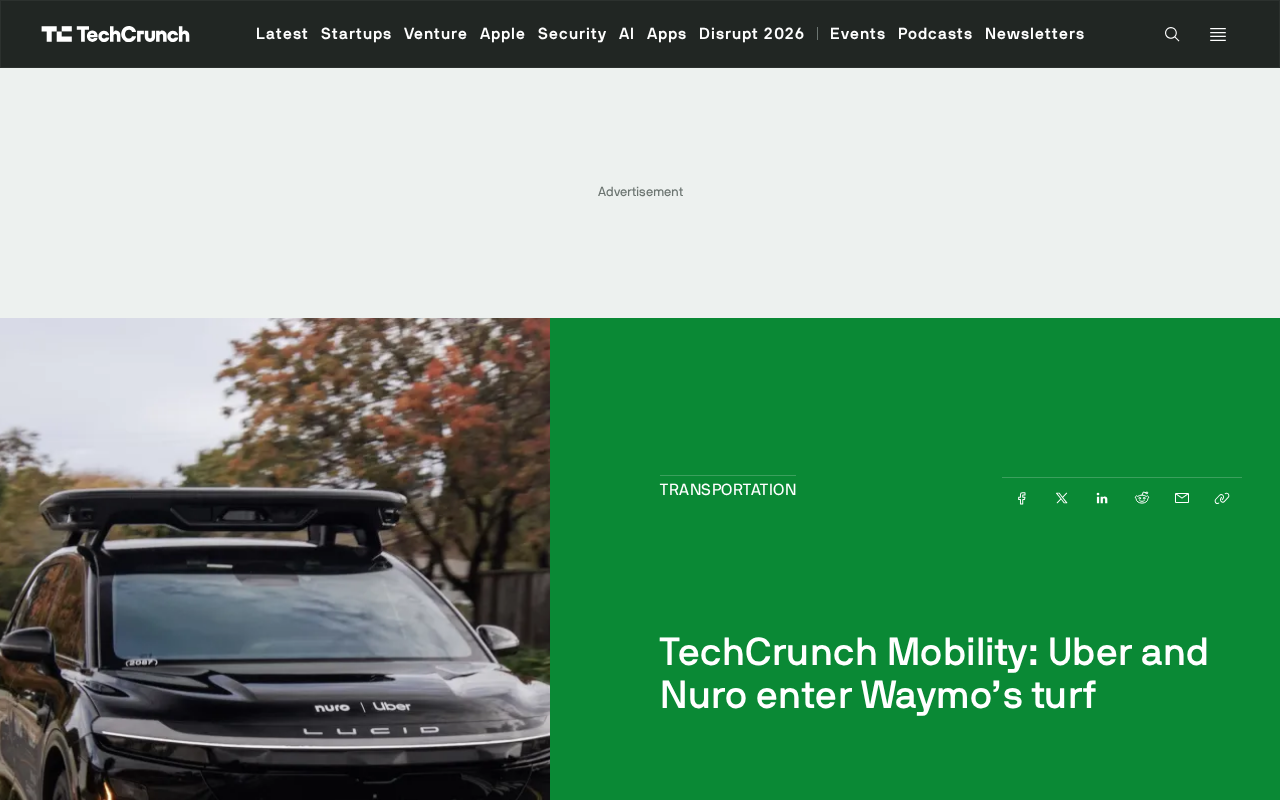
Why This Is "Entering Waymo's Turf"
Waymo got its start earliest in commercializing robotaxi operations and has accumulated substantial real-world operating mileage and user recognition across multiple cities, long regarded as the benchmark in this space. TechCrunch Mobility used "enter Waymo's turf" to describe Uber and Nuro's move — the phrasing itself carries strong competitive overtones: the new players aren't opening up marginal markets, but cutting directly into the core territory where Waymo has already established its advantage.
This kind of "frontal assault" partnership signals that competition in robotaxi is shifting from the technology validation phase to close-quarters combat over large-scale commercial operations.
Background on Waymo: Waymo is the autonomous driving subsidiary under Alphabet (Google's parent company), with roots tracing back to Google's self-driving project launched in 2009. It is one of the first companies globally to bring L4-level robotaxis to commercial operation without safety drivers, having provided public passenger services in cities including Phoenix, San Francisco, and Los Angeles, with cumulative autonomous driving mileage in the tens of millions of miles. Waymo adopts a "full-stack in-house" model — developing its own sensor suites, autonomous driving software, and operations platform, and building its own fleet. Its "turf" therefore encompasses not only technical barriers but also regulatory approvals already obtained, city-level operational experience, and user mindshare.
Role Division Between Uber and Nuro
Looking at the positioning of both companies, this partnership has a natural complementarity. Uber has a massive travel demand entry point, dispatch network, and user base, but has never developed its own autonomous vehicle solution; Nuro focuses on unmanned delivery and autonomous vehicle R&D, with hardware and autonomous driving software capabilities. Together, they form a "demand platform + autonomous driving capacity" combination, in sharp contrast to Waymo's "in-house technology + self-operated fleet" approach.
Whether this platform-based approach can break through Waymo's first-mover advantage is the most worth watching storyline going forward.
Background on Nuro: Nuro was founded in 2016 by former Google self-driving team engineers. It initially became known for its "unmanned delivery pods," with vehicles like the R2 designed specifically for low-speed, short-distance cargo delivery. It has partnered with retail brands such as Kroger and Domino's and obtained autonomous driving testing permits in California and other locations. Unlike Waymo's passenger taxi approach, Nuro has long focused on logistics scenarios, accumulating experience in low-cost vehicle design and regulatory compliance. The partnership with Uber means Nuro is extending from "unmanned delivery" to "passenger capacity" — its tech stack and vehicle platform need to adapt to higher speeds and passenger safety standards, which is also a key variable in whether the partnership can succeed.
Three Impacts on the Industry Landscape
Competition shifts from technology to ecosystem. Waymo's advantage lies in technical depth and operational experience, while Uber's strength is demand aggregation and network effects. The collision of these two models will shift the competitive focus partly from "whose technology is more mature" to "who can reach users faster."
Robotaxis enter a multi-player melee. As ride-hailing platforms like Uber personally enter the fray by binding with autonomous driving technology providers, the track is no longer a solo performance by single technology companies. Alliances and maneuvers among platforms, technology providers, and automakers will become more frequent.
Commercialization pace may accelerate. Platforms control the traffic entry point, meaning that once autonomous driving capacity is connected, real orders can be obtained faster — which in turn pushes technology providers to accelerate iteration and reduce costs.
L4 autonomous driving and the platform model: The "robotaxi" repeatedly mentioned in this article typically refers to L4-level autonomous driving — where vehicles can drive fully autonomously within a specific operational design domain without human takeover. There are two main implementation paths: one is Waymo-style "full-stack self-operation," where the technology provider simultaneously owns the vehicles, software, and operations; the other is the "platform + technology provider" model, where a ride-hailing platform (such as Uber) provides orders and dispatch, and a technology provider (such as Nuro) provides autonomous driving capacity. The latter's advantage is asset-light operations and the ability to quickly connect with multiple technology suppliers; its disadvantage is weaker control over vehicles and safety responsibility. The competition between these two models is essentially a route debate between "vertical integration" and "horizontal division of labor" in the early stages of autonomous driving commercialization.
Open Questions
Currently, public information remains at the level of partnership intent, with key details such as specific operating cities, deployment scale, and timelines still unclear. Whether Uber and Nuro can gain a foothold in markets where Waymo has already established deep roots depends on multiple factors including cost control, regulatory approvals, and user acceptance. TechCrunch Mobility's report is more like a signal flare — competition in robotaxis is moving from single-point technological breakthroughs to an ecosystem positioning battle.
For readers interested in AI's deployment in transportation, this route debate of "platform + technology" versus "full-stack self-operation" will be one of the most worth-tracking storylines for some time to come.
Related articles

Shokz OpenRun Pro 2 Drops to All-Time Low Price, $55 Off
Shokz OpenRun Pro 2 drops to $124.95 during Black Friday and Cyber Monday, $55 off and matching its all-time low. We break down the use cases, value, and buying advice for these open-ear sports headphones.

Why Does Radiation Cause Electronic Device Failures? New Study Offers an Explanation
A new study explains the mechanisms by which radiation triggers electronic device failures, exploring single event effects and total dose effects on semiconductor devices, and the implications for radiation-hardened chip design and aerospace electronics reliability.
Over Half of WordPress Sites Are Running Unsupported PHP Versions
Over 50% of WordPress sites run unsupported (EOL) PHP versions. This article examines the security risks, upgrade lock-in, and the shared responsibility of hosts and the plugin ecosystem.