UK AISI Assessment Report: A Complete Analysis of GPT-5.5's Cybersecurity Capabilities and Risks
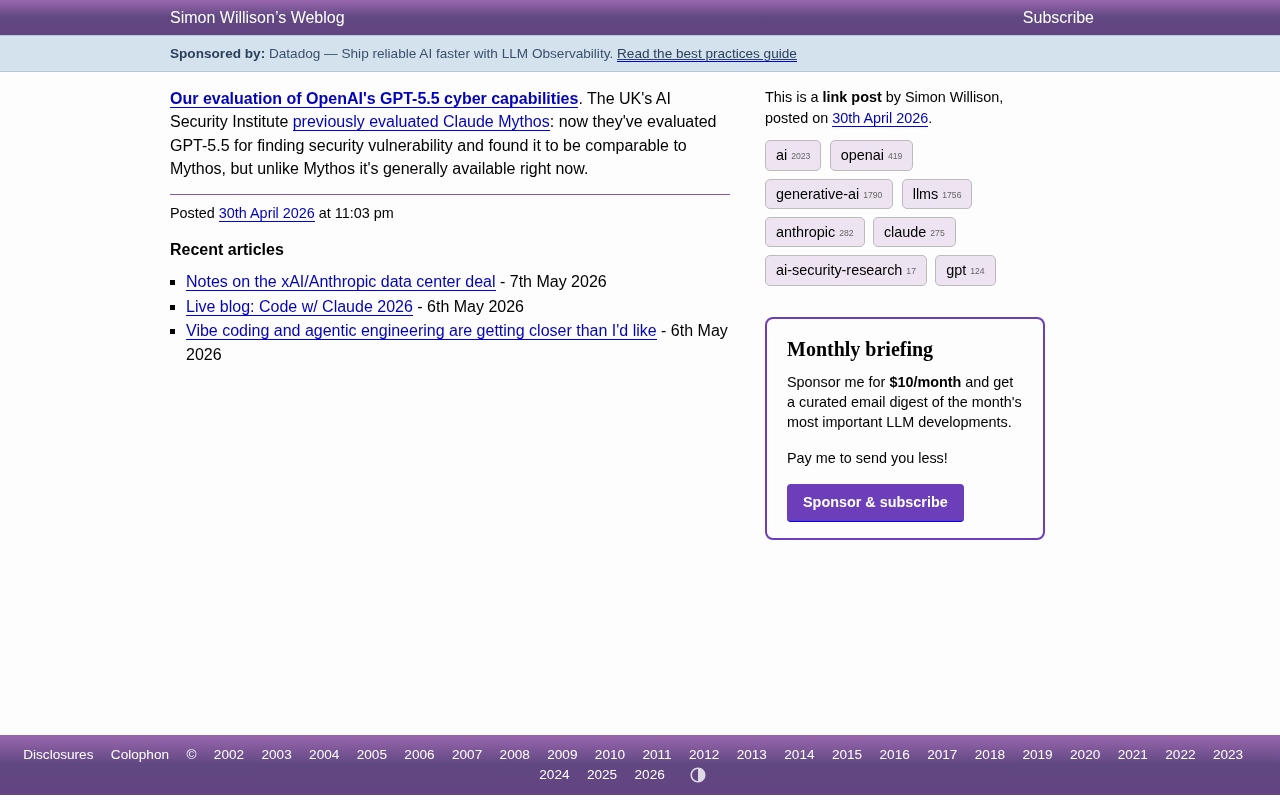
UK AISI finds GPT-5.5 matches Claude Mythos in cybersecurity, but its public availability amplifies risk.
The UK AI Safety Institute (AISI) assessed GPT-5.5's cybersecurity capabilities and found them on par with Anthropic's Claude Mythos in vulnerability discovery. The critical difference is that GPT-5.5 is already publicly available, making its professional-grade security capabilities accessible to anyone—including potential malicious actors—and raising urgent questions about defensive readiness and threat modeling.
The UK AI Safety Institute (AISI) recently released its cybersecurity capability assessment report for OpenAI's latest model, GPT-5.5. Following a similar evaluation of Anthropic's Claude Mythos, this represents AISI's systematic testing of yet another major large language model's ability to discover security vulnerabilities.
The results show that GPT-5.5's cybersecurity capabilities are roughly on par with Claude Mythos, but with one critical distinction that cannot be ignored—GPT-5.5 is currently available to the public, making the practical implications of the assessment findings all the more significant.
AISI Assessment Background: Who's Testing AI's Cybersecurity Capabilities
The UK AI Safety Institute is one of the first official organizations globally to conduct systematic assessments of AI model safety risks. Its core responsibilities include independently testing potentially dangerous capabilities of frontier AI models before and after release, with a focus on high-risk areas such as cybersecurity and biosecurity.
AISI's assessment work does not represent the position of any AI vendor. Its independence and standardized processes give its reports high reference value within the industry. This evaluation of GPT-5.5 follows the same testing framework previously used for Claude Mythos, ensuring comparability of results across different models.
GPT-5.5 Cybersecurity Assessment Methodology and Focus Areas
This assessment focused on GPT-5.5's capabilities in discovering security vulnerabilities, with testing typically covering the following dimensions:
- Code vulnerability identification: Having the model analyze code snippets to determine whether security flaws exist
- System architecture analysis: Evaluating whether the model can identify weaknesses at the system design level
- Penetration testing assistance: Testing the model's performance in simulated attack-and-defense scenarios, including whether it can assist with or independently complete penetration testing tasks
These capabilities serve as highly efficient defensive tools for security researchers, but they can equally be exploited by malicious actors. This is precisely why objective, independent assessment of frontier models' cybersecurity capabilities is so critically important.
Key Findings: GPT-5.5 vs. Claude Mythos Capability Comparison
Vulnerability Discovery Capabilities at the Same Level
AISI's assessment concludes that GPT-5.5's performance in cybersecurity vulnerability discovery is on par with Anthropic's Claude Mythos. This result sends an important signal: the frontier models from the two major AI labs are converging in cybersecurity capabilities, with the capability gap between models continuing to shrink.
The Critical Difference Lies in Availability
However, there is one far-reaching practical difference between the two:
| Comparison Dimension | GPT-5.5 | Claude Mythos |
|---|---|---|
| Cybersecurity capability | Professional-grade | Professional-grade |
| Public availability | Publicly released | In preview stage during assessment |
| Public accessibility | High | Limited |
Claude Mythos was still in a preview stage during AISI's assessment and had not been fully opened to the public; GPT-5.5, on the other hand, is already a model that anyone can access. This means the cybersecurity capabilities possessed by GPT-5.5 have already entered the realm of public accessibility, with a more direct impact on the security ecosystem.
The Double-Edged Sword Effect of AI Cybersecurity Capabilities
The advancement of large language model capabilities in cybersecurity is inherently a double-edged sword.
Value on the defensive side:
- Helping security researchers discover and patch vulnerabilities more quickly
- Reducing the time and human resource costs of security audits
- Improving overall enterprise security posture
Risks on the offensive side:
- Lowering the technical barrier to cyberattacks
- Enabling less skilled attackers to discover and exploit complex vulnerabilities
- Potentially accelerating the discovery and weaponization of zero-day vulnerabilities
This dual nature means that simply restricting AI capabilities is not the optimal solution. A more pragmatic approach is to build effective risk management mechanisms while simultaneously enhancing defensive capabilities.
What a Publicly Available GPT-5.5 Means for the Security Ecosystem
The fact that GPT-5.5 is already publicly available pushes the discussion around AI cybersecurity capabilities from the theoretical to the practical. The security community needs to confront several urgent questions:
1. Does the defensive infrastructure need upgrading?
When AI models with professional-grade vulnerability discovery capabilities are available to everyone, traditional security defense assumptions may no longer hold. Enterprises and organizations need to reassess their security posture and incorporate AI-assisted attacks into their threat models.
2. Can patching speed keep up?
AI can dramatically accelerate the vulnerability discovery process, but patching still relies on manual processes and organizational coordination. If discovery speed far exceeds patching speed, the security window will be drastically compressed.
3. How will the role of security professionals evolve?
When AI can handle a large volume of foundational vulnerability discovery work, the core value of security practitioners will increasingly be reflected in strategy formulation, risk judgment, and complex scenario response.
The Future Direction of AI Safety Assessment Frameworks
AISI's ongoing practice of conducting standardized assessments of frontier models from different vendors holds significant industry importance:
- Providing objective reference benchmarks for the industry, preventing vendors from making unsubstantiated claims
- Providing decision-making evidence for policymakers, supporting the establishment of regulatory frameworks
- Driving iteration of assessment methodologies, continuously refining testing standards as model capabilities evolve
As more and more models reach similar levels of cybersecurity capability, establishing unified assessment frameworks and risk classification standards will become increasingly urgent. It's foreseeable that future AI safety assessments will focus not only on what models "can do" but increasingly on "how they will be used" in real-world deployment environments.
Final Thoughts
The cybersecurity capabilities of frontier AI models are advancing rapidly, and the capability gaps between different models continue to shrink. AISI's assessment report on GPT-5.5 serves both as an objective record of technical capabilities and as a signal that the entire security industry should take seriously.
For security professionals, the immediate priority is clear: incorporate AI tools into your defensive infrastructure while simultaneously preparing thoroughly for the new types of threats AI may catalyze. In an era of rapid AI capability iteration, passive waiting is no longer an option.
Related articles
New Species Discovered in New York's C…
New Species Discovered in New York's Central Park? Inside the Urban Insect Hunting Project
Scientists set up insect traps in NYC's Central Park and Prospect Park to discover unknown species. With 90% of Earth's species still unnamed, urban biodiversity research is becoming a new trend in ecology.
The Full Story of the Higgs Boson Disc…
The Full Story of the Higgs Boson Discovery: An Insider's Account of the 'God Particle'
A Fermilab physicist's insider account of the Higgs boson discovery: the transatlantic race with CERN, behind-the-scenes details of the 2012 announcement, 14 years of verification, and the true origin of the 'God Particle' name.
 Research
SciMDR: How a 7B Small Model Rivals GPT-5 in Scientific Reasoning
Yale and other institutions introduce SciMDR, a two-stage data synthesis pipeline enabling a 7B model to match GPT-5 level performance in scientific literature comprehension.