UK's GDS Publicly Opposes NHS Decision to Shut Down Open Source Repositories: The Open vs. Secure Debate in the AI Era

UK's GDS publicly opposes NHS blanket closure of open source repos over AI security threats
After Project Glasswing reported that AI could scan and exploit vulnerabilities in public code, NHS blanket-closed all its open source repositories. The UK Government Digital Service (GDS) took the rare step of publicly releasing official guidance in response, explicitly advocating to "stay open by default," arguing that closing repositories not only fails to solve security problems fundamentally but also sacrifices the security benefits of community review. This public disagreement reflects the core governance challenge of how the public sector balances openness and transparency against security risks in the AI era.
NHS Blanket Shutdown of Open Source Repositories Over AI Security Vulnerabilities
The UK's National Health Service (NHS) previously made a highly controversial decision — shutting down public access to its open source code repositories. NHS is one of the world's largest single-payer healthcare systems, serving over 65 million people, and its digital transformation involves the development and maintenance of numerous software systems. NHS's open source code repositories are hosted on platforms like GitHub, containing projects ranging from patient appointment systems to data analytics tools. Open Source is a software development model where source code is publicly released, allowing anyone to view, use, modify, and distribute it. The core philosophy behind public sector adoption of open source is that code funded by taxpayers should be transparent to the public, while community collaboration improves code quality and security. The UK government has made "open by default" one of its core digital service principles since 2012.
The incident was triggered by Project Glasswing, which reported a series of security vulnerabilities to NHS, pointing out that AI technology could be used to scan and exploit security flaws in publicly available code. Project Glasswing is a project focused on AI security research, and its key finding is that modern Large Language Models (LLMs) such as the GPT series and Claude already possess the capability to automatically analyze codebases and identify common security vulnerability patterns. Traditional code security scanning relies on predefined rules and known vulnerability signature databases (such as SQL injection and cross-site scripting attacks listed in the OWASP Top 10), while AI tools can perform deeper semantic analysis and even discover logic vulnerabilities that human reviewers might miss. The "democratization" of this capability means the barrier to attack has been dramatically lowered — code audit work that previously required senior security experts weeks to complete could now potentially be done by AI in a matter of hours.
However, NHS's response was widely regarded as "ill-considered." Rather than addressing vulnerabilities in a targeted manner, NHS chose to blanket-convert all open source repositories to private, sparking strong reactions within the open source community and the UK public sector. Tech blogger Terence Eden has been continuously covering this incident, calling it "NHS declaring war on open source."
GDS Issues Official Guidance: Open Code Should Be the Default Position
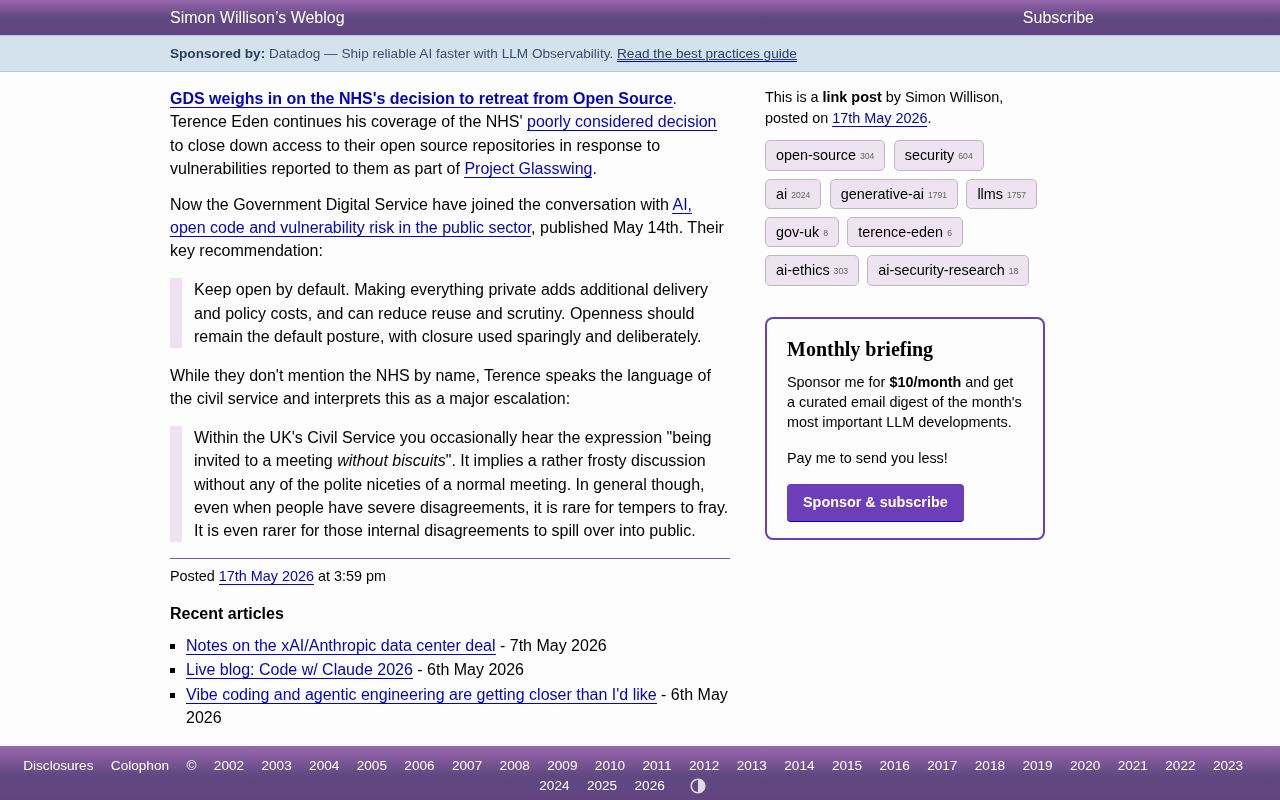
On May 14, 2026, the UK's Government Digital Service (GDS) published an official guide titled "AI, Open Code, and Vulnerability Risks in the Public Sector," formally entering the debate over open source security.
GDS was established in 2011 under the UK Cabinet Office and is the core driving force behind the UK's digital government transformation. GDS is responsible for setting cross-government digital standards and technical guidance. Its published Service Standard and Technology Code of Practice are binding on all central government departments. GDS enjoys an extremely high reputation in the global digital government space. Its "Government as a Platform" philosophy and the unified GOV.UK portal have been emulated by multiple countries. While GDS guidance does not carry legal enforcement power, it holds extremely strong authority and directional influence at the policy level, and departments typically treat it as a de facto standard to follow.
GDS's core recommendation is crystal clear:
Stay open by default. Making everything private adds delivery and policy costs and may reduce code reuse and review. Openness should remain the default posture, with closure used only when necessary — carefully and in a targeted manner.
This position stands in stark contrast to NHS's decision to shut down its open source repositories. GDS believes that when facing new code security risks brought by AI, the correct response is not to retreat into a closed state, but to manage risks in a targeted way while maintaining openness.
A Rare Public Disagreement Within the UK Civil Service
You might not have noticed that GDS did not directly name NHS in its guidance. But Terence Eden, who is familiar with UK civil service culture, believes this actually represents a major internal escalation. He used a vivid analogy to explain:
In the UK Civil Service, you occasionally hear the phrase "being invited to a meeting without biscuits." This implies a rather frosty discussion, lacking the polite courtesies of a normal meeting. Generally speaking, even when people have serious disagreements, they rarely make them explicit. And it's extremely rare for these internal disagreements to become public.
The UK Civil Service has centuries of tradition, known for political neutrality, professionalism, and internal coordination. Within this system, inter-departmental disagreements are typically resolved through internal memos, cross-departmental committees, and private consultations — rarely through public channels. The phrase "meeting without biscuits" is a metaphor within civil service circles: in UK workplace culture, formal meetings typically provide tea and biscuits as basic courtesy, and "no biscuits" implies an unfriendly, critical conversation. GDS choosing to express its position through a publicly released official guide rather than communicating with NHS through internal channels is indeed an unusually strong signal within UK government operational norms — nearly equivalent to publicly stating "we believe your approach is wrong."
In other words, GDS's choice to respond to NHS's decision by publicly releasing official guidance is, within the UK government's internal context, already an extremely strong signal — bordering on open criticism.
The Deep Contradiction Between Open Source Code Security and AI Threats
The core of this debate touches on a key issue in contemporary technology governance: When AI tools can scan and exploit vulnerabilities in public code at scale, how should the public sector balance openness and transparency against security risks?
Project Glasswing revealed an undeniable reality — Large Language Models (LLMs) and generative AI can indeed be used to discover and exploit security flaws in open source code. This is a real threat, and NHS's concern is not without merit.
But GDS's position represents a more mature line of thinking, theoretically grounded in the famous "Linus's Law" from the open source security field, proposed by open source advocate Eric S. Raymond in his classic work The Cathedral and the Bazaar: "Given enough eyeballs, all bugs are shallow." This principle holds that the public transparency of code allows the global developer community to participate in review, thereby discovering and fixing security vulnerabilities more quickly. Historically, the security of critical open source projects like the Linux kernel and OpenSSL has been maintained precisely through this kind of large-scale community review.
Of course, this principle is not without controversy — the 2014 Heartbleed vulnerability serves as a cautionary tale. Heartbleed was a severe vulnerability in the OpenSSL cryptographic library that existed for over two years, affecting approximately 17% of the world's secure web servers. It demonstrated that even widely used open source code can harbor critical vulnerabilities that go undetected for extended periods. This highlights that relying solely on "many eyes" is insufficient — systematic security audit processes are also needed.
The public nature of open source code is itself a security mechanism. More reviewers means higher security. Shutting down code repositories not only fails to fundamentally solve the problem (attackers may have already obtained copies of the code), but also loses the security benefits of community review, while increasing maintenance costs and reducing code reuse efficiency.
Implications for Global Public Sector Open Source Security Strategy
This incident provides an important reference case for open source strategies across the global public sector:
-
Panic-driven responses often backfire. When facing new security threats from AI, blanket closure of open channels may seem decisive but is likely to create more problems.
-
Code security strategy in the AI era requires greater granularity. Rather than closing all repositories, it's better to establish more robust vulnerability response mechanisms, code review processes, and sensitive information detection tools. There are currently multiple mature technical tools available for public sector adoption: GitHub's Secret Scanning feature can automatically detect accidentally committed API keys, passwords, and other sensitive information in code repositories; tools like Dependabot can automatically monitor known vulnerabilities in project dependency libraries and prompt updates; SAST (Static Application Security Testing) and DAST (Dynamic Application Security Testing) tools can automatically perform security scans before code deployment. Additionally, many organizations adopt a "Shift Left Security" strategy, embedding security checks into the early stages of the development process rather than reviewing code only after publication. These tools and methodologies make "maintaining openness while managing risk" a practical and viable strategy.
-
Openness and security are not a zero-sum game. GDS's guidance clearly states that it is possible to maintain openness by default while placing targeted restrictions on specific components that genuinely pose risks.
-
Policy-making requires sufficient technical understanding. NHS's decision exposes the possibility that decision-makers may lack sufficiently deep understanding of how the open source ecosystem operates and its security mechanisms.
This public disagreement within the UK government fundamentally reflects the governance challenges the entire public sector faces in the AI era. How to effectively manage emerging security risks while embracing open innovation will be a core question that governments worldwide must answer in the coming years.
Related articles
 Tech Frontiers
A Rare Quiet Day in AI: Recursive Self-Improvement Stirs Beneath the Surface
A rare quiet day in AI sees multiple sources go silent simultaneously. Behind the calm, Recursive Self-Improvement (RSI) research continues. What this means for the industry.
 Tech Frontiers
Reve 2 vs. Ideogram 4: A Deep Dive into Layout Control in AI Image Generation
A deep comparison of Reve 2 and Ideogram 4's layout control capabilities, covering technical approaches, real-world use cases, and industry trends for designers and creators.
 Tech Frontiers
In the Weights: Check Your Influence Score in the AI World
In the Weights is an AI influence search engine that quantifies your presence in the AI world with a score. Explore how it evaluates practitioners and what it means for digital identity.