Unified FreeBSD Service Management: Run All Services from a Single Console

FreeBSD services are scattered across entry points; a unified console can establish consistent semantics but requires weighing failure paths.
The article analyzes the pain point of scattered FreeBSD service management entry points, arguing that a unified console's value lies in consistent operational semantics for start, stop, status, and logs. It presents three technical layers—rc.d script wrappers, process supervisors like runit/s6, and jexec-based jail aggregation—along with their trade-offs, and recommends rc as the foundation, supervisors for core apps, and retaining native tools as an escape hatch.
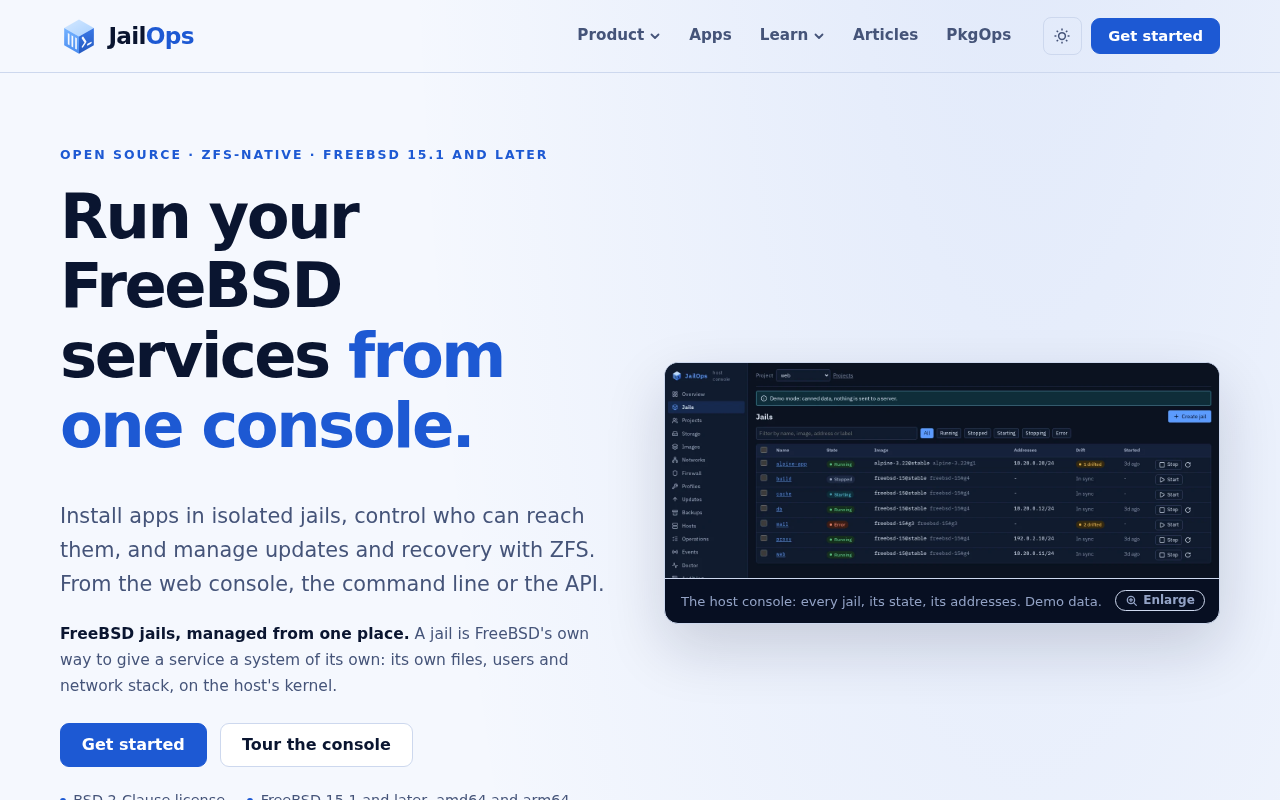
In heterogeneous operating system environments, FreeBSD has earned its place in the network services space thanks to its stability. But service management has long faced a real-world problem: built-in rc scripts, third-party daemons, services inside jails, and scheduled tasks are scattered across different management entry points, forcing operations staff to constantly switch between multiple terminals and tools. A recent discussion on Hacker News—"Run your FreeBSD services from one console"—speaks directly to this pain point.
Why a single console is worth attention
FreeBSD's rc system is the cornerstone of system service management; sysrc, service, and rc.d scripts form the standard path. But in real deployments, services take far more forms than this: databases, web servers, and message queues often run as standalone processes; jails and bhyve virtual machines host isolated environments; and cron and periodic handle recurring tasks.
Bringing these entry points together into one console is valuable not because it saves a few switches, but because it establishes consistent operational semantics. The actions of starting, stopping, checking status, and reading logs stay homogeneous across all services, so when troubleshooting you don't first have to recall "who manages this service."
Key conventions of rc.d scripts
FreeBSD's rc framework relies on a set of metadata variables to determine the load and execution order of scripts: PROVIDE declares the service name the script provides, REQUIRE lists services that must start first, BEFORE declares which services it should precede, and rcvar specifies the name of the switch variable that controls the service (usually in the form foo_enable). The script header must also source /etc/rc.subr and call run_rc_command "$1", letting the framework uniformly handle subcommands such as start, stop, and status. Only by following these conventions can a script be listed by service -l, included in the enabled list by service -e, and placed in the correct order in the boot sequence. Missing REQUIRE declarations can cause a service to start before its dependencies are ready—this is the most common source of failure in custom rc.d scripts.
Several technical layers of unified management
Using the rc system as the unified abstraction
The lightest-weight approach is to wrap services that aren't managed by rc into rc.d scripts as well. FreeBSD's rc framework itself supports custom scripts; by following the PROVIDE, REQUIRE, and rcvar conventions, a service can be brought into the unified view of service -e and service -l.
The advantage of this approach is zero external dependencies and compatibility with the system upgrade path; the cost is that you need to write and maintain a script for each service, and process supervision is limited—rc scripts are good at "starting once," while support for crash restart and resource limits requires additional design.
Introducing a process supervision layer
If you want to cover crash self-healing and log aggregation, a process supervisor is a more thorough solution. runit and s6 from the daemontools family both have mature practices on FreeBSD, providing supervision trees, automatic restarts, and structured logging. Making them the unified entry point for all services lets rc scripts handle one-shot system services while the supervisor handles long-running application processes—in fact making the boundary of responsibilities clearer.
What supervision trees and structured logging mean
The core model of supervisors like runit and s6 is the "supervision tree": a resident supervisor process is responsible for launching and watching its child processes, restarting them immediately after they exit, and using exponential backoff to avoid crash loops. Services are organized by directory, with a run script placed in each service directory, so the supervisor can learn about all services simply by traversing the directories without a central registry. As for structured logging, runit's svlogd and s6's s6-log write process stdout/stderr line by line into timestamped log directories with support for rotation, compression, and filtering, replacing syslog's centralized forwarding path. This binds logs to the service lifecycle, so when troubleshooting you can go directly to a specific service's output stream instead of filtering the global syslog by process name.
Incorporating jails and virtualization
When services run inside jails, the console needs to cross boundaries. jexec can enter a jail to execute commands, but aggregating the service status inside a jail into a host-side view requires additional wrapping. The trade-off here is: a merged view improves observability, but it also blurs the isolation semantics of the jail, so you need to be explicit about which operations are allowed to cross the boundary.
jexec and the jail isolation boundary
jexec is a tool provided by FreeBSD for entering a running jail to execute commands; it essentially uses the jail's prison association to fork a process within the target jail's namespace. It requires the caller to have the appropriate privileges on the host, and the target jail to be running. Because jails share the host kernel but have their own process view, network stack (configurable), and filesystem root, aggregating service status inside a jail from the host usually requires cross-boundary calls like jexec <jid> service <name> status, or collection through monitoring endpoints exposed inside the jail. Note that cross-boundary operations weaken the jail's isolation assumptions: once the console has the ability to execute arbitrary commands inside a jail, the console itself becomes the trust boundary of the isolation model, and its privilege design must be stricter than that of ordinary operations tools.
The costs to weigh
A single console isn't always better. An abstraction layer adds failure paths: if the supervisor itself goes down, all services are affected; if a wrapper script goes wrong, troubleshooting is harder than calling native tools directly. In addition, the FreeBSD community has a strong cultural preference for "keeping system tools simple," and introducing extra abstraction requires convincing the team to accept a shift in operational complexity.
A pragmatic criterion is the number of services. With a small number of services, a combination of native tools is sufficient; only when the service scale grows to the point where you need to remember multiple entry points do the benefits of a unified console begin to outweigh its maintenance cost.
Practical recommendations
Prioritize rc scripts as the foundation layer of the unified entry point, so that system services and non-critical processes fall into place first; for core applications that need self-healing, then introduce a supervisor and clearly define its boundary with rc. Keep jail-related operations on a separate command path, and merge views only for read-only status queries. Whichever combination you adopt, always retain an escape hatch for calling native tools directly—a unified console is a convenience layer, and should not become the only path.
One-line Summary
FreeBSD services are scattered across multiple entry points; a unified console can establish consistent operational semantics but requires weighing failure paths.
Paragraph Summary
The article centers on the Hacker News discussion "Run your FreeBSD services from one console," analyzing the real-world pain point of scattered FreeBSD service management entry points. The core argument is that the value of a unified console lies not in reducing the number of switches, but in establishing consistent operational semantics for starting, stopping, status queries, and log reading. The article presents three technical layers: wrapping non-rc services into rc.d scripts that follow the PROVIDE/REQUIRE/rcvar conventions, which is dependency-free but has limited supervision capability; introducing supervisors like runit and s6 for crash self-healing and structured logging; and bringing jail services into the view via jexec, while being wary of blurring isolation semantics. The article also points out that an abstraction layer introduces new failure paths, and uses the number of services as a pragmatic criterion for whether unification is worthwhile, ultimately recommending rc as the foundation layer, supervisors covering core applications, and retaining an escape hatch to native tools.
Related articles

Jensen Huang Returns to Nvidia: The Power Game Behind an "Aggro Reset"
Nvidia's board reappointed Jensen Huang as CEO less than two weeks after his scandal-driven resignation. This analysis explores the board's decision-making, Trump's political intervention, media power failure, and market reaction behind the dramatic return.

Why Voice AI Can't Understand Kenyans' Everyday Conversations
Swahili speech recognition hits 3.24% error on read text, but everyday Kenyan speech mixes English, Sheng slang, and accents—leaving mainstream voice AI struggling.

Data Centers Build Their Own Natural Gas Plants: AI Compute's Breakout Around a Decade-Long Grid Wait
Grid interconnection approvals can take a decade, so xAI and others are building off-grid natural gas plants to power AI clusters. This article analyzes the drivers, costs, and impact of behind-the-meter generation on AI infrastructure.