Unitree G1 Autonomous Kart Driving Video: Technical Breakdown and Community Skepticism

Technical analysis reveals why the Unitree G1 autonomous kart driving video is likely fake or heavily embellished.
A viral video claiming to show a Unitree G1 humanoid robot autonomously driving a go-kart has drawn strong skepticism from the robotics community. This article breaks down why the task exceeds current humanoid robot capabilities, examines the suspicious editing and unverifiable publisher identity, and provides practical guidelines for evaluating robot demonstration authenticity.
A Robot Driving Video That Sparked Controversy
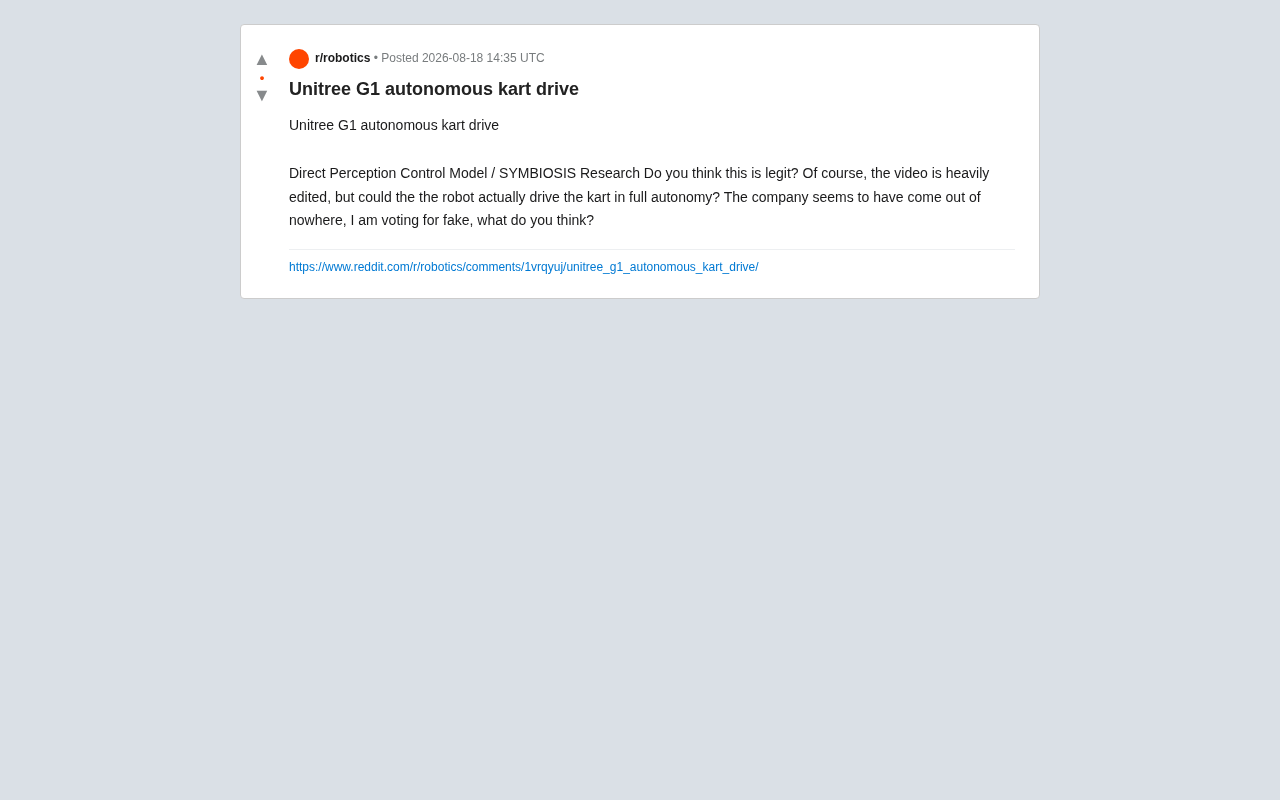
Recently, a video titled "Unitree G1 autonomous kart drive" went viral on Reddit and other social platforms. In the video, Unitree's humanoid robot G1 sits in a go-kart and appears to be driving the vehicle in a fully autonomous manner. The publisher attributes this to a so-called "Direct Perception Control Model" and credits a research organization called SYMBIOSIS Research.
However, the video was met with intense skepticism from the moment it appeared. As the original Reddit poster bluntly stated: "This company seems to have appeared out of nowhere — I'm voting fake." This suspicion isn't unfounded — the video is heavily edited, lacking continuous, unprocessed footage, which is precisely the key criterion for judging the authenticity of robotic autonomous capabilities.
Can the Unitree G1 Really Drive a Kart Autonomously? A Technical Feasibility Analysis
To assess whether this video is genuine, we need to break down the technical difficulty behind the task of "a robot autonomously driving a go-kart."
Unitree G1's Hardware Foundation and Positioning
Before analyzing task difficulty, it's important to understand the basic capability boundaries of the Unitree G1. Founded in 2016 and headquartered in Hangzhou, Unitree Robotics is one of the representative companies in the global humanoid and quadruped robot space. Their product line has expanded from early quadruped robots (such as A1, Go1, Go2) to humanoid robots. The G1, released in 2024, starts at approximately 99,000 RMB (around $14,000), positioned as a "cost-effective" option. Standing about 127cm tall and weighing approximately 35kg, it features up to 43 degrees of freedom. The G1 is equipped with depth cameras and LiDAR perception suites, supporting various control paradigms including reinforcement learning and imitation learning. Compared to Boston Dynamics' Atlas or Tesla's Optimus, the G1 is positioned more as a research platform for lightweight application scenarios — this hardware foundation determines its inherent limitations in high-dynamic, high-precision manipulation tasks.
Task Complexity Far Exceeds What Meets the Eye
Having a humanoid robot drive a go-kart may seem as simple as "sitting down, pressing the gas pedal, and turning the steering wheel," but it actually involves the coordination of multiple highly complex subsystems:
- Real-time environmental perception: The robot needs to identify track boundaries, obstacles, and driving paths through cameras or other sensors;
- Physical manipulation precision: The robot's hands must stably grip the steering wheel and make continuous, precise steering movements, while its feet (or hands) control the throttle and brake;
- Dynamic balance and disturbance rejection: Vibrations and centrifugal forces during kart operation continuously challenge the robot's seated stability;
- End-to-end control loop: The entire pipeline from perception to decision-making to execution must have extremely low latency to handle high-speed scenarios.
As a cost-effective humanoid robot, the Unitree G1's hardware capabilities (dexterous hand degrees of freedom, joint torque, perception suite) are at a respectable level in the industry, but independently completing all the above tasks still presents a considerable technical gap. Particularly at the physical manipulation level, go-kart steering wheels typically require significant torque to turn (especially at low speeds), and whether the G1's arm joint torque is sufficient to stably control direction during high-speed cornering is itself an unverified question.
What Exactly Is the Direct Perception Control Model?
The "Direct Perception Control Model" mentioned in the video is a real technical paradigm in the autonomous driving field — it advocates skipping explicit scene reconstruction and directly mapping perceptual inputs to control outputs (similar to end-to-end learning).
This concept was first systematically proposed by Princeton University researchers around 2015. Its core idea is to find a middle path between the traditional modular autonomous driving pipeline (perception → planning → control) and purely end-to-end approaches. Traditional methods require first building a complete 3D environment map, then performing path planning, and finally outputting control commands; Direct Perception instead extracts "affordance indicators" directly from camera images — such as the vehicle's distance from lane lines, the angle of the vehicle ahead — then generates control signals directly based on these intermediate representations. In recent years, this approach has gained more attention and engineering validation through work by NVIDIA's end-to-end autonomous driving, Tesla's FSD, and companies like Wayve.
But a crucial distinction must be emphasized: all successful application scenarios above involve standard vehicles where software directly controls electronic steering and throttle systems (i.e., sending digital control commands via CAN bus), rather than having a physical robot body manipulate a steering wheel. The latter adds an extremely complex layer of motion control — the robot must not only "decide" how many degrees to turn but also "execute" that decision through joint motor drives, hand force control, and a series of physical interactions. The technical gap between these two is far greater than most people imagine.
In other words, the concept is real, but there's an enormous engineering distance between "the concept is valid" and "it has been implemented and runs stably."
Why the Community Leans Toward "Fake"
Synthesizing the Reddit community discussion, skepticism mainly focuses on the following points:
Questionable Publisher Identity
"SYMBIOSIS Research" lacks verifiable background, publication records, or industry recognition. An organization that has truly achieved such a breakthrough would typically have accompanying technical reports, open-source code, or authoritative media coverage, rather than presenting only an edited video. In today's academic and industrial landscape, even startup teams that achieve noteworthy technical results typically establish credibility through arXiv preprints, GitHub repositories, or at least detailed technical blog posts.
Heavy Editing Conceals Critical Information
The original post explicitly noted that "the video is heavily edited." In the robotics demonstration field, editing is the most common sleight of hand — by splicing successful segments, hiding failure moments, or even using teleoperation to impersonate autonomous behavior, convincingly realistic effects can be created.
Teleoperation refers to a human operator remotely controlling a robot to perform tasks in real-time. In the current humanoid robotics field, teleoperation is not only a common data collection method (for gathering expert demonstration data to train imitation learning models) but is also the actual technical approach behind many seemingly "autonomous" demonstration videos. For example, an operator can wear a VR headset and motion capture gloves, mapping their movements to the robot in real-time. Since teleoperated videos and autonomous operation videos are virtually indistinguishable in appearance (unless an unattended control console is explicitly shown), it has become one of the most common "beautification" techniques in the industry. Companies like Figure and 1X Technologies have both faced community skepticism for this reason, later responding by releasing complete unedited videos and technical papers.
Truly autonomous capability demonstrations require long takes, no edits, and reproducibility.
Lack of Third-Party Verification and Official Confirmation
As of now, Unitree has not confirmed this as an official project, nor has any independent researcher reproduced or verified the results. In the AI and robotics field, "if it can't be reproduced, it's suspect" is a fundamental principle.
How to Judge the Authenticity of Robot Demonstration Videos
The virality of such videos reflects a phenomenon worth being vigilant about in today's robotics and AI field: the gap between demo marketing (demo hype) and actual capability is being systematically amplified.
Demo Hype has become a systemic issue in the AI and robotics industry. Between 2023-2025, as funding in the humanoid robotics sector surged (global humanoid robotics funding exceeded billions of dollars in 2024 alone), companies face enormous pressure to showcase results. Typical cases include early robot company demonstration videos that were revealed to be played at multiple speeds, pre-programmed trajectory playbacks, or the best clips selected from hundreds of attempts. The harm of this phenomenon lies not only in misleading the public but also in distorting investment decisions and talent flows, potentially leading to a trust crisis similar to an "AI winter." IEEE and multiple academic organizations have called for establishing standardized evaluation protocols for robot capability demonstrations.
As humanoid robots become the focus of capital and public discourse, all kinds of "mind-blowing" demonstrations keep emerging. As rational technology observers, we should adhere to the following judgment principles:
- Look for continuity: Prioritize trusting unedited long-take demonstrations;
- Look for reproducibility: True technical breakthroughs withstand third-party verification;
- Look for information transparency: Legitimate teams publicly share their methodology, limitations, and failure cases;
- Distinguish teleoperation from autonomy: Many "autonomous" demonstrations are actually remotely controlled by humans.
For the Unitree G1 kart driving case, in the absence of more conclusive evidence, classifying it as "most likely embellished or even fabricated" is a prudent and reasonable judgment. This doesn't deny the Unitree G1's actual capabilities, nor does it deny the value of "Direct Perception Control" as a technical direction. Rather, it reminds us: before cheering for an impressive demo, first ask "Can it be verified?"
Conclusion
Humanoid robotics is on the eve of an explosion — real progress is exciting, but exaggerated demonstrations can equally erode public trust. For videos like "Unitree G1 autonomous kart driving," maintaining curiosity while maintaining skepticism is perhaps the most needed technical literacy of our era. Until authoritative verification arrives, the answer remains a big question mark.
Related articles

AgentCore in Practice: Connecting Custom Tools and MCP Servers to Agents
DebuggerCafe tutorial shows how to connect custom tools and MCP servers to Amazon Bedrock AgentCore agents, covering tool contract design, MCP reuse, and production concerns.

816B Parameters Scores Only 39? The Real Cost-Effectiveness of the Open-Source LLM Parameter Race
Meta's 816B Muse Spark Open scores just 39 on Artificial Analysis, while 180B Qwen3.8-Flash-Next scores 40. This article analyzes 11 open-weight models' parameters vs. scores, exploring the real impact of activated parameters, quantized size, and deployment cost.

Aerial Manipulators: The Next Step for Drones from 'Seeing' to 'Changing'
Starting from a Reddit discussion, this article analyzes the technical challenges, potential applications, and deployment bottlenecks of aerial manipulators, exploring the key challenges for drones moving from environmental perception to physical manipulation.