Unscary AI: 42 Bite-Sized Lessons to Help You Stop Feeling Behind on AI

Unscary AI offers 42 free micro-lessons to help everyday users overcome AI anxiety on iOS.
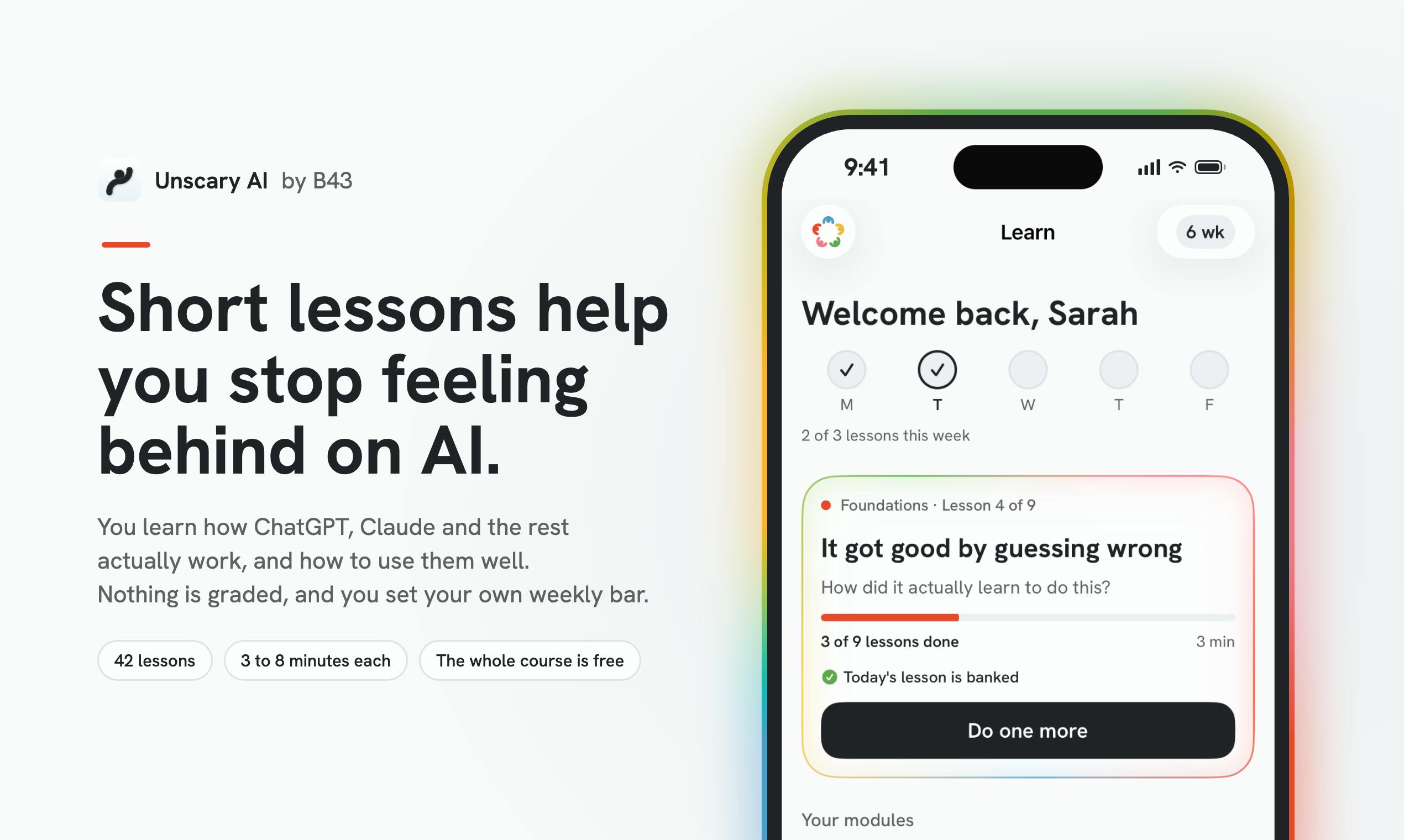
Unscary AI is a free iOS learning app designed for everyday users who feel anxious or left behind by AI. Built around real questions from learners at B43, the app delivers 42 short lessons covering how tools like ChatGPT work and how to use them effectively. It requires iOS 26 and earned 81 upvotes on Product Hunt at launch. Its core value lies in providing structured, low-pressure guidance for the non-technical majority who are stuck at the AI onboarding stage.
A Learning App Designed for "AI Anxiety"
As artificial intelligence evolves at a breakneck pace, a familiar feeling is spreading — many people feel like they just can't keep up. With ChatGPT, new large language models, and an endless stream of "must-know" prompting tips flooding social media, everyday users often find themselves drowning in information overload and self-doubt.
Unscary AI is an iOS app built specifically for this pain point. Its tagline is refreshingly straightforward — "Short lessons help you stop feeling behind on AI." After launching on Product Hunt, the app earned 81 upvotes and ranked #19, listed under the iOS, Education, and Artificial Intelligence categories.
Curriculum Built Around Real Student Questions
What makes this product stand out is that its content wasn't designed in a vacuum — it grew out of real teaching experiences. According to the development team, their organization B43 trains dozens of people every week, and through that process they noticed something counterintuitive: many learners genuinely feel like they're falling behind in the age of AI.
As the developer candidly put it: "If you're on Product Hunt, you probably don't feel behind on AI. It's a highly filtered audience." This gets straight to the heart of who the app is for — not tech enthusiasts, but everyday people who feel confused and anxious about AI. The entire curriculum is built around real questions collected from those learners.
This question-driven approach feels more grounded than many AI tutorials that simply pile on features. Rather than trying to cover every cutting-edge concept, it focuses on answering the questions learners actually have right now.
42 Micro-Lessons: Learning AI Principles in Bite-Sized Chunks
Unscary AI packages its curriculum into 42 short lessons, all accessible on iPhone. The content focuses on two core dimensions:
- How tools like ChatGPT actually work — helping users understand the basic logic behind the AI "black box" and demystify the technology
- How to use these tools effectively — offering practical, actionable techniques that translate into real-world skills
The short-lesson format is well-suited to modern fragmented learning habits. Each lesson is brief and low-barrier, making it easy to squeeze in during a commute, a wait in line, or any idle moment — without the pressure that comes with long-form video tutorials. The app's name, "Unscary," says it all: AI doesn't have to be intimidating, and understanding it isn't as hard as it seems.
Free to Use — With a System Requirement to Note
The entire course is completely free, which lowers the barrier to entry and reflects the team's mission to make AI education more accessible. One caveat: the app requires iOS 26, which means users on older devices or older software versions won't be able to access it for now.
For an educational product, a free model is a smart way to build an early user base and earn word-of-mouth. But the high system requirement could filter out a portion of potential users in the short term — a tradeoff between broad reach and leveraging the latest platform capabilities.
iOS 26 is Apple's next-generation mobile operating system, announced at WWDC 2025. It's currently in developer preview, with the public release expected alongside new iPhones in the fall. Requiring iOS 26 suggests the app may rely heavily on new system APIs or UI frameworks (such as the new Liquid Glass visual system), but it also means the app is inaccessible to the vast majority of current iPhone users during this period. This system requirement drew some attention in the Product Hunt community, with several users noting they couldn't install it — which likely explains the app's relatively modest vote count. For the developers, launching ahead of the public release may be a strategic move to claim an early foothold in the new ecosystem, at the cost of waiting for the user base to grow as the system rolls out.
A Few Observations on AI Education Products
The emergence of Unscary AI reflects a need that's easy to overlook amid the broader AI conversation. While the industry focuses on model parameters and technical breakthroughs, a large number of everyday users are stuck at the very first step — not because they lack information, but because they lack structured, psychologically accessible guidance.
From this perspective, the value of a product like this isn't about teaching advanced technical skills. It's about helping users build a basic mental model of AI and the confidence to actually use it. As AI tools become increasingly woven into daily work and life, the demand for accessible, non-technical education will only grow. Unscary AI's lightweight, free, question-driven approach offers a compelling template for serving that market.
Product Hunt is a globally recognized platform for launching tech products, where new releases are featured daily for community voting and discussion — with top-ranked products earning significant visibility. Its user base skews heavily toward early adopters, developers, and tech enthusiasts. That's precisely why the developer noted that "Product Hunt users don't feel behind on AI" — Unscary AI's true target audience isn't active on platforms like this. They're scattered across a much broader population of everyday consumers. This audience mismatch is a common early-stage challenge for products aimed at non-technical users: the people who need it most are often the least likely to find it through the channels where it gets the most exposure.
Related articles

Gemini 4 Argon Hands-On: AI Builds Board Games, Constructs Temples, and Trains Robots Autonomously
Gemini 4 Argon hands-on roundup: AI autonomously builds a desk racetrack and temple in Blender, writes a ray tracing engine, trains a humanoid robot to sink 7 shots, plus API pricing and developer access.

The Magic Octagonal Coin: Why Only 9% of People Can Predict Its Flip?
Only 9% of people can correctly predict the Magic Octagon coin flip. This article explains its spatial rotation mechanism, common cognitive pitfalls, and a new hypothesis based on Relevance Theory, exploring the limits of human spatial reasoning.

Sam Altman: AI Is Entering the Era of Scientific Discovery — Math Breakthroughs Will Replicate in Biology and Energy
Sam Altman says AI is entering the era of scientific discovery — math breakthroughs will replicate in biology, materials science, and energy to help develop new drugs and energy sources.