Unsloth Now Supports AMD GPUs: 2x Training Speedup and 70% VRAM Savings Across 500+ Models

Unsloth brings its 2x faster, 70% VRAM-saving fine-tuning framework to AMD's full GPU lineup.
Unsloth has partnered with AMD to bring its efficient LLM fine-tuning framework to AMD GPUs, covering RDNA 3-4 consumer cards, Strix Halo APUs, and MI300 data center accelerators. The integration delivers 2x training speedup and 70% VRAM savings across 500+ models, with support for reinforcement learning, vLLM weight sharing, and Windows/Linux/WSL compatibility—offering a viable alternative to NVIDIA's CUDA-dominated training ecosystem.
Unsloth Teams Up with AMD, Bringing a New Hardware Option for LLM Training
For years, large language model training and fine-tuning has been almost entirely dominated by NVIDIA's CUDA ecosystem. NVIDIA's CUDA (Compute Unified Device Architecture) was released in 2007 and has accumulated over a decade of development into a complete software stack spanning from low-level drivers to high-level frameworks. Major deep learning frameworks like PyTorch and TensorFlow prioritize CUDA optimization, while acceleration libraries such as cuDNN, cuBLAS, and NCCL form the infrastructure of AI training. This deep software ecosystem lock-in means that even when competing hardware offers better price-performance ratios, developers are often forced to choose NVIDIA due to software compatibility concerns—creating a de facto platform lock-in effect.
Recently, the well-known open-source fine-tuning framework Unsloth announced a deep collaboration with AMD, officially extending its efficient training capabilities to AMD GPU platforms and injecting new possibilities into the AI training ecosystem. Unsloth is an open-source project founded by brothers Daniel and Michael Han in 2023, focused on efficient fine-tuning of large language models. Its core technology achieves dramatic reductions in training resource requirements without sacrificing model accuracy through manual backpropagation kernel rewriting (rather than relying on PyTorch autograd), 4-bit quantized training (QLoRA) optimization, and intelligent memory management. Unsloth rapidly accumulated tens of thousands of GitHub stars and has become one of the go-to tools for individual developers and small teams fine-tuning mainstream open-source models like Llama, Mistral, and Gemma.
According to Unsloth's official announcement, this collaboration brings reinforcement learning (RL), inference, Notebook support, and a series of other features to Unsloth and Unsloth Studio, claiming 2x training speedup and up to 70% VRAM savings across more than 500 models.
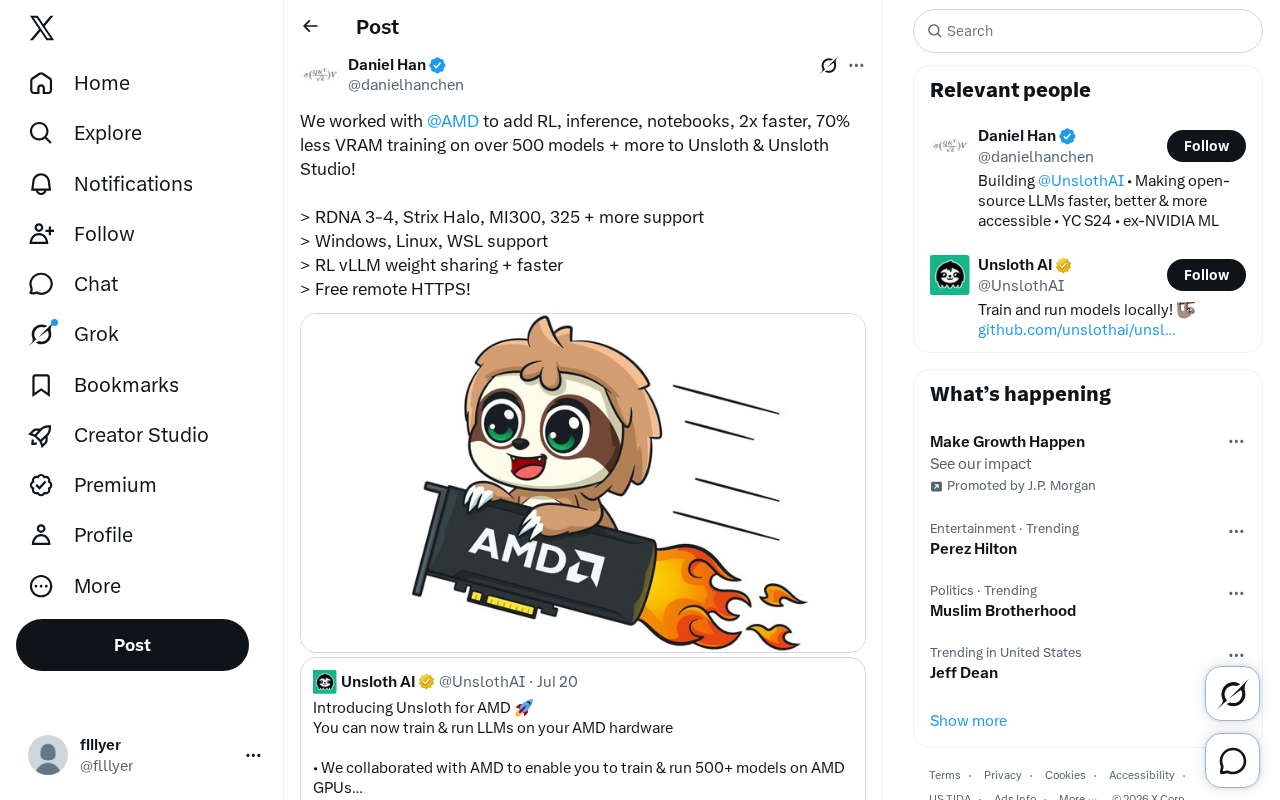
Broad AMD Hardware Coverage
The most striking aspect of this collaboration is the breadth of hardware support. Unsloth explicitly lists supported AMD product lines, spanning nearly every mainstream architecture from consumer to data center:
-
RDNA 3-4 Architecture: Covers AMD's last two generations of consumer Radeon graphics cards, allowing everyday developers to perform efficient fine-tuning with their gaming GPUs. RDNA (Radeon DNA) is AMD's consumer GPU architecture series launched since 2019. RDNA 3 (Radeon RX 7000 series) introduced a chiplet design that separates compute units from memory controllers in manufacturing, and was the first consumer GPU to adopt a hybrid 5nm+6nm process. RDNA 4 (Radeon RX 9000 series) launched in early 2025, further enhancing matrix computation capabilities related to AI inference. Notably, RDNA architecture support for FP16/BF16 matrix operations has seen substantial improvements with each generation, providing the hardware foundation for running AI training tasks on consumer graphics cards.
-
Strix Halo: AMD's APU platform targeting high-performance mobile and mini workstation use cases, opening up possibilities for edge-side AI development. Strix Halo integrates powerful RDNA 3.5 GPU cores with large-capacity unified memory, with a shared CPU-GPU memory pool that can reach 128GB—offering unique advantages for loading large-parameter models.
-
MI300, MI325, and Other Data Center Accelerators: Flagship AI chips competing against NVIDIA H100/H200, directly targeting enterprise-scale large-scale training scenarios. The AMD Instinct MI300X uses the CDNA 3 architecture with 192GB of HBM3 memory (far exceeding NVIDIA H100's 80GB) and memory bandwidth of 5.3TB/s. The MI325X is an upgraded version, boosting HBM3e memory to 256GB. These products' massive memory capacity offers natural advantages when handling ultra-long contexts or extremely large models, and companies like Meta and Microsoft have already deployed MI300 series for certain workloads.
This full-line coverage from desktop to data center means developers can tap into Unsloth's optimized training workflow regardless of what tier of AMD device they own, dramatically lowering the barrier to entry.
Breaking Platform Barriers: Full Support for Windows, Linux, and WSL
On the software compatibility front, Unsloth has also put in significant effort. The team officially announced support for Windows, Linux, and WSL (Windows Subsystem for Linux) environments.
WSL is Microsoft's built-in Linux compatibility layer in Windows 10/11, with WSL2 running a complete Linux kernel through a lightweight virtual machine. For AI developers, WSL2's key value lies in its GPU passthrough support—NVIDIA implemented CUDA on WSL as early as 2020, while AMD's ROCm support for WSL lagged behind. WSL allows developers to maintain their Windows desktop environment (for daily work and IDEs) while gaining native Linux-level AI training capabilities, avoiding the hassle of dual-boot switching.
This point is particularly crucial for the AMD ecosystem. Previously, AMD's ROCm (Radeon Open Compute) software stack had relatively weak Windows platform support, and many training workflows could only run under Linux. ROCm provides the HIP (Heterogeneous-compute Interface for Portability) programming interface, allowing developers to port CUDA code to AMD GPUs relatively easily, but it has long faced challenges including incomplete Windows support, limited consumer GPU coverage, and insufficient optimization of certain deep learning operators. In recent years, AMD has significantly increased investment, and ROCm 6.x versions have shown notable improvements in stability and compatibility, with PyTorch now natively supporting the ROCm backend.
With full support across all three platforms—especially native Windows and WSL compatibility—the large number of individual developers and researchers using Windows workstations can now more smoothly conduct model fine-tuning on AMD hardware without being forced to switch operating systems or set up complex dual-boot environments.
Reinforcement Learning and Inference Capabilities
Beyond basic supervised fine-tuning (SFT), this update also introduces support for reinforcement learning (RL), which is particularly timely given the growing importance of alignment and reasoning model training. The industry currently employs techniques like RLHF (Reinforcement Learning from Human Feedback), DPO (Direct Preference Optimization), and GRPO (Group Relative Policy Optimization) to improve model alignment and reasoning performance—methods that often demand far more computational resources than basic supervised fine-tuning.
A noteworthy technical detail is RL vLLM weight sharing. vLLM is a high-performance LLM inference engine developed at UC Berkeley, with its core innovation being PagedAttention technology that manages KV Cache in a manner similar to operating system virtual memory paging, dramatically improving inference throughput and VRAM utilization. During reinforcement learning training, you typically need to maintain both a training model (actor model for policy updates) and an inference model for generation sampling (generating responses for reward model evaluation), which often creates enormous VRAM overhead—for a 70B parameter model, simply loading two copies of the model weights requires over a hundred gigabytes of VRAM. Through the weight sharing mechanism with the vLLM inference engine, Unsloth enables the training framework and inference engine to share the same model weights in memory, avoiding redundant loading, further compressing VRAM usage and improving overall throughput. This is one of the key technologies behind achieving the "70% VRAM savings" claim.
Additionally, built-in inference support and Notebook integration allow users to immediately validate model performance after fine-tuning, creating a closed-loop workflow from training to testing that significantly improves development efficiency.
Free Remote HTTPS: Lowering the Barrier to Experience
The official announcement also specifically mentions a free remote HTTPS feature. This means users can more conveniently access, share, or deploy their training environments and model services remotely—quite valuable for team collaboration and quick demonstration scenarios. Integration similar to tools like ngrok allows developers to expose locally running model services as accessible HTTPS endpoints without configuring complex network environments or purchasing public IPs. These kinds of "out-of-the-box" convenience features are often critical factors in whether open-source tools achieve widespread adoption.
Analysis: A Crack in CUDA's Monopoly
From an industry perspective, the Unsloth-AMD collaboration carries significant implications.
First, it provides developers with a genuinely viable alternative beyond CUDA. The long-standing strong dependency on NVIDIA hardware for AI training has led to high compute costs and supply constraints. During 2023-2024, NVIDIA H100 market premiums at one point exceeded 2-3x the list price, with delivery lead times stretching to months. When a mature fine-tuning framework renowned for "efficiency" begins natively supporting AMD's full product line, market diversification and competition finally have a real foundation.
Second, Unsloth itself is known for saving VRAM and delivering speed, with its core value proposition being to enable resource-constrained developers to fine-tune large models. The underlying QLoRA (Quantized Low-Rank Adaptation) technology stores pre-trained models at 4-bit quantized precision while performing gradient computation and updates at full precision on a small number of low-rank adapter parameters, making it possible to fine-tune 65B parameter models on a single GPU with 24GB of VRAM. Unsloth further optimizes quantization/dequantization compute kernels and memory access patterns on top of this. Porting these optimization capabilities to AMD hardware—which typically offers better price-performance—undoubtedly amplifies this value: cheaper GPUs running more VRAM-efficient, faster training is extremely attractive to individual researchers, startups, and university labs.
Of course, it's worth noting that the officially claimed "2x speedup" and "70% VRAM savings" are typically measured against unoptimized baselines, and actual performance will vary by model size, hardware model, and task type. Developers are still advised to validate against their own use cases before adoption.
Conclusion
The Unsloth-AMD collaboration signals that efficient LLM training tools are actively embracing a multi-hardware ecosystem. For developers struggling with compute costs or NVIDIA GPU supply constraints, this at least provides a new path worth exploring. As supported models surpass 500 and hardware coverage extends from desktop to data center, AMD's presence in the AI training space is poised to grow further. Meanwhile, Intel's oneAPI and Gaudi accelerators, along with various domestic AI chips, are also working to build their own training ecosystems—the entire AI compute market is gradually shifting from NVIDIA's dominance toward multi-player competition. This race for AI compute ecosystem supremacy is becoming increasingly exciting.
Related articles

DIY Air Purifier: Building a Silent CR Box with PC Fans and an Aluminum Frame
Learn how to build a quiet Corsi-Rosenthal air purifier using PC case fans and an aluminum frame, covering fan selection, PWM speed control, and cost analysis.

Universality of Gradient Descent Training: Does Neural Network Architecture Choice Really Matter?
Exploring the universal approximation capability of gradient descent training, analyzing the relationship between neural network architecture choice and learnability, from UAT to NTK theory.

From AI to Large Models: Understanding the Conceptual Landscape and Technological Evolution of Artificial Intelligence
Understand how AI, machine learning, deep learning, large models, and generative AI relate to each other. From Deep Blue to ChatGPT, learn how Transformer architecture gave rise to LLMs.