Unsloth Update Deep Dive: Run Qwen-Image-2.1 Locally and Custom Agent Skills

Unsloth now runs Qwen-Image-2.1 locally and introduces reusable Agent Skills for modular AI workflows.
Unsloth v0.1.815-beta combines feature breakthroughs with dense polish. It enables local Qwen-Image-2.1 image generation and editing on consumer GPUs via Fast FP8 and GGUF Q4_K_M. New Agent Skills let users package workflows as reusable modules importable from Claude Code `.agents` files, activated via `@`. Inference rendering jumps from 30 to 60 FPS, training resumption and dataset mapping are fixed, and LoRA SFT on B200 is ~8% faster. Linux gains ARM64 .deb packages and an AMD ROCm Docker image.
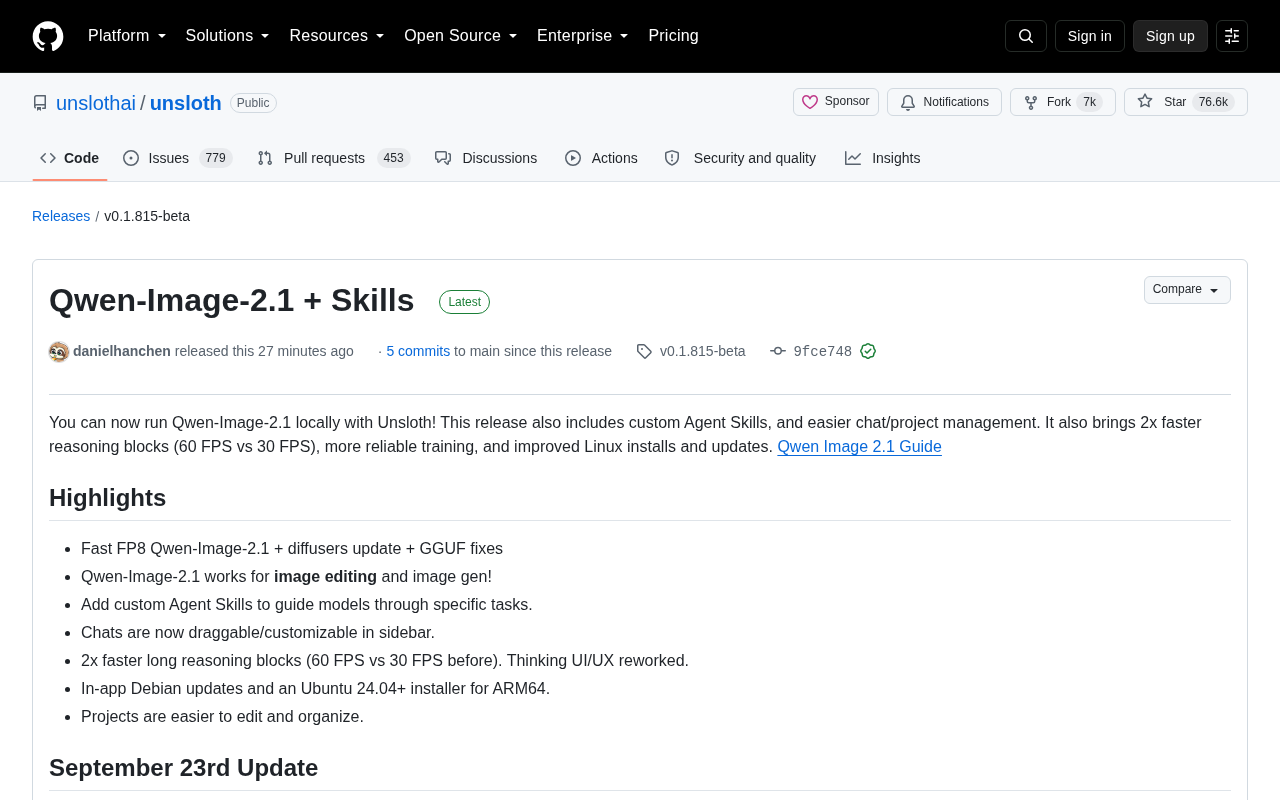
Unsloth has released v0.1.815-beta (pip version unsloth>=2026.9.7), with two major highlights: the ability to run the Qwen-Image-2.1 image model locally, and the introduction of a customizable Agent Skills mechanism. Beyond these, the release brings a smoother inference interface, more reliable training workflows, and significantly improved Linux desktop distribution support.
Running Qwen-Image-2.1 Locally
The most anticipated capability in this update is local support for Qwen-Image-2.1, covering both image generation and image editing. Unsloth provides a Fast FP8 version that balances speed with VRAM usage, making local deployment of image models accessible to consumer-grade GPU users.
The changelog reveals that integrating the image model was no small feat. The September 22 update added image editing support for Qwen-Image-2.1, fixed diffusers update issues and a GGUF loading bug, and changed the default GGUF precision from F16/BF16 to Q4_K_M to lower the barrier to entry. The team also resolved diffusion-related black artifact issues on A100 and consumer GPUs.
On September 23, further fixes addressed httpx errors in diffusion pipelines and a bug preventing the Fast FP8 version from appearing in the UI. This rapid succession of patches reflects the significant compatibility and hardware adaptation work involved in stably integrating diffusion-based image models into a local inference framework.
Qwen-Image-2.1 is a multimodal diffusion model released by Alibaba's Tongyi team, supporting both text-to-image and image editing tasks. Its underlying architecture is based on Diffusion Models, which differ from the Transformer inference path used in large language models — diffusion models require multi-step denoising iterations, placing greater demands on memory bandwidth and compute intensity, which explains why they present more compatibility challenges than pure text models.
Fast FP8 refers to an inference quantization scheme using 8-bit floating point (Float8) numerical format. Compared to standard FP16 or BF16, FP8 reduces VRAM usage by roughly half and delivers higher throughput on GPUs with hardware FP8 acceleration (such as NVIDIA H100/H200/B200). GGUF Q4_K_M is a 4-bit quantization format for CPUs and low-VRAM GPUs, driven by the llama.cpp ecosystem and suited for consumer hardware. Switching the default precision from F16 to Q4_K_M means ordinary users can run the model directly without manually selecting a compression level.
Agent Skills: Equipping Models with a "Skill Pack"
The newly introduced Agent Skills allow users to add custom skills to guide the model through specific tasks. The design is pragmatic — it can directly reuse existing skills from your Claude Code and .agents folders, avoiding redundant configuration.
In practice, users can invoke skills via the @ symbol in chat and manage their skill library in one place. This "skills as plugins" approach modularizes agent capabilities: rather than cramming all instructions into a lengthy system prompt, common task workflows are encapsulated into reusable, switchable skill units. For developers who frequently switch between different tasks, this significantly reduces the burden of context management.
Claude Code is Anthropic's command-line AI coding assistant. Its .agents folder convention stores a collection of custom instructions as Markdown files, each describing a reusable workflow or role definition. Agent Skills can read this format directly, meaning developers who have already built up a skill library in Claude Code workflows can reuse it in Unsloth with zero migration cost.
Architecturally, Agent Skills are essentially a structured management layer over "system prompt injection." The traditional approach is to manually paste large blocks of instructions before a conversation begins, whereas the Skills mechanism modularizes these instructions into independent units that are activated on demand via the @ symbol — enabling more granular context control within a single inference session and making it easier for teams to share and version-manage their prompts.
A Thorough Polish of the User Experience
Beyond functional breakthroughs, this release also invested heavily in interaction details. Chat history can now be drag-sorted, pinned, or moved into projects; model loading behavior is smarter, with chats correctly remembering previous settings; and the Thinking (chain-of-thought) UI/UX has been redesigned for a cleaner, more modern look.
On the performance front, rendering speed for long reasoning blocks has doubled — from 30 FPS to 60 FPS — and long code responses maintain smooth syntax highlighting during streaming output. Project management is more flexible too, with users now able to edit project names, instructions, and folders directly from the Projects page.
Also noteworthy is an enhancement for vision models: they can now "see" images returned by MCP tools, completing the loop for multimodal workflows. On the storage side, chats can reuse already-downloaded models instead of re-fetching them, and Settings now includes a view for inspecting and clearing cache usage.
More Robust Training and Export
For model fine-tuning users, this release includes numerous reliability fixes. Training resumption and dataset preparation are more dependable, and uploading models to Hugging Face Hub now automatically excludes leftover files from earlier exports.
Hugging Face datasets now work correctly in recipes, past training runs can be resumed with accurate remaining time displayed, dataset column mapping is more precise, and selected splits/subsets are correctly respected. These seemingly minor fixes are precisely the areas where long training runs most commonly go wrong.
On the performance side, there's a concrete data point: on a single B200 GPU, LoRA SFT per-step time for Qwen3.5-9B was reduced from 0.84 seconds to 0.77 seconds — a model-agnostic, general-purpose optimization.
LoRA (Low-Rank Adaptation) SFT (Supervised Fine-Tuning) is the mainstream parameter-efficient fine-tuning approach today. LoRA inserts low-rank decomposition matrices alongside the original weight matrices, training only the newly added parameters (typically 0.1%–1% of full parameters), dramatically reducing VRAM requirements and training costs. SFT refers to supervised training using labeled input-output pair datasets, and is the foundational step before RLHF pipelines.
B200 is NVIDIA's Blackwell architecture data center GPU, offering higher FP8/FP4 compute and HBM3e memory bandwidth. The per-step reduction for Qwen3.5-9B LoRA SFT on B200 from 0.84s to 0.77s (roughly 8.3% improvement) is described as "model-agnostic," meaning these framework-level improvements benefit all models running on Blackwell hardware — not a Qwen3.5-specific optimization.
Significant Improvements for Linux and Hardware Support
This update brings meaningful enhancements to Linux/desktop distribution. The Debian installer now supports in-app updates, and a native ARM64 Linux .deb package is now available, along with an ARM64 installer for Ubuntu 24.04+.
AMD users get a new ROCm Docker image bundling Unsloth Studio and JupyterLab. The team also did extensive work for complex hardware environments: mixed NVIDIA and AMD hosts can request the ROCm torch stack, APUs with unified memory are correctly identified as sharing host memory rather than dedicated VRAM, and when ROCm is unavailable the system falls back to a Vulkan-based sd.cpp build.
Accessibility and readability have also been improved — larger text gets more display space, contrast settings make buttons and menus easier to read, and logs can be filtered, word-wrapped, and quickly jumped to the latest entry. These improvements may seem minor, but they directly impact the smoothness of day-to-day use.
Summary
Overall, this release is a classic combination of feature breakthroughs and dense detail polishing. Local support for Qwen-Image-2.1 extends Unsloth from a pure fine-tuning tool toward a multimodal inference platform, while Agent Skills strengthens its positioning as an agent development environment. Behind the scenes, the hundreds of PRs covering stability, cross-platform compatibility, and interaction fixes are the real foundation that makes these new capabilities genuinely usable. For developers pursuing local, controllable AI workflows, this update is well worth attention.
Related articles

Trump's Request to Rename the Atlantic Rejected by Google; 1Password Lets AI Agents Log In Securely
The Vergecast roundup: Trump's request to rename the Atlantic the 'Trump Ocean' was politely declined by Google's CEO; 1Password's new feature lets AI agents log into accounts without touching passwords; OPPO launches the world's first 200-megapixel phone, the Find X10 Pro Max. All three point to the boundaries of tech authorization and trust.

The Truth About American College Party Culture: The Risks Schools Won't Admit
Behind American college party culture, the administration's "don't ask, don't tell" attitude is amplifying freshman risks. This article analyzes how the pandemic strengthened Greek dominance, freshmen's difficulty accessing safety information, and the chain reactions caused by a culture of denial.

OpenAI Reportedly Raising $30B at $1.25T Valuation Ahead of IPO
OpenAI is planning a $30B funding round at a possible $1.25T valuation, paving the way for an IPO. If completed, it would set a private company valuation record. This article analyzes the funding size, pre-IPO logic, and industry signals.