Unsloth v0.1.461-beta: Fix for Local GGUF Vision Model Loading

Unsloth v0.1.461-beta fixes local GGUF vision model loading issues in llama-server.
Unsloth v0.1.461-beta is a targeted patch release that fixes local GGUF vision model loading in Unsloth Studio's llama-server backend. Key changes include preserving visual inference capability, reducing noisy log output, and adding smart companion file (mmproj) discovery from variant directories — improving stability for local multimodal deployments.
Unsloth Continues to Iterate: Focusing on Local Multimodal Deployment
Unsloth is one of the most popular LLM fine-tuning acceleration frameworks available today, with over 67,000 GitHub stars and 6,100+ forks — firmly in the top tier of open-source fine-tuning tools. Its ability to significantly reduce VRAM usage and speed up training workflows has made it a go-to solution for efficiently fine-tuning mainstream open-source models like Llama, Mistral, and Qwen.
Unsloth's performance advantage stems from its deep optimization of the backpropagation computation graph. Traditional PyTorch training requires retaining large amounts of intermediate activations during gradient computation. Unsloth reimplements the attention mechanism and portions of the feed-forward network layers using hand-written Triton kernels. Triton is a GPU programming language developed by OpenAI that allows developers to write high-performance GPU kernels using Python-like syntax, with performance approaching hand-written CUDA code. Unsloth adopts a "recomputation" strategy via Triton — rebuilding intermediate activations on demand during backpropagation rather than caching them throughout. This technique, also known as Gradient Checkpointing, reduces memory usage from O(n) to O(√n) at the cost of roughly 30% additional compute overhead. By combining recomputation with operator fusion, Unsloth maximizes VRAM savings while keeping extra compute costs in check, achieving an overall VRAM reduction of 40–70%.
Combined with QLoRA (Quantized Low-Rank Adaptation), Unsloth enables consumer GPUs like the RTX 3090 and 4090 to fine-tune models with billions of parameters. QLoRA was proposed by the University of Washington team in 2023. Building on the original LoRA (which freezes pretrained weights and only trains bypass low-rank decomposition matrices), QLoRA introduces 4-bit NormalFloat (NF4) quantization to compress base model weights, along with double quantization and paged optimizer techniques — making it possible to fine-tune a 65B parameter model on a single consumer GPU. This creates a complementary contrast to multi-GPU distributed training solutions like DeepSpeed and FSDP.
Recently, Unsloth released version v0.1.461-beta, focused on fixing local GGUF vision model loading behavior in the Studio module on llama-server. For developers relying on locally deployed multimodal models, this patch-level update carries real practical value.
Core Updates: Three Key Fixes
Primary Fix: Preserving Local GGUF Vision Inference Capability
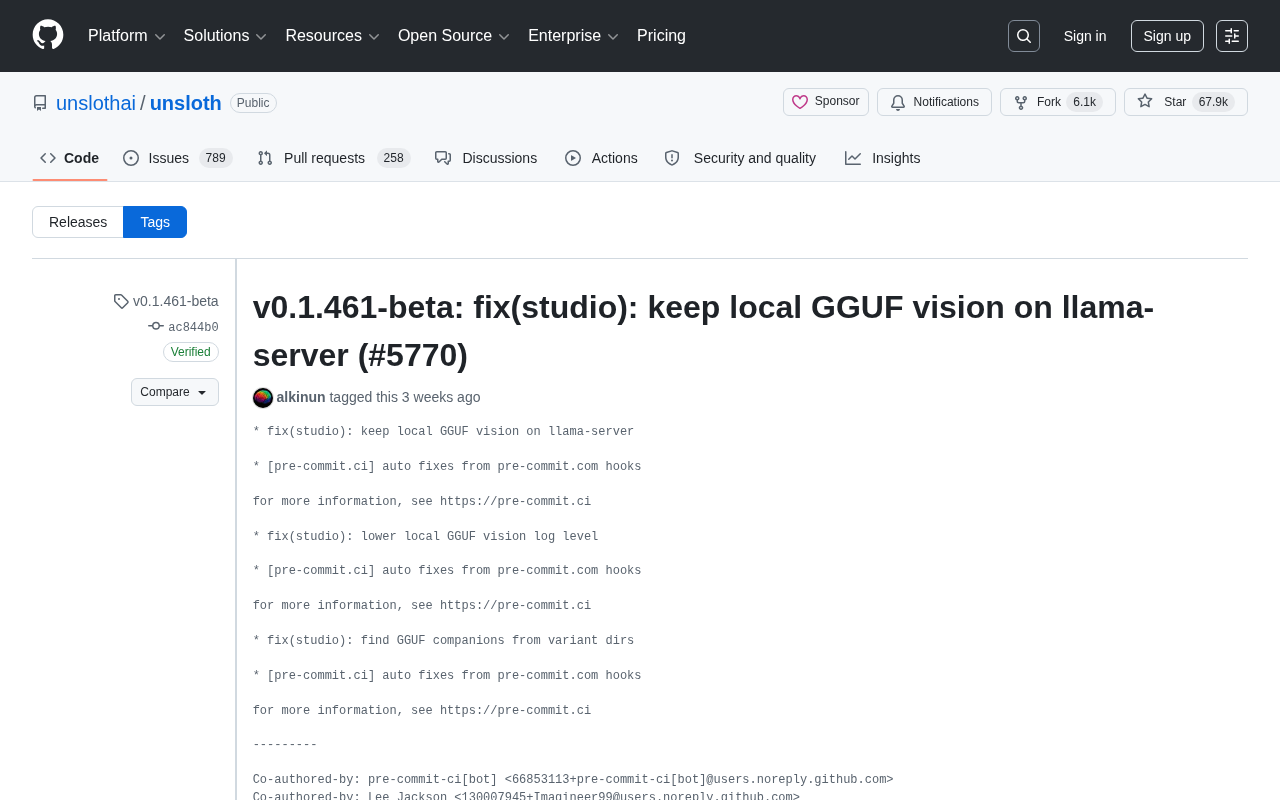
The central commit in this update is fix(studio): keep local GGUF vision on llama-server (PR #5770). The root cause: when users loaded local GGUF-format vision models in Unsloth Studio, llama-server failed to properly preserve the visual inference capability, causing multimodal functionality to break silently.
GGUF (GPT-Generated Unified Format) is the standard model format for the llama.cpp ecosystem, introduced by the llama.cpp project in August 2023 as a comprehensive upgrade and replacement for the earlier GGML format. GGUF bundles model weights, tokenizer vocabularies, hyperparameter configurations, and more into a single file, supporting multiple quantization precisions such as Q2_K, Q4_K_M, and Q8_0 — compressing 70B-parameter models to sizes manageable on consumer hardware. The "K" series quantization uses grouped quantization and mixed-precision techniques, preserving higher precision for more critical layers. GGUF has become the de facto standard format for mainstream local inference tools like llama.cpp, Ollama, and LM Studio.
For vision-language models (VLMs), beyond the main model weights, a separate multimodal projector (mmproj) file is typically required to handle image input. This fix directly targets that multimodal loading pipeline.
Three Substantive Changes
- Preserve local GGUF vision capability: Ensures that visual inference functionality is not inadvertently stripped when llama-server loads a local GGUF model.
- Lower vision log verbosity: Reduces the log level for local GGUF vision-related messages, preventing excessive noise during normal operation and improving the user experience.
- Find GGUF companion files from variant directories: Adds
find GGUF companions from variant dirslogic to automatically locate companion files like mmproj from model variant subdirectories, improving file organization flexibility.
These three changes precisely address three critical points in local multimodal deployment: whether it loads, whether it loads cleanly, and whether companion files can be found.
Technical Background: Why Local Vision Model Loading Is Complex
The File Structure Challenge of Multimodal Models
Unlike text-only models, locally deployed vision-language models consist of multiple files. The multimodal projector (mmproj) is a key bridging component that connects the visual encoder to the language model. Taking the LLaVA architecture as an example, the complete inference pipeline unfolds in three stages: first, a visual encoder such as CLIP transforms the image into high-dimensional visual feature vectors — CLIP (Contrastive Language-Image Pretraining), released by OpenAI in 2021, was trained on 400 million image-text pairs using contrastive learning. Its visual encoder (typically a ViT-L/14 or ViT-H/14 variant) divides the input image into fixed-size patches and outputs sequences of 1024 or 1280-dimensional feature vectors. Next, the mmproj (usually an MLP linear layer or cross-attention module) maps the visual feature space to the language model's word embedding space, placing image features and text tokens in the same semantic dimension — the quality of this projection layer directly determines the ceiling of the model's vision-language understanding. Finally, the language model performs autoregressive generation over the fused multimodal sequence.
For common architectures like LLaVA and Qwen-VL, the complete inference pipeline typically requires:
- The main language model's GGUF quantized file;
- The mmproj projection file corresponding to the visual encoder (usually only a few hundred MB, far smaller than the main model);
- Corresponding tokenizer and configuration files.
In GGUF local deployment scenarios, llama-server must explicitly specify the projector path at startup via the --mmproj parameter. Any error in path resolution logic causes visual capability to silently fail. When these files are scattered across different variant directories, toolchains lacking smart path discovery logic are prone to the "found the main model but lost vision capability" failure mode. The newly added variant directory search logic directly addresses this pain point.
llama-server's Role in Inference Deployment
llama-server is a local HTTP inference service provided by llama.cpp that implements an interface specification highly compatible with the OpenAI Chat Completions API, allowing developers to switch existing OpenAI API code to a local endpoint with minimal changes. llama.cpp was initiated by Georgi Gerganov in March 2023, starting as an experiment running LLaMA models on a MacBook CPU and rapidly evolving into a cross-platform inference engine supporting multiple backends including CUDA, Metal, and Vulkan. Its core technique involves quantizing high-precision floating-point weights to 4-bit or lower integer representations and achieving efficient inference through highly optimized CPU/GPU hybrid compute paths. llama-server emerged as the core component for service-oriented deployment within this ecosystem.
Unsloth Studio uses llama-server as one of its inference backends. In Unsloth Studio's workflow, after users complete LoRA fine-tuning and export to GGUF, they can launch llama-server directly through the Studio interface for conversational testing — evaluating fine-tuning results without additional deployment engineering. This fix ensures that fine-tuned vision models can properly exercise their multimodal capabilities along this deployment path, completing the full loop from training to local deployment.
Practical Value for Developers
Improved Stability for Local Multimodal Inference
As data privacy and cost control become increasingly important, more teams are choosing to deploy quantized multimodal models locally rather than relying on cloud APIs. This update directly improves the stability of visual inference tasks in offline environments and reduces the likelihood of hitting deployment issues with local GGUF vision models.
Upgrade Recommendations
v0.1.461-beta is still in beta and may have other edge cases that aren't fully stable yet. Production environment users are advised to first validate local GGUF vision model loading and inference behavior in a test environment — confirming that companion files like mmproj are correctly detected — before upgrading. Additionally, since log verbosity has been reduced, you may need to manually increase log detail levels when troubleshooting issues.
Summary
Unsloth v0.1.461-beta is a minor, fix-focused release, but it reflects the project's ongoing refinement of the local multimodal deployment use case. As vision-language models become increasingly mainstream, the ability to reliably run GGUF-format multimodal models in local environments is becoming an important dimension for evaluating the maturity of fine-tuning frameworks. For developers active on the front lines of open-source model fine-tuning, staying current with updates like this often helps avoid significant deployment headaches in real-world engineering.
Related articles

The Truth Behind Codex 'Build a Website in 5 Minutes': AI Isn't Creating Sites—It's Helping You Copy Them
Exposing the truth behind viral Codex 5-minute website videos: creators aren't building original sites with AI—they're copying shared prompts or scraping others' work. Learn AI coding tools' real limits.

Getting Started with AI Agent Development: A Complete Guide from Concept to Practice
A comprehensive guide to AI Agent architecture and development, covering automated marketing, intelligent customer service, and investment analysis scenarios with single and multi-agent collaboration.

The Truth Behind Codex 'Build a Website in 5 Minutes': AI Isn't Creating Sites — It's Helping You Copy Them
Exposing the truth behind viral Codex 5-minute website videos: creators aren't building original sites with AI — they're copying shared prompts or scraping others' work.