US Air Force Awards $49M Contract to WindBorne for Weather Data: 700 Balloons and an AI Forecasting Model

US Air Force awards WindBorne a $49M non-competitive contract for global weather data and AI forecasting.
The US Air Force signed a contract worth up to $49 million with WindBorne Systems to procure global atmospheric data and AI forecasting on a non-competitive basis. WindBorne operates ~700 autonomous balloons feeding its WeatherMesh 6 AI model, enabling high-frequency, high-resolution data. About $1.7M in orders have been placed so far. The deal marks commercial weather data's entry into defense procurement.
The US Air Force has signed a contract worth up to $49 million with California-based weather technology company WindBorne Systems to procure its global atmospheric observation data and AI forecasting capabilities. What makes this deal unusual is that it bypassed the public bidding process—the government directly determined that WindBorne possesses a "unique capability" to deliver the global-scale atmospheric data the military needs.
What WindBorne Does: 700 Autonomous Balloons + the WeatherMesh Model
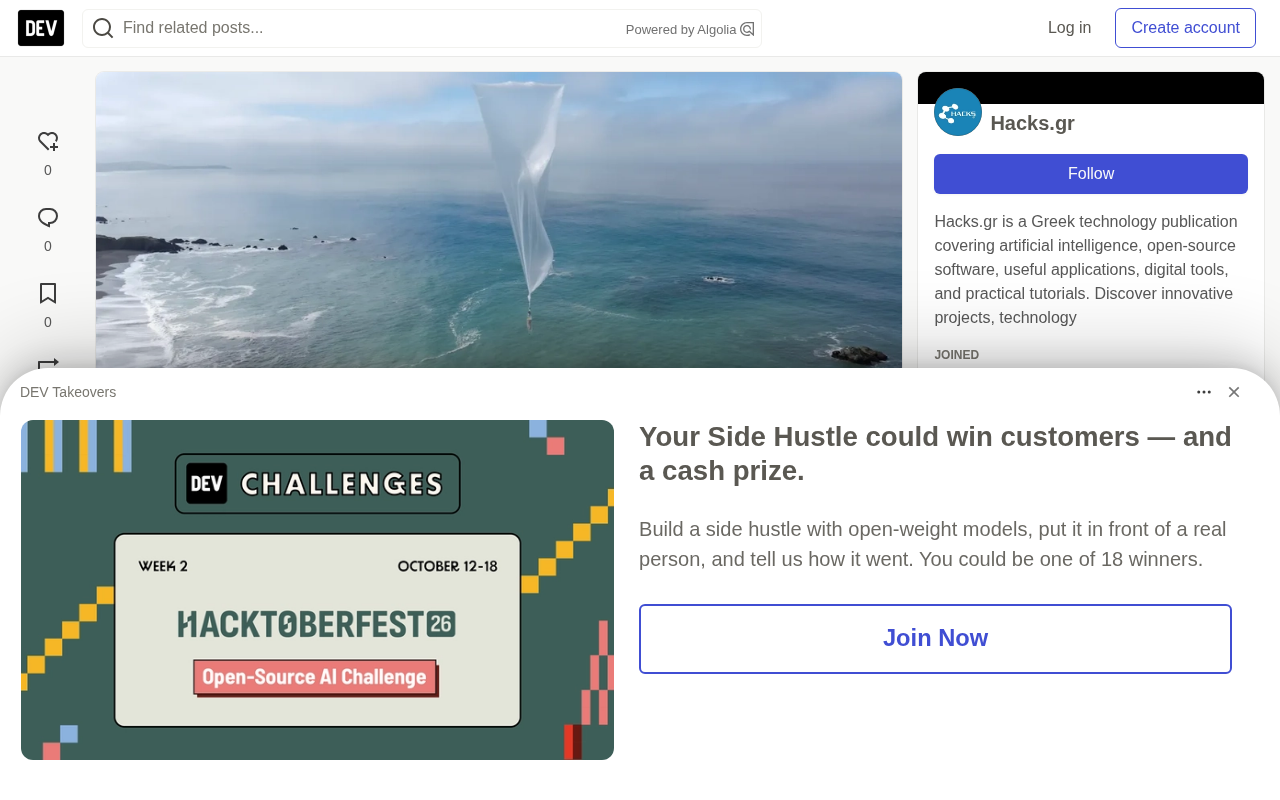
Founded in 2015 and headquartered in California, WindBorne Systems' core business is collecting atmospheric measurement data worldwide using a fleet of roughly 700 autonomous flying balloons. Unlike traditional radiosondes that launch at fixed times and altitudes, these balloons can navigate autonomously, linger at specific altitude layers, and adjust their flight paths based on mission requirements.
The sensor readings they collect are fed directly into the company's proprietary AI weather forecasting model, WeatherMesh 6. In other words, WindBorne controls both the "data source" and the "forecasting algorithm"—a combination that is uncommon in the commercial weather industry. Most forecasting companies rely on government open data (such as NOAA observations), whereas WindBorne chose to build its own observation network to feed its own model.
The advantage of this vertical integration lies in data freshness and spatial coverage density. For military users, high-frequency, high-resolution atmospheric data over specific regions is often more valuable than global average accuracy.
Traditional radiosondes are the cornerstone of the global weather observation network, typically released at fixed times and locations each day, drifting with the wind after launch with no ability to actively control their heading. WindBorne's balloons fall into the category of "autonomous navigation balloons," using altitude adjustment (changing buoyancy) to catch different wind directions, thereby achieving path control and station-keeping over target areas. This capability allows balloons to loiter in specific airspace for extended periods on demand, rather than passively drifting with the wind. Consequently, the temporal and spatial sampling density of their sensor data far exceeds that of traditional radiosonde networks, with particular value for regions where ground observation stations are scarce—oceans, polar regions, and deserts. Weather data assimilation systems are especially sensitive to such high-frequency, irregularly distributed observations, and can significantly improve the accuracy of the initial field in numerical forecasting.
WeatherMesh 6 is an AI weather forecasting model whose technical approach differs fundamentally from traditional numerical weather prediction (NWP). NWP relies on supercomputers to solve the physical equations of atmospheric motion, incurring extremely high computational costs; AI forecasting models, by contrast, learn atmospheric evolution patterns from historical reanalysis data through deep learning and can generate forecast fields within seconds. However, AI models are typically constrained by the quality and coverage of training data, and perform unstably in scenarios with scarce samples—particularly at convective scales and for extreme weather. WindBorne's vertical integration strategy directly targets this bottleneck: using its own observation network to provide exclusive, real-time atmospheric measurement data, continuously fine-tuning and calibrating the model to achieve accuracy beyond that of models trained on public data in specific regions and time periods.
How the Contract Works: Pay-as-You-Go, with $1.7M in Orders Already Placed
This contract is not a one-time buyout but follows an on-demand procurement model—the Air Force places orders at any time based on actual needs to purchase weather data for specific time periods and regions. To date, approximately $1.7 million in orders have been generated, leaving substantial room before reaching the $49 million ceiling.
The contract was awarded on a non-competitive basis. The government's stated rationale is that WindBorne's ability to provide the required global data is unique, and no other supplier can meet the requirements under equivalent conditions. This kind of "unique capability determination" is not uncommon in defense procurement, typically appearing in fields with high technical barriers and scarce alternatives.
The company's management includes CEO John Dean and co-founder and CTO Andrei Susko. Judging from the team composition, WindBorne takes a technology-driven approach rather than following the business model of traditional weather service providers.
Non-competitive contracts in US federal procurement typically correspond to a "sole source" determination, with the legal basis primarily stemming from provisions in the Federal Acquisition Regulation (FAR) regarding "the only supplier capable of meeting the requirement." The government must provide written justification explaining that no other supplier can deliver under equivalent conditions, subject to approval. This award method is common in fields with extremely high technical barriers, strong intellectual property protection, or urgent timelines. For suppliers, obtaining a unique capability determination means not only the contract itself but also exclusive advantages for follow-on orders. At the same time, however, it requires the company to maintain its technological lead—once an alternative emerges, the government can restart the competitive process.
Extreme Condition Validation: Drone Flown into Hurricane Eye
WindBorne has not stopped at routine atmospheric sounding. In August, the company successfully flew an unmanned aerial vehicle directly into the eye of a hurricane, obtaining measured data from the storm's core region.
The hurricane eye is one of the most dangerous and most valuable regions for weather observation. Traditionally, such missions are carried out by manned "Hurricane Hunter" aircraft, which are costly and extremely risky. If unmanned systems could replace or supplement them, it would significantly lower the threshold and risk of data collection.
This mission also validated the reliability of WindBorne's platform under extreme conditions—precisely the kind of metric military users value most. Battlefield weather support, flight safety, and missile trajectory correction all require the ability to obtain accurate data even under harsh conditions.
What This Deal Signals
From a broader perspective, this contract reflects two trends.
First, commercial weather data is becoming a formal category in defense procurement. In the past, military weather support relied mainly on government-built systems (such as the Air Force Weather Agency). Now, private companies using autonomous observation networks and AI models can already provide data density and update frequency that government systems struggle to match.
Second, AI forecasting models are beginning to earn operational-level trust. WeatherMesh 6 is not a lab demo but has been written into the data delivery chain of a military contract. This means AI weather forecasting is moving from "auxiliary reference" to "operational use."
For readers interested in AI applications in the real world, the WindBorne case offers a clear example: when an AI model is combined with exclusive data sources and validated in extreme scenarios, it can break into high-value, high-barrier government and defense markets. This path may be more effective at building moats in vertical domains like weather, ocean, and space than simply building SaaS tools.
One-line Summary
The US Air Force awarded WindBorne a non-competitive contract worth up to $49 million for global atmospheric data and AI forecasting, marking commercial weather data's formal entry into defense procurement.
Paragraph Summary
The US Air Force signed a contract worth up to $49 million with California-based weather technology company WindBorne Systems to procure its global atmospheric observation data and AI forecasting capabilities on a non-competitive basis. WindBorne operates approximately 700 autonomous navigation balloons, with collected data fed directly into its proprietary WeatherMesh 6 AI forecasting model, achieving vertical integration of data source and algorithm and enabling high-frequency, high-resolution atmospheric data. The contract is pay-as-you-go, with approximately $1.7 million in orders generated so far. The company also successfully flew an unmanned aerial vehicle into a hurricane eye, validating reliability under extreme conditions. This deal signals that commercial weather data has become a formal category in defense procurement, that AI forecasting models are moving from auxiliary reference to operational use, and it provides a clear example of combining AI with exclusive data to enter high-barrier government markets.
Related articles

OpenAI Partners with Shield: How the Astra Agent Revolutionizes IT Troubleshooting
OpenAI and Shield launch the Astra agent, which autonomously logs into computers and legacy systems to fix IT issues in real time, 35-40% faster than traditional models, with humans involved only when judgment is needed.

iPhone Duo Battery Life Tested: One Charge a Day Is Unavoidable, and the Large Screen Is the Culprit
iPhone Duo battery test: heavy use needs at least one charge a day, and about 30% remains after 6.5 hours of screen-on time. How often the large screen is unfolded is key; a MagSafe battery pack helps, and long-term degradation is also worth watching.

Kimi K3.1 Pro Open-Sourced: 2.8 Trillion Parameters Close In on Opus
Moonshot releases the open-source MoE model Kimi K3.1 Pro, with 2.8T total parameters and 104B activated, trailing Opus 5.5 by under 1 point on Terminal Bench 4.0.