US Department of Energy's $5 Billion Loan Boosts Nuclear Plants to Power AI Data Centers

The US DOE's $5 billion loan supports nuclear plant upgrades, with tech giants' power purchases locking in baseload electricity for AI data centers.
The US Department of Energy has provided a $5 billion loan to Constellation Energy for nuclear reactor modernization and life extension. Most of the new generating capacity has been locked in through long-term power purchase agreements for Google, Amazon, and Meta data centers, meeting AI computing's demand for stable, low-carbon baseload power. This marks a major policy shift amid surging data center power demand: government financial tools lower nuclear financing barriers, while tech giants' purchase commitments provide revenue certainty, together forming a new paradigm for clean baseload power financing. Areas around nuclear plants may attract data center clusters, but whether upgrade timelines can match AI growth remains to be seen.
Nuclear Revival: A Policy Shift Driven by Data Center Power Demand
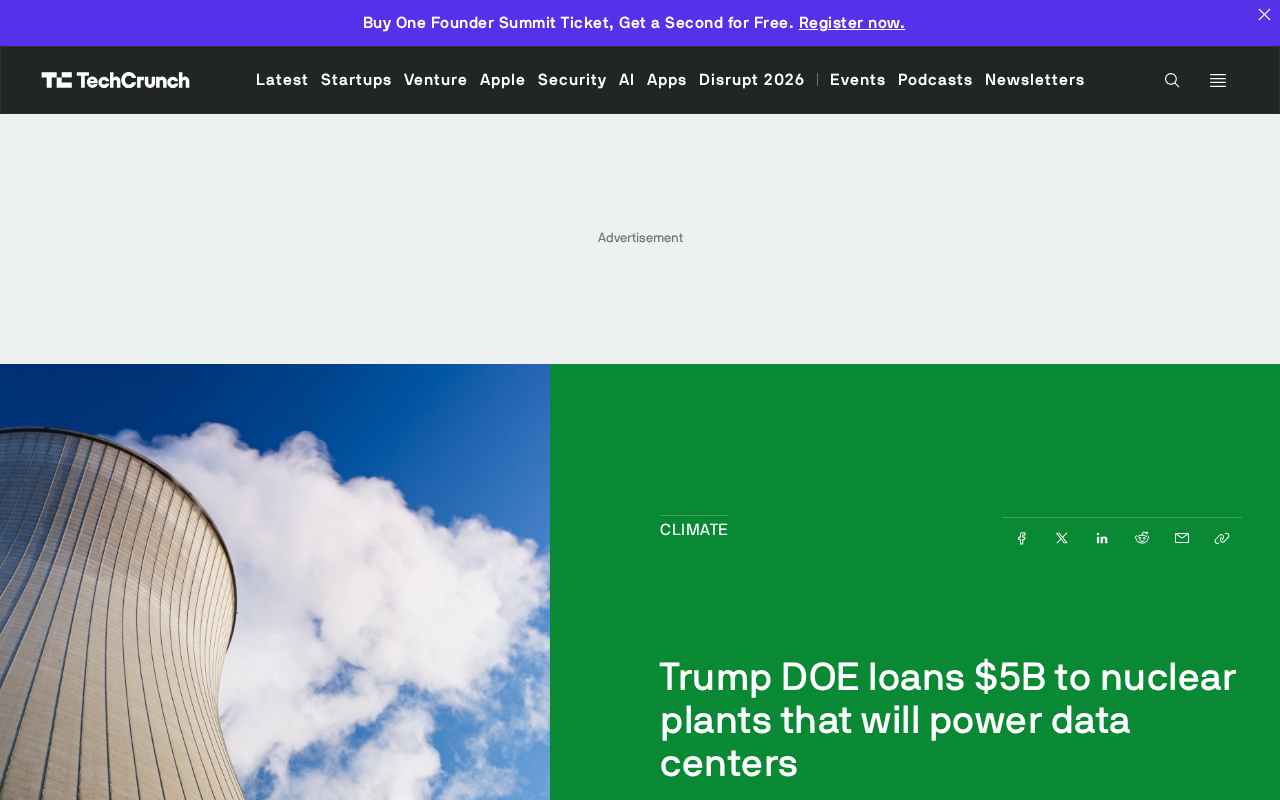
The US Department of Energy (DOE) under the Trump administration announced a $5 billion loan to Constellation Energy to modernize nuclear reactors. The funding will help nuclear plants extend their operating lifespans and boost generating capacity, with most of the new capacity already locked in for data centers owned by tech giants such as Google, Amazon, and Meta.
This move marks a major shift in US nuclear energy policy amid surging power demand from data centers. Traditionally, life extensions and upgrades for nuclear plants have faced economic challenges, but the strong demand from tech companies for stable, low-carbon electricity provides a new commercial rationale for nuclear power.
Tech Giants Lock In Nuclear Power: The Energy Backbone of the AI Race
Constellation Energy, one of the largest nuclear plant operators in the US, will use the loan to modernize its reactor fleet. Notably, the vast majority of the new capacity has already been committed to Google, Amazon, and Meta through long-term power purchase agreements (PPAs).
This reflects the stringent requirements AI data centers place on power supply: they need not only large-scale, stable baseload power but also low-carbon emissions to meet tech companies' sustainability commitments. Nuclear power satisfies both conditions at once, with a capacity factor far higher than wind and solar, enabling uninterrupted 24/7 power supply.
According to the original report, the loan is part of the Trump administration's energy policy, aimed at supporting the continued operation of existing nuclear plants through financial tools. Previously, multiple nuclear plants faced the risk of early closure due to economic pressure, but power purchase commitments from tech giants have changed the situation.
Capacity Factor is a measure of the ratio of a power generation facility's actual output to its theoretical maximum output. Nuclear plants typically have capacity factors exceeding 90%, meaning they operate at full power for most of the year; by comparison, wind power has a capacity factor of about 35%-45%, and solar is even lower. This difference is critical for AI data centers, which require uninterrupted 24/7 power. Power sources with low capacity factors must be paired with large-scale energy storage or backup capacity to meet baseload demand, whereas nuclear power inherently possesses baseload characteristics.
Long-term Power Purchase Agreements (PPAs) are multi-year electricity purchase contracts between power generators and buyers, typically locking in prices and volumes to provide stable revenue expectations for generation projects. In the nuclear sector, PPAs are particularly significant: traditionally, nuclear plants rely on spot market electricity sales, where price volatility is high and investment payback periods are long, making financing difficult to attract. After tech giants sign 10-20 year PPAs, the predictability of nuclear plant cash flows improves significantly, making banks and rating agencies more willing to provide loans, thereby reducing overall financing costs. This is also the key mechanism that makes the "tech company power purchase + government loan" model viable.
Dual Drivers: Policy and Market
From a policy perspective, the DOE's loan guarantees and direct loan tools are becoming an important financing channel for the nuclear industry. The $5 billion scale is significant for a single operator, sufficient to cover the upgrade costs of multiple reactors.
From a market perspective, data center power demand is growing far faster than grid expansion, forcing tech companies to proactively invest on the supply side. The PPAs from Google, Amazon, and Meta not only provide revenue certainty but also send a signal to financial markets that nuclear assets have long-term value.
This "tech company power purchase + government loan support" model could become a template for financing clean baseload power sources in the future.
The DOE's loan guarantee and direct loan tools operate primarily through its Loan Programs Office (LPO). A loan guarantee means the government provides credit backing for the borrower's repayment obligations, reducing default risk for private lenders; direct loans involve the government providing funds directly to projects. The LPO expanded significantly after the 2009 American Recovery and Reinvestment Act and has supported solar and electric vehicle projects, though it also drew controversy over the Solyndra bankruptcy. This $5 billion loan falls under the direct loan category and requires rigorous due diligence and congressional oversight; its policy signaling significance is no less important than the funding itself.
Potential Impact on the AI Infrastructure Landscape
This loan and the accompanying PPAs will directly affect the layout of US AI infrastructure. Nuclear plants are typically located in low-population-density areas with relatively abundant surrounding land and power resources, potentially attracting data centers to cluster in these regions.
For Constellation Energy, obtaining government loans and long-term contracts from tech giants significantly improves the economics of its nuclear units, helping to retain existing capacity and explore upgrades and expansion. For tech companies, locking in nuclear power means securing long-term, stable energy guarantees in the AI computing race.
However, nuclear plant modernization requires lengthy approval and construction cycles, and whether new capacity can match the explosive growth of AI data centers in time remains to be seen.
Conclusion
The DOE's $5 billion loan supporting Constellation Energy's nuclear plant modernization, combined with power purchase commitments from Google, Amazon, and Meta, outlines a new paradigm for energy supply in the AI era: government financial tools lower the financing threshold for nuclear power, while tech giants use long-term PPAs to lock in clean baseload electricity. Whether this model can be replicated at scale will affect America's energy cost advantage in the AI infrastructure competition.
Related articles
AWS AgentCore Gateway: Connecting AI A…
AWS AgentCore Gateway: Connecting AI Agents to Enterprise Backends with MCP
How AWS AgentCore Gateway acts as a primary MCP server to aggregate REST APIs, Lambda, and existing MCP services? Analyzing its AST real-time mapping, zero cold start, semantic search for tool overload, session isolation, and key injection security design, plus the architectural approach to decoupling enterprise AI agents from backends.

One Link Gives Figma AI a New Skill: Hands-On with MCP Connectors
Paste one MCP server link and the AI Agent in Figma gains new tool capabilities. We break down the setup flow, 20+ one-click apps, read/write permissions and execution policies, and the public HTTPS requirement.

Cognition SWE-2 in Practice: One Prompt to Handle the Whole Product Launch Process
Analyzing a YouTube creator's prompt for using Cognition SWE-2 to launch a product: a landing page, seven-email sequence, and non-buyer follow-up tool, plus how the 'test and report' constraint changes AI delivery quality.