Usage Plummets After Update? Users Sound Off on Codex Quota Reset Chaos

AI coding tool's post-update quota burns faster and resets fail to arrive, eroding user trust.
A Reddit discussion reveals user frustration after an AI coding tool update: multiple users report noticeably faster quota consumption for the same workload, with one seeing usage drop from 89% to zero in an hour; the expected weekend reset never came, leaving users unable to predict reset cycles and even afraid to tap into reserves. Comments cite founder Tibo saying resets are typically granted when complaint volume is high or the team admits model problems, rather than on a fixed schedule. This erratic quota policy is eroding trust, with some users downgrading it to a "hobby tool" rather than a productivity dependency. Users' core demand is not more quota but predictability and transparency.
Usage Anxiety Sparked by an Update
"How's your usage holding up after this update?" A question posed by a Reddit user quickly struck a chord. The comments section filled with complaints: some said outright that "usage burns faster than during the previous promo," others were confused—"I thought it would reset last night, but now my usage is at 0"—and one angry user reported that "usage dropped from 89% to 0% in an hour, doing the exact same work as the past four days." 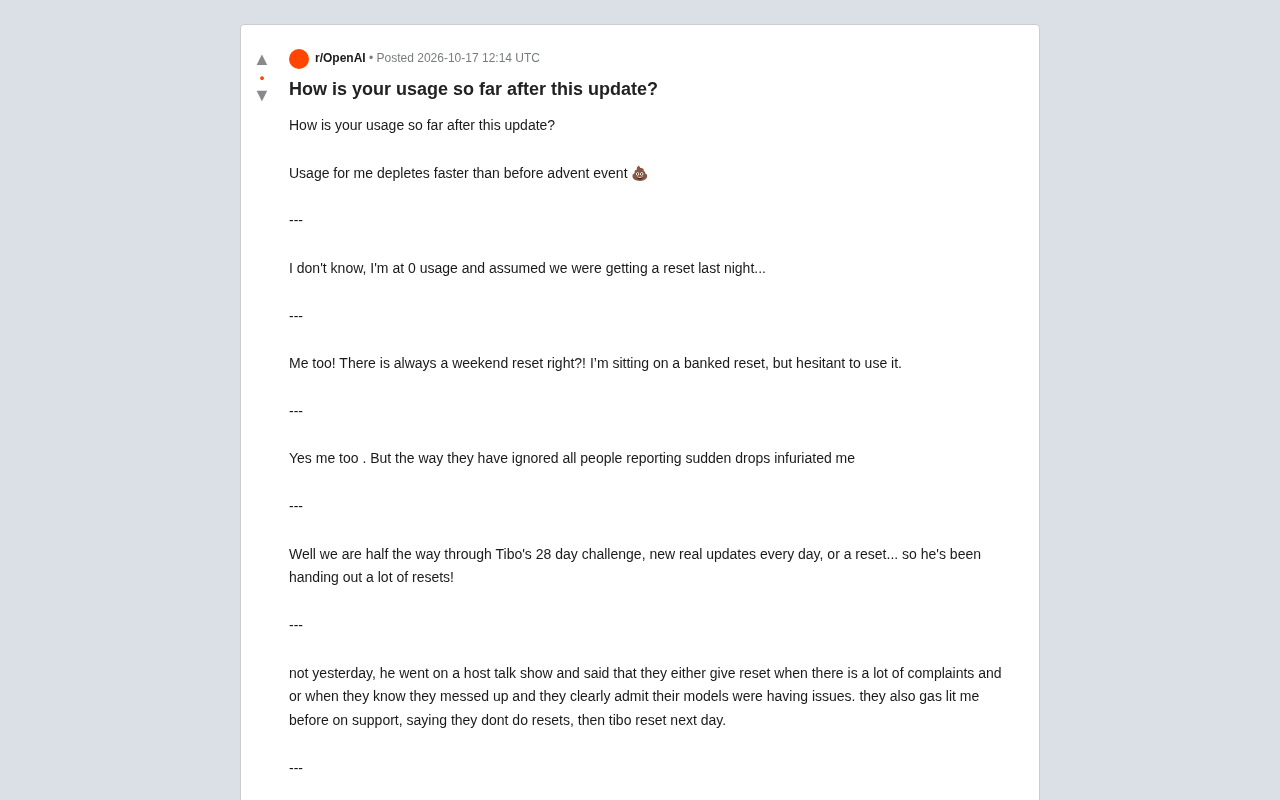
The discussion centers on an AI coding tool (from context, the "Codex" and "Tibo" mentioned by users point to a platform offering code generation services, whose founder Tibo is quite active in the community). The update was supposed to bring improvements but instead ignited user frustration over the quota mechanism.
Faster Quota Burn: Illusion or Reality?
Multiple users described similar experiences: the same workload, but noticeably faster quota consumption after the update. One user claimed their usage went from 89% to zero within an hour, something that hadn't happened over four days of doing the same work. Another described the current rate as "burning faster than during the previous promo."
These accounts point to a common perception: after the update, the quota consumed per task seems to have increased. Although there's no official data to confirm this, multiple independent reports of similar phenomena lend the claim some credibility.
Quotas for AI coding tools are typically measured in tokens or request counts, and actual consumption varies greatly across models and context lengths. The perceived "acceleration" often stems from the service provider adjusting backend model routing, context window size, or billing weights during the update. For example, if the update enabled longer contexts or more complex reasoning models by default, the token count per task could multiply. Changes in cache hit rates and batching strategies also affect how much ultimately counts against a user's quota. Therefore, while multiple independent reports of similar phenomena don't directly prove that billing rules were modified, they are enough to suggest that the update may have changed the underlying parameters of resource consumption—and the lack of official transparency only fuels user suspicion.
Broken Reset Promises Leave Users in Limbo
What unsettles users even more than accelerated consumption is the uncertainty of the reset mechanism. Multiple users mentioned expecting a weekend reset that never came. One said, "My usage is already at 0—I thought it would reset last night." Another said they were "saving a reset and afraid to use it" because they weren't sure when the next reset would arrive.
This uncertainty directly affects usage decisions—when quota becomes a scarce resource, people start managing each call like a budget, even afraid to tap into their reserves.
In subscription-based AI services, a "reset" generally refers to zeroing out consumed quota within a period or restoring it to an initial value. Common reset mechanisms include fixed-cycle resets (e.g., monthly or weekly) and event-driven resets (e.g., compensation for service outages). Fixed-cycle resets let users plan their usage rhythm, while event-driven resets carry randomness. When users expected a weekend reset that didn't happen, it suggests they may have been relying on informal reset patterns derived from community experience rather than an officially committed cycle. Once this reliance on an "implicit contract" is broken, users are left in limbo—unable to judge when the next reset will come, they dare not consume their remaining quota freely.
The Founder's Reset Logic: Complaint-Driven?
A key piece of information emerged in the comments regarding the criteria for granting resets. One user cited founder Tibo's remarks on an interview show: resets are typically granted in two situations—when complaint volume is very high, or when the team explicitly acknowledges that the model had problems and they messed up.
The same user added their own experience: customer service had previously denied that a reset would happen, but the next day Tibo granted one. This account suggests that resets are not executed on a fixed cycle but are more like a crisis PR tactic.
Crisis-PR-style compensatory resets are not uncommon in SaaS and API services, usually used to appease users after outages, major bugs, or billing errors. However, when compensatory resets become the primary expected source of quota for users, it indicates that the service's normal quota supply may be insufficient to meet demand, or that the company lacks a stable quota management strategy. A founder publicly stating that resets happen "only when complaints are high" effectively ties quota allocation to user volume—incentivizing users to seek resources through public complaining rather than normal feedback channels. Over time, silent users may be systematically ignored, and the community atmosphere shifts from technical discussion to emotional pressure tactics.
Eroding Trust: From "Productivity Tool" to "Hobby Tool"
The sharpest criticism came from a user who said their "bubble burst" a month and a half ago. He described a recurring pattern: Tibo frequently grants resets, then suddenly goes seven days straight without one, "completely destroying any sense that you can reliably use it for a full week."
His conclusion is representative: "This made me realize how crazy it is to rely on Codex for actual work—at best it's a hobby tool." This statement highlights the deeper cost of an erratic quota mechanism—when users cannot predict tool availability, it struggles to earn the trust required for a production role.
Another user was "furious" that the company ignored numerous reports of sudden usage drops, finding that attitude more disappointing than the quota issue itself.
Community Sentiment After the Update
From this discussion, it's clear that users' core demand is not simply "more quota" but predictability. Changes in consumption rates, vague reset rhythms, and the absence of official responses together form the current dissatisfaction.
One user wrote half-jokingly: "After this post, usage will drop from 89% to 0% in an hour and a half—you should be grateful." Behind the sarcasm lies the community's genuine expectation for transparency and stability. For developers who rely on AI coding tools for their daily work, every fluctuation in the quota mechanism directly affects whether they can incorporate the tool into a reliable workflow.
One-line Summary
AI coding tool's post-update quota burns faster and resets fail to arrive, eroding user trust.
Paragraph Summary
A Reddit discussion reveals user frustration after an AI coding tool update: multiple users report noticeably faster quota consumption for the same workload, with one seeing usage drop from 89% to zero in an hour; the expected weekend reset never came, leaving users unable to predict reset cycles and even afraid to tap into reserves. Comments cite founder Tibo saying resets are typically granted when complaint volume is high or the team admits model problems, rather than on a fixed schedule. This erratic quota policy is eroding trust, with some users downgrading it to a "hobby tool" rather than a productivity dependency. Users' core demand is not more quota but predictability and transparency.
Related articles

RAG Getting Started in Practice: From Principles to Building an Enterprise Knowledge Base
Bilibili RAG course highlights: from retrieval-augmented generation principles, document chunking and vectorization, to five accuracy factors and enterprise knowledge base boundaries, with fine-tuning vs RAG selection advice.

AI Model Selection Guide: DeepSeek vs. Qwen3 in Practice
How should AI developers choose models? Based on a Bilibili tutorial, this article breaks down the Function Calling differences between DeepSeek V3 and R1, Qwen3's programmatic thinking mode switching and agent capabilities, and outlines a multi-model learning path and practical selection logic.

Anchoring, Loss Aversion, and Nudges: 5 Psychological Tactics Retailers Use to Make You Spend
Behavioral economics reveals how retailers use anchoring, framing, loss aversion, and nudge theory to manipulate your spending decisions. This article breaks down 5 common psychological tactics and offers counterstrategies like slowing down decisions and setting your own anchors to see through the pricing design behind discounts.