Using Agentic AI to Migrate CUDA Tile Operations from Python to Rust
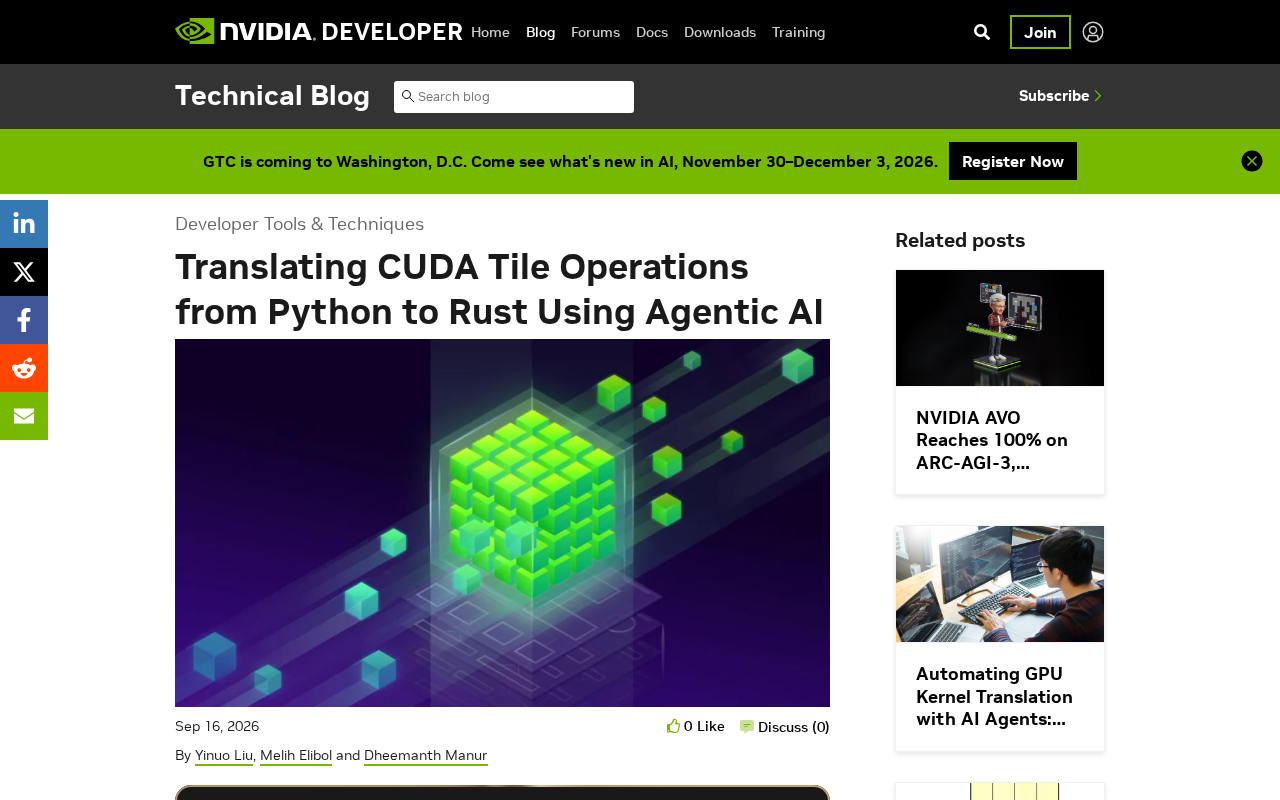
NVIDIA used Agentic AI to translate CUDA tile operations into Rust, producing the memory-safe, high-performance cuTile Rust project.
NVIDIA has revealed a project using Agentic AI to migrate CUDA Tile operations from Python to Rust, resulting in cuTile Rust (cutile-rs) — a tile-first GPU kernel authoring system for Rust. Its core value is extending Rust's ownership model into GPU development, shifting memory safety guarantees from runtime to compile time. Unlike single-turn code generation, the agentic approach iteratively invokes the compiler, captures borrow checker errors, and self-corrects to bridge deep differences in type systems and memory models across languages. The project reflects two converging trends: Rust's expansion into GPU computing, and Agentic AI's evolution into a tool capable of completing verifiable engineering tasks.
NVIDIA recently unveiled a technically ambitious initiative: using Agentic AI to translate CUDA Tile operations from Python to Rust, giving rise to the cuTile Rust (cutile-rs) project — a tile-based GPU kernel authoring system for the Rust language. This effort bridges two worlds that have largely remained separate: the mature ecosystem of high-performance GPU computing, and Rust, a language celebrated for its memory safety guarantees.
What Problem Does cuTile Rust Solve?
cuTile Rust is positioned to let developers write GPU kernels in Rust in a safe, idiomatic way. Traditional CUDA kernel development primarily relies on C/C++ or Python (paired with various frameworks). While performant, these approaches depend on developer discipline for memory management and concurrency safety, making them prone to pitfalls like out-of-bounds access and data races.
Rust's core value lies in its ownership model — enforcing memory safety at compile time through borrow checking, without the overhead of garbage collection. The key insight behind cuTile Rust is to extend Rust's ownership model into GPU kernel development, catching errors at compile time that would otherwise only surface at runtime. For high-performance computing and AI infrastructure teams that demand both performance and reliability, this is a compelling direction.
Why Tiling Matters
Tiling is a foundational abstraction in modern GPU programming. It breaks large datasets and computations into smaller chunks that fit the GPU's on-chip storage and thread organization, enabling better utilization of shared memory, improved data locality, and reduced latency from global memory access. High-frequency deep learning operators — matrix multiplication, convolution, attention computation — almost universally depend on efficient tiling strategies to approach peak hardware performance.
By treating tiles as first-class citizens, cuTile allows developers to describe computation at a level closer to algorithmic intent, delegating tedious index management, boundary handling, and memory movement to the system abstraction. Migrating this tiling semantics from the Python side to Rust is essentially filling a critical gap in Rust's GPU high-performance computing ecosystem.
Take matrix multiplication as an example: global memory access latency on a GPU can be hundreds of clock cycles, while on-chip shared memory latency is only a few dozen cycles. The essence of tiling is to split a large matrix into smaller blocks, load each block into shared memory, and allow threads within the same warp to repeatedly reuse that data — dramatically reducing global memory accesses. The core optimizations in high-performance libraries like NVIDIA's cuBLAS and FlashAttention are built on carefully tuned tiling parameters, where block size directly governs the balance between registers, shared memory, and compute throughput. Different GPU architectures (such as Ampere and Hopper) have different on-chip storage specifications, meaning tiling parameters often need to be re-tuned per hardware generation — one of the most expert-intensive aspects of high-performance operator development. By elevating tiling to a first-class abstraction, cuTile aims to encapsulate these low-level details and let developers express computational intent at a higher semantic level.
The Role of Agentic AI in Code Translation
The most noteworthy aspect of this effort is the use of Agentic AI to drive cross-language translation. Unlike a one-shot "translate this, give me the output" request, an agentic approach typically means the AI can decompose tasks, generate iteratively, verify results, and self-correct based on feedback.
Migrating CUDA Tile operations from Python to Rust is far from a simple syntax substitution. It involves deep differences in type systems, memory models, and error-handling paradigms between the two languages — and crucially, the generated Rust code must satisfy ownership rules and pass the borrow checker, which is a formidable challenge for purely pattern-matching translation. Driving this process with an agent enables an automated loop: generate code, compile it, capture compiler errors, adjust accordingly, and repeat. This represents a broader trend in AI-assisted engineering: moving from "writing code snippets" toward "completing a verifiable engineering task."
Implications for Developer Workflows
For teams maintaining cross-language codebases or looking to migrate existing Python/CUDA assets to Rust, this agentic translation paradigm offers a reference path. The goal isn't to replace engineers, but to hand off repetitive, error-prone migration work to AI — freeing humans to focus on architectural decisions and performance tuning. That said, generated code still requires human review, especially where GPU memory layout and performance-sensitive paths are involved.
The core distinction between Agentic AI and traditional single-turn LLM code generation lies in "tool use + feedback loops." In code translation scenarios, agents are typically equipped with the ability to invoke compilers, run test suites, and query documentation. For CUDA-to-Rust translation, a typical agent loop might look like: generate initial Rust code → invoke rustc → parse borrow checker errors → locate the problematic ownership or lifetime annotation → revise and recompile, until zero errors remain. This "think-act-observe" loop (the ReAct framework being one prominent implementation) enables AI to handle complex engineering tasks that cannot be solved correctly in a single inference pass. This is especially critical for cross-language migration: Rust's borrow checker error messages are semantically rich, providing high-quality feedback signals that guide each successive correction — a natural fit for agentic iteration.
Significance and Observations
The emergence of cuTile Rust reflects two converging technological currents. First, Rust continues to penetrate systems-level, performance-sensitive domains, and GPU computing remains a largely untapped frontier. Second, Agentic AI is evolving from a conversational assistant into a serious engineering productivity tool, with code translation and migration as a prime use case for demonstrating that capability.
A note of realism: the publicly available information currently focuses more on project positioning and methodology. Hard metrics — actual performance benchmarks, operator coverage, and translation accuracy — still await further validation. But directionally, combining a memory-safe language, a tile-based GPU abstraction, and AI-assisted engineering is an experiment well worth following.
For developers tracking AI infrastructure and high-performance computing, cuTile Rust is both a potentially practical tool and a window into how AI is reshaping low-level software development.
Related articles
The Siberian Ice Maiden and the Archaeological Mysteries of the Scythian World
The Siberian Ice Maiden is a Scythian female mummy from the Ukok Plateau. Her tattoos, silk garments, and grave goods reveal ancient nomadic art, social hierarchy, and cross-regional trade — alongside ongoing repatriation controversies.
SQL Row Pattern Matching: Implementing "Row-Level Regex" with MATCH_RECOGNIZE
MATCH_RECOGNIZE gives SQL regex-like power over row sequences. Detect brute-force attacks, fraud patterns, and user behavior flows with clean, declarative syntax — no more messy self-joins.

Hackers Break Into Flock Surveillance Cameras, Exposing the Inner Workings of License Plate Recognition Systems
Hackers breached Flock Safety's ALPR cameras, exposing how license plate recognition systems collect data and the privacy and security risks they pose.