Using and Topping Up Claude in China: Three Methods Compared and a Guide to Avoiding Account Bans

The pros and cons of three ways to top up Claude membership and habits to reduce ban risk.
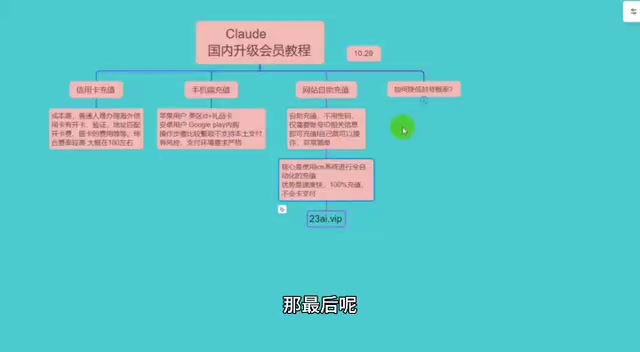
Based on a Bilibili creator's tutorial, this article systematically covers three paths for Chinese users to subscribe to Claude: direct credit card payment has the highest barriers and cost (all-in rate around 180) and suits only those with overseas cards; mobile in-app purchases require a US-region ID plus gift cards or Google Play, with a cumbersome process, strict payment environment requirements, and higher suspension risk; self-service website top-up requires no credentials and uses iOS-side automation, offering a short process and high success rate but entrusting trust to a third party. The article also stresses that account maintenance is key to long-term stable use, offering five habits: fixed device, stable network, no account sharing, normal usage frequency, and avoiding short bursts of high-frequency requests — and notes that third-party top-up is a gray area requiring your own risk assessment.
Chinese users who want to access overseas AI services like Claude usually find the bottleneck isn't the model itself, but the subscription and payment process. A Bilibili creator recently put together a Claude membership upgrade tutorial that lays out the pros and cons of three paths — direct credit card payment, in-app purchases on mobile, and self-service top-up via a website — fairly candidly, along with habits for reducing the risk of account suspension. Here's a systematic overview based on the video content.

Comparing the Real-World Experience of Three Top-Up Methods
Direct Credit Card Payment: Suited to Long-Time Users with Overseas Cards
Credit card top-up comes with high barriers and high costs. It's hard for an ordinary person to get a compliant overseas credit card, and even after getting one, there's a whole chain of hassles: card activation verification, billing address matching, card-on-file maintenance, and so on. The creator estimates the all-in cost at around 180 (i.e., actual spending is noticeably higher than the subscription's face value). This method is better suited to people who already have an overseas card and cross-border payment experience; beginners are not advised to start here.
Mobile In-App Purchases: Pitfalls on Both Apple and Android
iOS users need a US-region ID plus gift cards, while Android users go through Google Play in-app purchases. It looks like an official channel, but the practical experience isn't easy: the process is cumbersome, local payment methods aren't supported, and there are strict requirements for the payment environment — an unstable environment can easily cause problems midway. The risk of suspension is also relatively high, and once triggered, dealing with it takes more time than the top-up itself.
A US-region Apple ID is an Apple account registered in the United States, independent of a China-region account. Only after logging into the App Store with a US-region ID can you download and make in-app purchases for most overseas AI apps. Since a US-region ID can't directly link a domestic bank card, you usually need to first buy US App Store gift cards and load them into the account balance, then use the balance to complete the subscription. The difficulty of maintaining a US-region ID lies in: you need to fill in a US address and phone number when registering, some scenarios require payment method verification, and frequently switching accounts or logging in from different locations easily triggers Apple's security verification — or even gets the account locked. So in-app purchases via a US-region ID essentially mean maintaining two sets of account systems, and the operational cost isn't necessarily lower than third-party channels.
Self-Service Website Top-Up: The Lightest Process
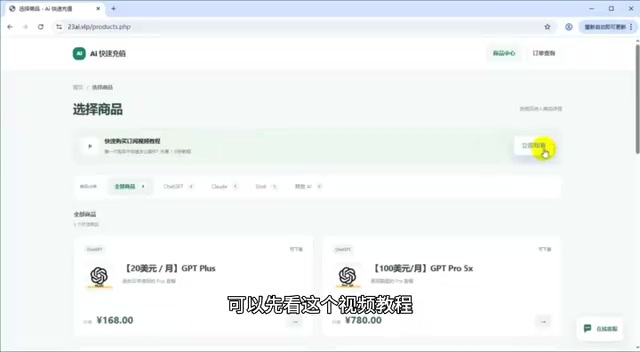
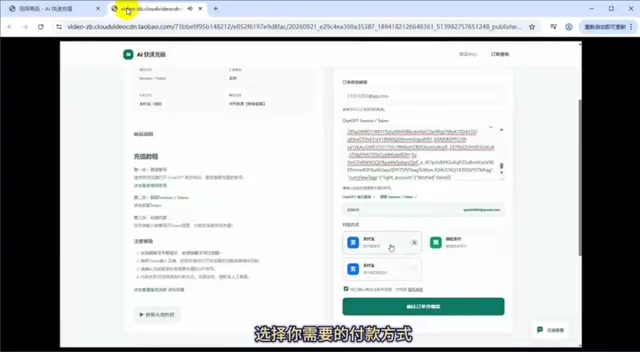
The creator's main demonstration is self-service website top-up. The distinguishing feature of this approach is that the user does everything themselves — no need to hand over account credentials, only account ID-related information; the core logic is completing automated top-up on the iOS system side, with good speed and success rates, so it basically doesn't get stuck at the payment step. The video lays out the specific steps: open a browser and go to the site, find the video tutorial under all products and watch it first, then select a plan, fill in your email (only for order lookup), obtain and paste the session information, verify the account, choose a payment method, submit the order, and after processing is complete, return to the original site and refresh to see the membership status. Even a first-time user can follow the whole process, and the site also provides online customer service and an invoicing portal.
The image below shows the payment method selection screen when submitting an order; the creator didn't demonstrate the payment details in the video.
It should be noted that third-party top-up services occupy a gray area and involve account information and financial security; readers should assess the risks themselves. This article is for informational purposes only and does not constitute an endorsement.
Session information (a session identifier) is a string of credentials generated by a website or app after a user logs in, which the server uses to identify "which logged-in account is currently performing the operation." It's usually stored in the browser's cookies or local storage. Third-party top-up sites ask users to provide their session so they can complete the subscription operation on the user's behalf while already logged in, thereby avoiding the need for account credentials. That's precisely where the risk lies: during its validity period, a session is equivalent to login permission — if leaked, others can read account information or even perform operations. Therefore, before providing a session, confirm the site is trustworthy, and after the top-up is complete, log out promptly so the old session becomes invalid.
Five Usage Habits to Reduce the Risk of Suspension
In the second half of the video, the creator emphasizes that regardless of which top-up method you use, account maintenance is the key to whether you can use it stably over the long term. He offers five habits:
- Log in from a fixed device — don't frequently switch between phone and computer;
- Maintain a stable network environment — avoid frequent IP switching;
- Don't share the account with others;
- Maintain a normal usage frequency — don't leave the account idle for long periods;
- Avoid high-frequency IP switching or large numbers of requests in a short time — even for old accounts, abnormal operations easily trigger risk controls.
These five points essentially point to the same logic: let the platform see a real user with stable behavior. IP hopping, device drift, and multi-person sharing are all the signals risk control systems are most sensitive to. For Chinese users relying on overseas AI services, subscribing is only the first step; the cost of long-term stable use is mostly spent on daily habits.
A risk control system is an automated mechanism platforms use to identify abnormal behavior and prevent abuse and fraud. It typically scores across dimensions such as device fingerprint, IP location and switching frequency, login time patterns, request frequency, and account-sharing characteristics; an abnormal score triggers verification, rate limiting, or a ban. For overseas AI services, common triggers for Chinese users include: cross-border IP switching in a short time, the same account logging in from multiple devices and locations, and batch or scripted requests. Understanding this makes it clear that so-called "account nurturing" isn't mysticism — it's simply trying to keep behavioral characteristics close to those of a single real user's normal usage pattern, reducing the signals the risk control model flags as abnormal.
A Bit of Judgment
Among the three methods, credit cards suit people with cross-border payment infrastructure, mobile in-app purchases suit people willing to tinker and able to maintain a US-region account, and self-service website top-up wins on a short process and low barrier — but it entrusts trust to a third party. Which to choose depends on whether you care more about cost, convenience, or account controllability. If you decide to go through a third-party channel, at least do two things: don't hand over your account credentials, and after topping up, nurture the account according to the habits above.
Related articles

VERS: Editing Activation Explanations to Halve Reasoning Model Tokens
VERS guides reasoning models by editing activation explanations, cutting 45.8% of tokens on GSM8K with only a 0.82 pp accuracy drop and transferring to larger models, but losing accuracy on competition problems.

Finding Errors Is Not Enough: Selective Model Escalation for Entity-Targeted Sentiment Analysis
This study explores selective model escalation for entity-targeted sentiment analysis, comparing data collection ordering, uncertainty-driven re-examination, and model routing—finding that minority-class priority only helps at very small data volumes, the oracle upper bound far exceeds actual gains, and escalation must be tailored to each dataset.
WAS-PO: Using Whitened Advantages to Solve the Correlation Trap in Multi-Reward Reinforcement Learning
WAS-PO paper proposes whitening advantages to correct correlation bias in multi-reward RL: when rewards are correlated, naive weighted summation effectively applies Σ^{1/2}w instead of w. Experiments show training reward improves steadily, but held-out accuracy does not improve in sync, and under two rewards it actually falls behind.