UV-Tracking Gem Bracelet: Rethinking the Impact of Sunlight on Health
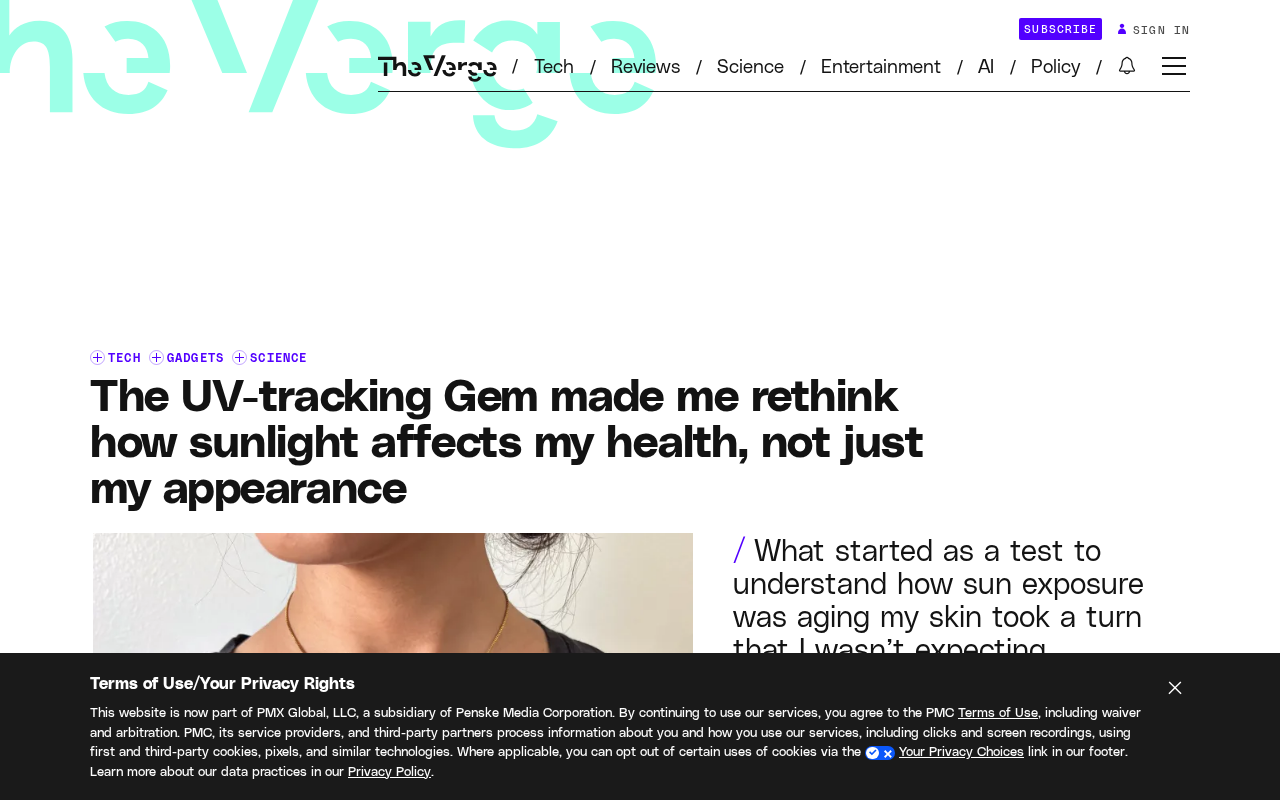
UV-tracking device Gem uses individualized data to reveal sunlight's deeper health effects, beyond just tanning.
The article opens with the author's experience at an outdoor party in Los Angeles, where she felt exhausted and dizzy even under a patio umbrella. It introduces how the UV-tracking device Gem monitors personal ultraviolet exposure in real time and translates it into health insights. It points out a common misconception—that shade does not equal safety—because UVA has strong penetrating power and can pass through clouds, glass, and some fabrics. Gem prompted the author to shift from appearance-focused sun protection to concern about sunlight's effects on overall health, including vitamin D synthesis, immune regulation, fatigue, and mood. The article also discusses the potential and boundaries of wearable environmental exposure devices, including sensor accuracy, the threshold for data interpretation, and whether knowing the data actually changes behavior.
Sunlight Is More Than Just Tanning
Los Angeles in August, with temperatures nearing 90°F (about 32°C), I attended an outdoor party hosted by relatives. To escape the heat, I sat under a patio umbrella with a powerful fan nearby, thinking I could avoid both the sun and the high temperatures. Yet half an hour later, I felt exhausted and dizzy—this scene comes from a hands-on article about the UV-tracking device "Gem," and the author's experience made me start rethinking: the impact of sunlight on us goes far beyond skin tanning.
We typically equate sun protection with preventing tanning and aging, but the deeper health effects of ultraviolet radiation—such as its influence on the immune system, vitamin D synthesis, and even mood and fatigue—are often overlooked. Gem, a wearable device, attempts to reveal these hidden connections through data.
What Is Gem? What Can It Track?
Gem is a UV (ultraviolet) tracking device. From the original description, it is designed to be worn on the body (possibly as a wristband or clip-on). Its core function is to monitor the user's ultraviolet exposure dose in real time and translate that data into understandable health insights.
Unlike typical sun-protection apps, Gem doesn't just tell you "the UV index is high today—remember to apply sunscreen." It emphasizes individualized exposure records: how long you spent in the sun during the day, your cumulative UV dose, and what that dose means relative to your skin type. The original author mentioned that using Gem made her realize "even under the umbrella, I was still being exposed to UV"—this breaks the common misconception that "shade = safe."
Why Is Shade Still Not Safe?
UVA in ultraviolet radiation has strong penetrating power—it can pass through clouds, glass, and to some extent reflect off the fabric of umbrellas onto the body. The author's fatigue and dizziness at the outdoor party may be related to the combined effects of prolonged exposure to heat and UV. Gem's data might help her recognize the risk earlier, rather than waiting for the body to send warning signals.
The difference between UVA and UVB is fundamental to understanding the health effects of ultraviolet radiation. UVB has a shorter wavelength (280–315 nm) and higher energy, primarily affecting the epidermis. It is the main cause of sunburn and the primary driver of vitamin D synthesis, but it has weak penetrating power—glass blocks most of it. UVA has a longer wavelength (315–400 nm) and lower energy but extremely strong penetrating power. It can reach deep into the dermis and can pass through clouds, glass, and some fabrics. UVA is the main driver of photoaging, generates free radicals, indirectly damages DNA, and is believed to be associated with immunosuppression. The SPF in everyday sun protection ratings mainly reflects protection against UVB, while PA or broad-spectrum labels address UVA. Umbrellas, cloudy days, and indoor environments near windows can block most UVB but cannot fully block UVA—this is the physical reason why "exposure still occurs in the shade."
The Shift from "Appearance Management" to "Health Management"
The original title points to a key shift: Gem made the author rethink how sunlight affects health, not just appearance. Behind this is an upgrade in perspective.
Traditionally, we protect against the sun to prevent sunburn, tanning, and photoaging—all appearance-related considerations. But a growing body of research focuses on the impact of ultraviolet radiation on overall health, including:
- Vitamin D synthesis: Moderate UVB exposure helps the skin synthesize vitamin D, which is crucial for bone health and immune regulation;
- Immune system regulation: Ultraviolet radiation suppresses local immune responses, which is why excessive sun exposure may increase infection risk;
- Fatigue and heat stress: The combined effects of high temperatures and UV can exacerbate dehydration, fatigue, and dizziness, as the author experienced at the party;
- Mood and circadian rhythm: Sunlight exposure affects serotonin and melatonin secretion, which are related to mood and sleep quality.
Gem's value lies in translating these abstract health connections into quantifiable personal data. When you see that your cumulative UV dose for the day far exceeds expectations, you may reassess your outdoor activity schedule—not just apply a layer of sunscreen before going out.
Data-Driven Sun Protection Habits
The author did not describe Gem's specific specifications or app interface in detail in the original article, but from her experience, the device provided sufficiently intuitive data feedback to make her realize she was still exposed to UV in a "seemingly safe" environment. This instant feedback mechanism is more effective than regularly checking the weather forecast or relying on gut feeling.
Vitamin D synthesis and the double-edged sword of ultraviolet radiation deserve elaboration. The human body primarily synthesizes vitamin D3 in the skin under UVB exposure. It participates in calcium and phosphorus metabolism, bone health, and regulates immune cell function. However, synthesis efficiency is greatly affected by latitude, season, skin color, sun protection measures, and exposed skin area—in winter at high latitudes, effective synthesis is nearly impossible. At the same time, excessive ultraviolet radiation suppresses local skin immunity, accelerates photoaging, and increases skin cancer risk. Therefore, public health recommendations typically emphasize "moderate, short-term" exposure rather than maximizing synthesis. This also explains why the significance of UV-tracking devices lies not in encouraging more or less sun exposure, but in helping individuals find the balance between exposure dose and health benefits.
The Boundaries and Potential of Wearable Health Devices
Gem is part of a broader trend: wearable devices extending from tracking steps and heart rate to more specialized environmental exposure monitoring. Similar devices include air quality monitors and noise trackers. Their common feature is making invisible environmental risks into visible data.
But such devices also face challenges. First, data accuracy is crucial—if the UV sensor is not calibrated accurately, users may be misled. Second, data interpretation requires expertise: what UV dose is safe for a specific skin type? This requires considering factors such as individual skin type, geographic location, and season. The original article did not discuss these issues, but as consumers, we need to remain rational.
Another point worth considering: after knowing the data, will behavior actually change? The author's experience shows that, at least for her, the cognitive impact of Gem was real. She began to view sunlight as a health variable rather than simply a beauty enemy.
Sensor calibration and individualized interpretation of wearable devices are key to the credibility of such products. Consumer-grade UV sensors are mostly small photodiodes, and their readings are affected by wearing angle, occlusion, and temperature drift. The manufacturer's claimed accuracy often differs from actual wearing scenarios. Moreover, "safe dose" is not a uniform value: it depends on skin phototype (Fitzpatrick scale), whether sunscreen products are used, medication history (some drugs increase photosensitivity), and the local UV index. If a device only provides cumulative dose without this context, users can easily misinterpret it. The ideal approach is to combine personal skin type, real-time UV index, and sun protection behavior to provide dynamic thresholds, and to clearly state that the data is an estimate rather than a medical diagnosis—this is also a dimension worth noting when evaluating such products.
Conclusion: A New Approach to Sun Management
Gem, the UV-tracking device, helps users build a more comprehensive view of sun health through individualized ultraviolet exposure data. It reminds us that sun protection is not just about looking good—it's about overall physical comfort and safety. Especially in hot weather, even hiding under an umbrella does not mean completely avoiding the risks of UV and heat stress.
Of course, the information provided in the original article is limited, and we cannot know Gem's exact performance, price, or long-term effectiveness. But its core idea—empowering personal health management with data—is worth paying attention to. If you frequently spend time outdoors or are curious about the relationship between sunlight and health, such devices may offer a new perspective.
(Note: This article is based on publicly available RSS article content and does not add specific parameters or data not mentioned in the original.)
Related articles
 Tech Frontiers
Edge AI on Microcontrollers: When Is It Actually Worth Deploying?
Drawing on Reddit discussions and Arm case studies, this article analyzes the real-world use cases for edge AI on microcontrollers: when each device needs independent inference, when a gateway or cloud is more reasonable, and the costs and boundaries of specialized hardware.
 Tech Frontiers
Pushing the Limits of Extreme Sudoku on a 16GB GPU: Insights from Depth and Flow Matching
A researcher trained a 16.54M-parameter model on a 16GB GPU to solve extreme Sudoku, finding effective depth breaks the 60% plateau and flow matching with improved sampling pushes accuracy past 99% with ~50× lower layer-evaluation budget.
 Tech Frontiers
AI Agent Approval Workflows: Why Human Confirmations Always Get Mindlessly Clicked
Why do AI agent approval workflows always get mindlessly clicked? A Reddit discussion shows that separating rules from keys, low-frequency high-risk approvals, and GitHub Environments-style gates are the keys to effective approvals.