v4.1.28 Update: Model Catalog Refresh and Provider Adjustments
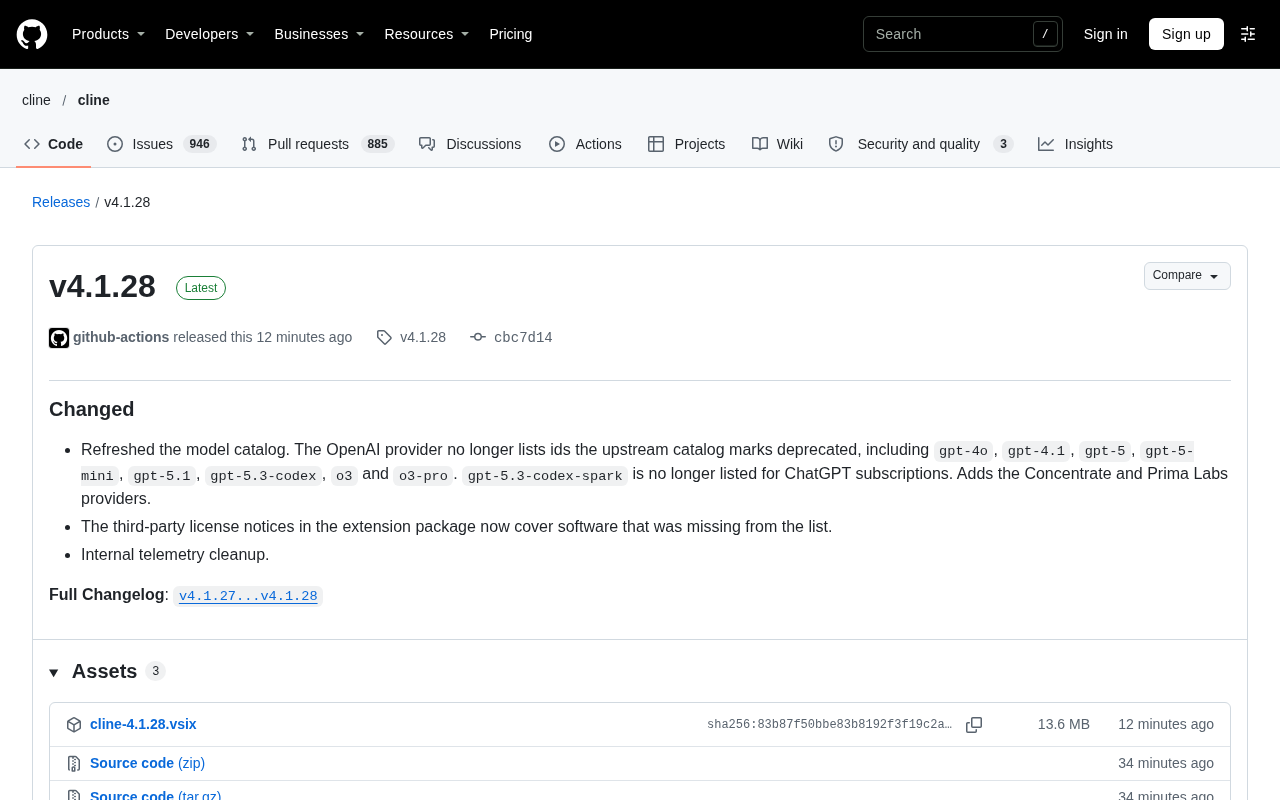
v4.1.28 refreshes the model catalog, removes several deprecated OpenAI models, and adds two providers.
Version v4.1.28 was released on November 26 as a minor maintenance update focused on the model catalog and compliance information. The OpenAI provider removed upstream-deprecated model IDs including gpt-4o, gpt-4.1, gpt-5, gpt-5-mini, gpt-5.1, gpt-5.3-codex, o3, and o3-pro, so developers using these models should check compatibility and adjust configurations; gpt-5.3-codex-spark is also no longer listed for ChatGPT subscribers, which may affect access to specific model variants. The update also adds Concentrate and Prima Labs as new providers, expanding model options, and completes previously missing third-party license notices in the extension package. Additionally, the version includes internal telemetry cleanup with no direct impact on end-user functionality. Overall, the catalog additions and removals reflect the rapid evolution of the upstream model ecosystem, and developers should keep monitoring the availability status of the models they use.
Version Update Overview
According to the GitHub release page, version v4.1.28 was released on November 26. This update mainly involves refreshing the model catalog, improving third-party license notices, and cleaning up internal telemetry. Among these, the changes to the model catalog are particularly noteworthy, reflecting the continuous evolution of the upstream model ecosystem.
OpenAI Provider Model List Adjustments
In this update, the OpenAI provider removed model IDs marked as deprecated in the upstream catalog, including gpt-4o, gpt-4.1, gpt-5, gpt-5-mini, gpt-5.1, gpt-5.3-codex, o3, and o3-pro. This means developers using these models need to watch for compatibility changes and adjust their application configurations promptly.
Additionally, gpt-5.3-codex-spark is no longer listed for ChatGPT subscribers. This adjustment may affect subscribers' access to specific model variants.
Model ID deprecation is a routine lifecycle management practice for upstream vendors like OpenAI: vendors mark a model as "deprecated" in API documentation in advance, provide a shutdown date, and during that period the model can still be called but no longer receives feature updates; after the deadline, requests return errors. Aggregation platforms typically follow upstream catalog refreshes, removing deprecated IDs from selectable lists to prevent users from configuring models that are about to become invalid.
For developers, the key is to distinguish between "model aliases" and "fixed version snapshots": the former, like gpt-4o, point to new underlying models according to vendor policy, while the latter carry date suffixes and behave more stably. When migrating, prioritize switching to officially recommended replacement models, extract model names into configuration items rather than hardcoding them, and retain fallback logic and regression tests so you can switch quickly when upstream adjusts the catalog again.
New Providers and License Updates
This update adds two new providers, Concentrate and Prima Labs, offering users more model choices. At the same time, third-party license notices in the extension package now cover the previously missing software list, improving compliance transparency.
Third-party license notices are a standard product of open-source compliance: when software distribution includes dependencies licensed under MIT, Apache-2.0, BSD, MPL, etc., copyright statements and full license texts usually need to be retained in the distribution, and some licenses (such as Apache-2.0) also require marking modified files.
For packaged and distributed extensions or clients, omitting notices for certain transitive dependencies constitutes a compliance gap. Completing the previously missing software list this time means the dependency tree scan results are aligned with the final manifest. In engineering practice, such manifests are generally generated by automated tools in the build process and re-validated on every dependency change, avoiding drift caused by manual maintenance.
Internal Telemetry Cleanup
The version also includes internal telemetry cleanup, which is a maintenance improvement with no direct impact on end-user functionality.
Summary
Although v4.1.28 is a minor update, the adjustments to the model catalog and the addition/removal of providers reflect the rapid changes in the AI model ecosystem. Developers should pay attention to the availability status of the models they use.
Related articles
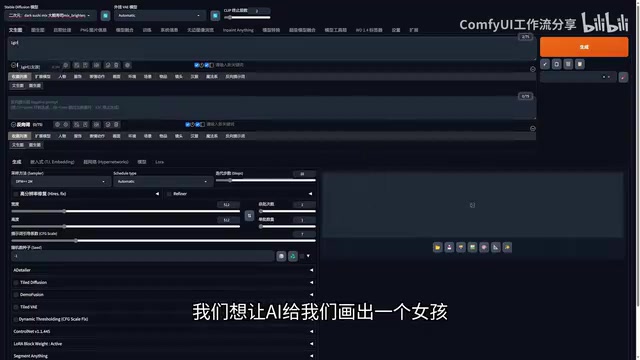
Akio SD Bundle 2026 Edition: One-Click Install & Zero-Basics Image Generation Tutorial
Akio Stable Diffusion bundle 2026 one-click install tutorial: text-to-image prompts, checkpoint and VAE selection, sampling parameters, seed reproduction, and ControlNet line-art repainting—generate images from zero basics.
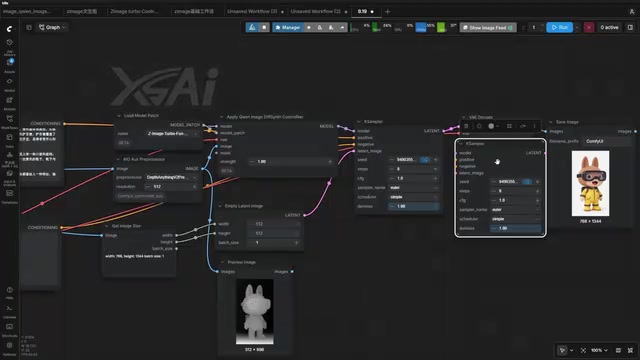
ComfyUI Two-Stage Sampling in Practice: A Guide to Choosing ControlNet Preprocessors
ComfyUI two-stage sampling tutorial: ControlNet controls structure in stage one; stage two drops ControlNet to boost quality with Denoise at 0.75. Covers OpenPose, Canny, Soft Edge, and Depth preprocessors.

2026's Most Mind-Bending Animated Series 'Infinite Flow': The Ultimate Fusion of Mystery, Deduction, and Survival Challenges
An in-depth analysis of Bilibili's animated series *Infinite Flow*: its infinite-flow worldview, mystery-deduction and survival challenges, Lin Qian's growth, ensemble portrayal, and narrative ambition.