Valuation Cut in Half? AI Giant's IPO in Flux, the Battle Behind a Trillion-Dollar Valuation
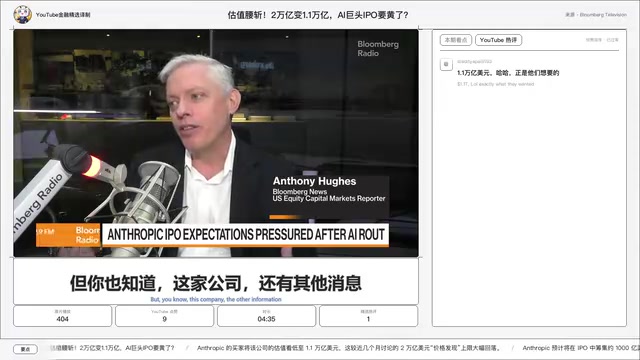
Anthropic IPO valuation expectation cut from $2T to $1.2–1.5T, with the roadshow about to launch.
The article analyzes the market shift ahead of Anthropic's IPO: amid broad market volatility and pressure on hedge funds, its valuation expectation has been lowered from $2 trillion to a $1.2–1.5 trillion range, but the listing pace is undisturbed and the roadshow may kick off next Tuesday. Supporting its confidence are a reported October run-rate above $80 billion, its irreplaceable scarcity in the AI ecosystem, and investors' "must-hold" mindset. The final valuation remains a moving target that will shift with roadshow feedback and first-day trading, and the company's roughly $200 billion cash reserve also factors into pricing. Overall, it sits at a complex juncture between macroeconomic headwinds and strong fundamentals.
From "Immune" to Under Pressure: The Market Shift Before the IPO
Over the past few months, the market has been broadly optimistic about Anthropic's IPO, with some even arguing that the company—thanks to its pivotal position in the AI ecosystem and staggering growth rate—could be somewhat "immune" to macroeconomic volatility. Recently, however, that view has begun to crack. According to overseas financial analysis cited by a Bilibili creator, as the broader market has swung significantly, Anthropic's listing process is no longer a surefire "independent track."
The valuation once discussed was as high as $2 trillion; now the potential range has been adjusted to between $1.2 trillion and $1.5 trillion. Though the numbers remain enormous, the pullback in expectations reflects a subtle shift in market sentiment. The analysis notes that many hedge funds and hot money took heavy losses this week, and the pressure on marginal buyers has directly affected the IPO pricing environment.
Roadshow Countdown: Timeline and Certainty
Despite the lowered valuation expectations, the IPO's pace appears undisturbed. According to the discussion, Anthropic has a chance to launch its IPO marketing campaign next week, with the more specific roadshow kickoff possibly falling on Tuesday—the 15th day after its public filing.
Conventionally, many IPOs choose Monday to launch, but Tuesday is also a common choice. Investment banks send institutional investors a schedule including roadshow city arrangements; while such information isn't widely publicized, professional investors typically get it in advance. Analysts stress that because a great deal of preparatory work has already been done—including groundwork for offshore issuance and retail allocation—postponing the listing at this point would cause enormous inconvenience. So even in a poor market environment, the deal is still highly likely to proceed.
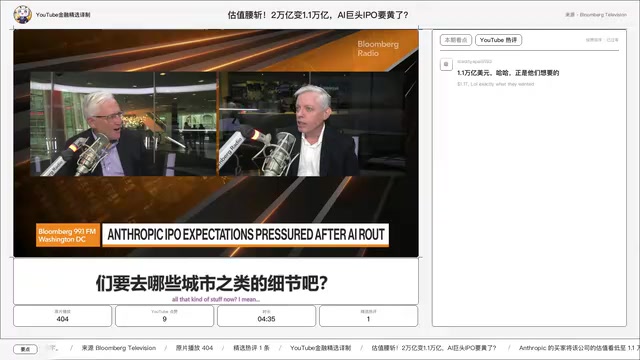
IPO roadshow is a series of promotional events held before a company goes public, aimed at institutional investors. Typically organized by underwriting banks and spanning several major financial cities, the roadshow has management explain the business model, financial performance, and growth prospects to potential buyers, gathering subscription intentions and price sensitivity. A roadshow usually lasts one to two weeks, and its feedback directly determines the final offering price and size. For a high-profile large IPO like Anthropic's, the roadshow is not just a pricing step but a key window for stabilizing market expectations and anchoring long-term investors.
Growth and Scarcity: Why It's Still a "Must-Hold" Asset
What underpins Anthropic's listing confidence is its still-strong fundamentals. Although the October run-rate figure the market had awaited is missing, according to The Wall Street Journal, it is said to exceed $80 billion. That number sends investors a clear signal: the company's growth remains extremely fast and has reached considerable scale.
For many investors, even those wary of an AI bubble, Anthropic is still seen as a "must-hold" stock. The reason is that the company plays a critical role in advancing the entire AI narrative, and its industry position is hard to replace. This scarcity may give it greater pricing tolerance than an ordinary company—the company doesn't need to squeeze every last dollar from the market, but rather prioritizes a smooth listing and the start of public trading to pave the way for future development.
Run-rate is an annualized revenue metric commonly used by SaaS and high-growth tech companies, usually calculated by multiplying the most recent month's or quarter's revenue by 12 to estimate the full-year level. It is not realized annual revenue but an "instantaneous annualized" measure reflecting current growth. For Anthropic, a run-rate above $80 billion means its commercialization has entered a very large-scale phase, but investors should also note that the metric may include one-off or high-growth-period non-steady-state factors, and should be judged alongside retention rates and gross margins.
Dynamic Pricing: The Final Valuation Is Still a Moving Target
As for the final valuation, the currently circulating figures of $1.2 trillion, $1.3 trillion, or even $1.5 trillion are only potential ranges. The analysis notes that the final market cap could change both during the roadshow and on the first day of trading. If demand is strong, the valuation could be revised upward, and vice versa.
In addition, the company's cash reserves are an important factor in valuation considerations. Assuming Anthropic raises about $100 billion through this IPO, it would hold roughly $200 billion in cash on its books. How this massive sum is factored into the valuation varies among investors, which is one reason the valuation range is so wide.
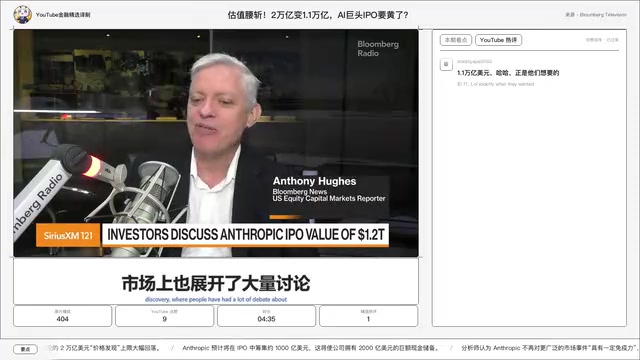
Overall, Anthropic's IPO sits at a complex juncture: on one hand it must contend with macroeconomic headwinds and a valuation pullback; on the other, it must leverage its irreplaceable industry position and rapid growth to shore up market confidence. This closely watched listing drama is about to enter its crucial roadshow phase.
IPO pricing mechanism typically uses book-building: underwriters assess total demand at various prices based on institutional subscription orders gathered during the roadshow, then negotiate the final offering price with the issuer. If demand is strong, the price range can be raised or the offering size expanded; if demand is insufficient, it may be lowered or reduced. In addition, the greenshoe option (over-allotment) allows underwriters to stabilize the share price after listing. Therefore, the valuation range disclosed in the prospectus is only a reference—the actual pricing is a dynamic result of roadshow feedback and market sentiment combined.
One-line Summary
Anthropic's IPO valuation expectation has been cut from $2 trillion to $1.2–1.5 trillion, with the roadshow set to launch soon.
Paragraph Summary
The article analyzes the market shift ahead of Anthropic's IPO: amid broad market volatility and pressure on hedge funds, its valuation expectation has been lowered from $2 trillion to a $1.2–1.5 trillion range, but the listing pace is undisturbed and the roadshow may kick off next Tuesday. Supporting its confidence are a reported October run-rate above $80 billion, its irreplaceable scarcity in the AI ecosystem, and investors' "must-hold" mindset. The final valuation remains a moving target that will shift with roadshow feedback and first-day trading, and the company's roughly $200 billion cash reserve also factors into pricing. Overall, it sits at a complex juncture between macroeconomic headwinds and strong fundamentals.
Related articles

Hermes Agent Beginner's Guide: Hands-On with a Self-Evolving AI Agent
A beginner's guide to Hermes Agent, the open-source self-evolving AI agent that gained 41.7K GitHub stars in two months—covering Harness Engineering, the learning loop, three-layer memory, WSL installation, and hands-on configuration.

AI Agent in Action: Building a Smart Office Assistant with WorkBuddy
A practical case study shows how Tencent WorkBuddy batch-converts and archives files, compares chat LLMs with AI Agents, and analyzes WorkBuddy's credit system, use cases, and positioning for office automation selection.

From Single-GPU Bottlenecks to Hundreds of Billions of Parameters: 6 Key Questions in Large Model Distributed Parallelism
Based on a Bilibili tutorial, this article organizes core knowledge of large model distributed parallelism: starting from decoder-only architecture's token-by-token generation and the essence of X times W computation, it analyzes six key questions including data parallelism, tensor parallelism, and pipeline parallelism under single-GPU bottlenecks. Suitable for learners in private deployment and model training scenarios to build systematic understanding.