Vercel AI SDK @ai-sdk/openai@4.0.78 Update: What's New

Vercel AI SDK v4.0.78 adds reasoningEffort 'none' support and dual-level parameter validation.
The `@ai-sdk/openai` package in Vercel AI SDK has released patch version 4.0.78, centered on enhancements to the `reasoningEffort` parameter. This update adds support for `reasoningEffortUpdate: 'none'` targeting next-gen reasoning models like GPT-6 Sol and Luna, letting developers fully disable reasoning extension for lower latency and cost. It also introduces stricter validation — warning and ignoring unsupported effort updates at the request level, while rejecting them outright in historical messages to prevent invalid configs from polluting conversation context. As a patch release, it carries low breaking-change risk and is safe to adopt on a regular upgrade schedule.
Version Update Overview
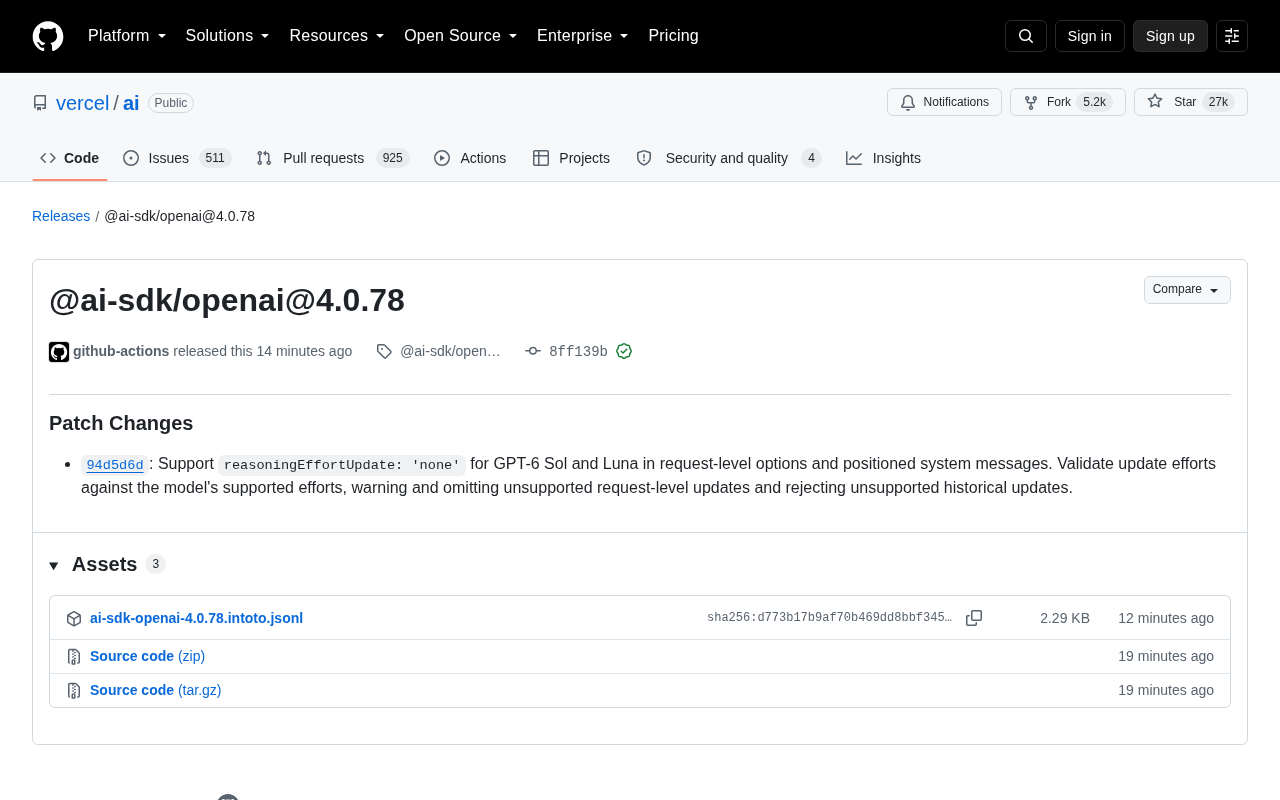
Vercel's AI SDK project has released @ai-sdk/openai@4.0.78 as a patch update. With over 27k stars and 5.2k forks on GitHub, the AI SDK is a critical piece of infrastructure for many developers building AI-powered applications — making every release worth paying attention to.
This update falls under Patch Changes, focusing primarily on expanded support for the reasoning effort parameter and adapting to new model capabilities.
Core Change: Enhanced reasoningEffort Parameter
The key change in this patch is the addition of support for reasoningEffortUpdate: 'none'. According to the release notes, this capability targets the GPT-6 Sol and Luna models and can be used in both request-level options and positioned system messages.
In short, reasoningEffort is a parameter that controls how much cognitive effort the model invests in reasoning. Allowing it to be set to 'none' means developers can now explicitly disable or skip additional reasoning overhead in certain scenarios — enabling more flexible tradeoffs between response speed and reasoning depth. This is particularly useful in production environments where fine-grained control over cost and latency is essential.
Parameter Validation Mechanism
Beyond the new value, this update also introduces stricter validation logic: the SDK now validates update requests against the model's actually supported efforts.
Specific behaviors include:
- For unsupported updates at the request level, the SDK will issue a warning and automatically omit the update rather than aborting the request;
- For unsupported updates in historical messages, the SDK will directly reject them, ensuring consistency and correctness of the conversation context.
This dual strategy — lenient at the request level, strict at the history level — balances runtime robustness with data reliability. It prevents application crashes caused by parameter mismatches while stopping invalid configurations from polluting conversation history.
The reasoningEffort parameter was originally introduced alongside OpenAI's reasoning models (such as the o1 and o3 series). These models perform internal Chain-of-Thought reasoning before generating a final answer, consuming additional compute tokens in the process. reasoningEffort typically supports three tiers — 'low', 'medium', and 'high' — corresponding to different reasoning depths and token costs. The higher the tier, the stronger the model's handling of complex problems, but with increased latency and cost.
Previously, 'none' was not a supported value, meaning even simple tasks couldn't fully bypass the reasoning phase. The newly added 'none' option lets developers completely disable reasoning extension for specific requests, reverting the model to a direct generation mode closer to standard GPT models — significantly reducing latency and cost for simple Q&A, classification, formatting, and similar use cases.
The "updates in historical messages" (i.e., reasoningEffortUpdate within positioned system messages) refers to embedding reasoning effort changes into the system messages of the conversation context, allowing dynamic switching of reasoning intensity across different stages of a multi-turn dialogue. Since historical messages, once written, are passed as context to all subsequent turns, any unsupported configuration within them will continuously affect every future request. This is why the SDK takes a hard-reject approach at the history level — to prevent "dirty configs" from propagating throughout the entire conversation chain. Request-level options, by contrast, only affect a single call and have a contained impact scope, so a warn-and-ignore approach is used instead of a hard rejection. This gives developers a clear debugging signal while avoiding a cascade failure that would take down the entire application over a single incompatible parameter.
What This Means for Developers
For teams integrating OpenAI models via the Vercel AI SDK, this update provides finer-grained control over the latest generation of reasoning models. As model reasoning capabilities continue to advance, efficiently allocating reasoning resources on demand is becoming an increasingly important engineering concern.
It's worth noting that the GPT-6 Sol and Luna model identifiers mentioned in the release notes are relatively new. Specific capability details should be verified against official model documentation. After upgrading to this version, developers can experiment with reasoningEffort-related parameters based on what their target models actually support.
Upgrade Recommendations
As a patch release, this update is not expected to contain breaking changes, making the upgrade risk low. Projects using the AI SDK can follow their regular update cadence to upgrade to 4.0.78 — especially teams looking to use the aforementioned reasoning models or needing fine-grained control over reasoning behavior.
This version was automatically published via GitHub Actions and has been verified with GitHub's verified signature (GPG key ID: B5690EEEBB952194), ensuring the integrity and trustworthiness of the release artifact.
Related articles

Why Does the Tesla Roadster Need to Fly? A Deep Dive into Musk's Wild Demo
Tesla's Roadster launch showed wall-climbing, upside-down driving, and flying stunts—but The Vergecast notes the demo car may lack a battery, the Rocket version is invite-only and not street-legal, and the website terms don't guarantee delivery. After nine years of delays, why does this car still need to exist?

AI Is Not a Replacement: Human-AI Collaboration Through the Lens of Factory Root Cause Analysis
Starting from factory root cause analysis, this article explains how AI accelerates evidence chain construction rather than replacing human experts, exploring the pragmatic implementation logic and business value of 'AI supporting people rather than replacing them.'

AI Agent Decision Auditing: Building an Evidence Chain in Regulated Workflows
Starting from a Reddit discussion, this article analyzes three core issues in AI agent decision auditing within regulated workflows: what fields audit records should contain, how to handle feedback latency for erroneous decisions, and how to continuously calibrate LLM judge consistency with human judgment.