Vercel AI SDK Releases @ai-sdk/rsc 2.0.297 Patch Update

Vercel AI SDK releases @ai-sdk/rsc@2.0.297 patch to sync upstream dependencies across its monorepo packages.
Vercel AI SDK has released `@ai-sdk/rsc@2.0.297`, a patch-level update alongside core package `ai@6.0.297`, primarily aimed at syncing internal dependencies within its monorepo architecture. `@ai-sdk/rsc` is designed for React Server Components, enabling server-side streaming of LLM outputs as interactive React components — the technical backbone of Vercel's Generative UI vision. The release contains no breaking changes, making upgrades low-risk, though developers should note the version mismatch between `@ai-sdk/rsc` (2.0.x) and the core `ai` package (6.0.x) when combining multiple sub-packages.
Vercel's AI SDK ecosystem recently released a @ai-sdk/rsc@2.0.297 update. This is a patch-level release focused on dependency synchronization, accompanied by the core package ai@6.0.297, primarily aimed at maintaining version consistency across the entire SDK family.
What's in This Update
According to the GitHub Releases page, @ai-sdk/rsc@2.0.297 is a patch version update that introduces no breaking changes. The core changes are centered on dependency updates. The release notes list several updated dependency commits, including changes corresponding to hashes 8349396, ab0b94b, ce660b0, 850d4d5, cdc5b56, and d4203d2.
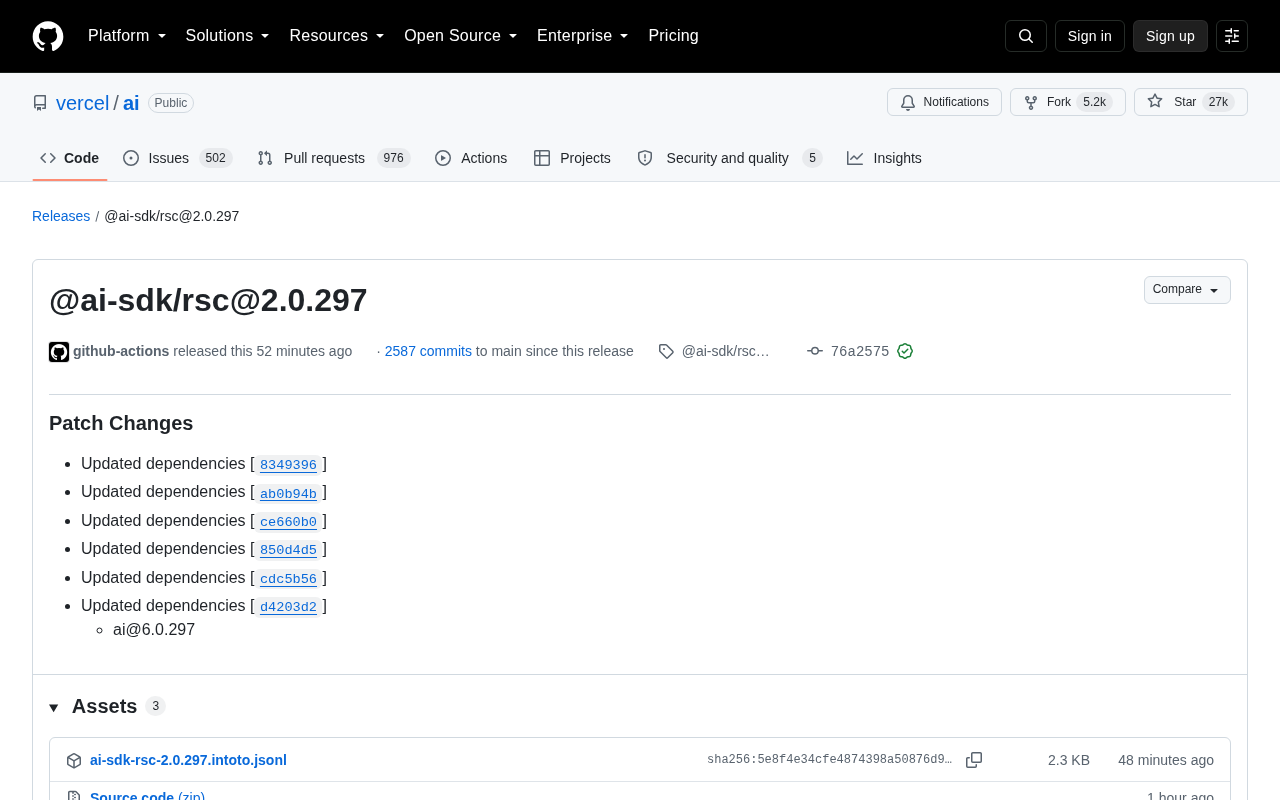
Notably, the version numbers differ between packages: @ai-sdk/rsc remains on the 2.0.x major version line, while the underlying core package ai has progressed to the 6.0.x series. This version discrepancy reflects Vercel AI SDK's monorepo multi-package management strategy — different sub-packages each maintain their own independent version numbers, while patch releases keep internal dependencies in sync.
Background: A monorepo (single-repository, multi-package) is an engineering strategy that centralizes multiple related packages in a single codebase. Vercel AI SDK implements this using pnpm workspaces. Under this model, sub-packages like
@ai-sdk/rsc,@ai-sdk/openai, and@ai-sdk/anthropiccoexist alongside the coreaipackage in the same repository, each with its ownpackage.jsonand version number. A Patch Release in Semantic Versioning (SemVer) corresponds to an increment of thex.x.PATCHposition, indicating only backward-compatible bug fixes or dependency syncs — no new features or breaking changes. These releases are typically auto-generated via tools like Changesets, which trigger CI pipelines to publish — a routine maintenance practice for keeping multi-package health in large open-source projects.
The Role of the RSC Package in AI SDK
@ai-sdk/rsc is the sub-package within Vercel AI SDK dedicated to React Server Components (RSC). It enables developers to stream AI-generated UIs within server components, mapping large language model outputs directly to interactive React components rather than plain text streams.
This capability is the technical foundation of Vercel's "Generative UI" concept. Compared to traditional text-only chat interfaces, RSC-based approaches allow AI to dynamically return rich interactive components — charts, cards, forms, and more — based on context, expanding the expressive possibilities of AI applications. While this patch update brings minimal functional changes, it maintains compatibility between this package and the mainline core library, making it an essential maintenance action for production projects that depend on it.
Background: React Server Components (RSC) is an architectural feature introduced in React 18 that allows components to render on the server and stream HTML directly to the client, without bundling component logic into client-side JavaScript. Unlike traditional Server-Side Rendering (SSR), RSC enables component-level server/client separation: server components can directly access databases, filesystems, or call LLM APIs without an additional API layer.
@ai-sdk/rscleverages this capability through APIs likecreateStreamableUIandstreamUI, mapping LLM streaming outputs to React component trees on the server side in real time, then pushing them to the browser via React's streaming protocol — eliminating the overhead of additional client-side requests or manual text parsing.
Project Popularity and Community Activity
Based on GitHub repository data, Vercel's AI repository has approximately 27,000 stars and 5.2k forks, making it one of the most widely followed AI development frameworks in the JavaScript/TypeScript ecosystem. The main branch has accumulated over 2,587 commits since the project launched, reflecting a notably fast iteration cadence.
This release was completed automatically via GitHub Actions and uses GitHub's verified signature (GPG key ID: B5690EEEBB952194), ensuring the trustworthiness of the release artifacts. For teams using automated CI/CD pipelines, these frequent small patch releases can typically be upgraded smoothly through dependency management tools like pnpm or npm's semver range specifiers.
What Developers Should Do
For developers currently using Vercel AI SDK, upgrading a patch version is generally a low-risk operation. It's worth reviewing the update notes for the main ai@6.0.297 package, since the RSC package's changes in this release are primarily driven by upstream dependency syncs. If your project locks to specific version numbers, assess whether to upgrade based on your actual needs; if you're using compatible version ranges, the update will typically be picked up automatically.
One important note: since @ai-sdk/rsc and the core ai package have different major version numbers, when combining multiple sub-packages, pay attention to the version compatibility matrix between them to avoid type definition or runtime issues caused by version mismatches. Overall, this is a routine maintenance release that reflects the Vercel AI SDK team's continued commitment to version consistency and dependency health.
Related articles

Gemini 4 Argon Hands-On: AI Builds Board Games, Constructs Temples, and Trains Robots Autonomously
Gemini 4 Argon hands-on roundup: AI autonomously builds a desk racetrack and temple in Blender, writes a ray tracing engine, trains a humanoid robot to sink 7 shots, plus API pricing and developer access.

The Magic Octagonal Coin: Why Only 9% of People Can Predict Its Flip?
Only 9% of people can correctly predict the Magic Octagon coin flip. This article explains its spatial rotation mechanism, common cognitive pitfalls, and a new hypothesis based on Relevance Theory, exploring the limits of human spatial reasoning.

Sam Altman: AI Is Entering the Era of Scientific Discovery — Math Breakthroughs Will Replicate in Biology and Energy
Sam Altman says AI is entering the era of scientific discovery — math breakthroughs will replicate in biology, materials science, and energy to help develop new drugs and energy sources.