Vercel AI SDK Releases @ai-sdk/tui 1.0.111 Patch Update

Vercel AI SDK releases @ai-sdk/tui 1.0.111 patch, syncing core dependency to ai@7.0.110.
Vercel AI SDK's terminal UI sub-package `@ai-sdk/tui` has released version 1.0.111, a patch update that syncs the underlying dependency to `ai@7.0.110` with no breaking changes. The package targets CLI and terminal-based AI applications, reusing the SDK's streaming and tool-calling abstractions. The release was automated via GitHub Actions with GPG signature verification, reflecting the project's rigorous engineering practices. The repository has surpassed 26,900 GitHub stars and continues its high-frequency release cadence.
Vercel's popular open-source AI SDK project recently released @ai-sdk/tui@1.0.111. This is a patch-level update that primarily syncs the core dependency to ai@7.0.110. For developers building AI applications with this terminal UI component, this is a maintenance release worth keeping an eye on.
Release Overview
According to the GitHub Release page, @ai-sdk/tui@1.0.111 was published via an automated GitHub Actions workflow at commit hash a9d97b5, and verified with an official GitHub GPG signature (GPG key ID: B5690EEEBB952194), ensuring the integrity and trustworthiness of the release artifact.
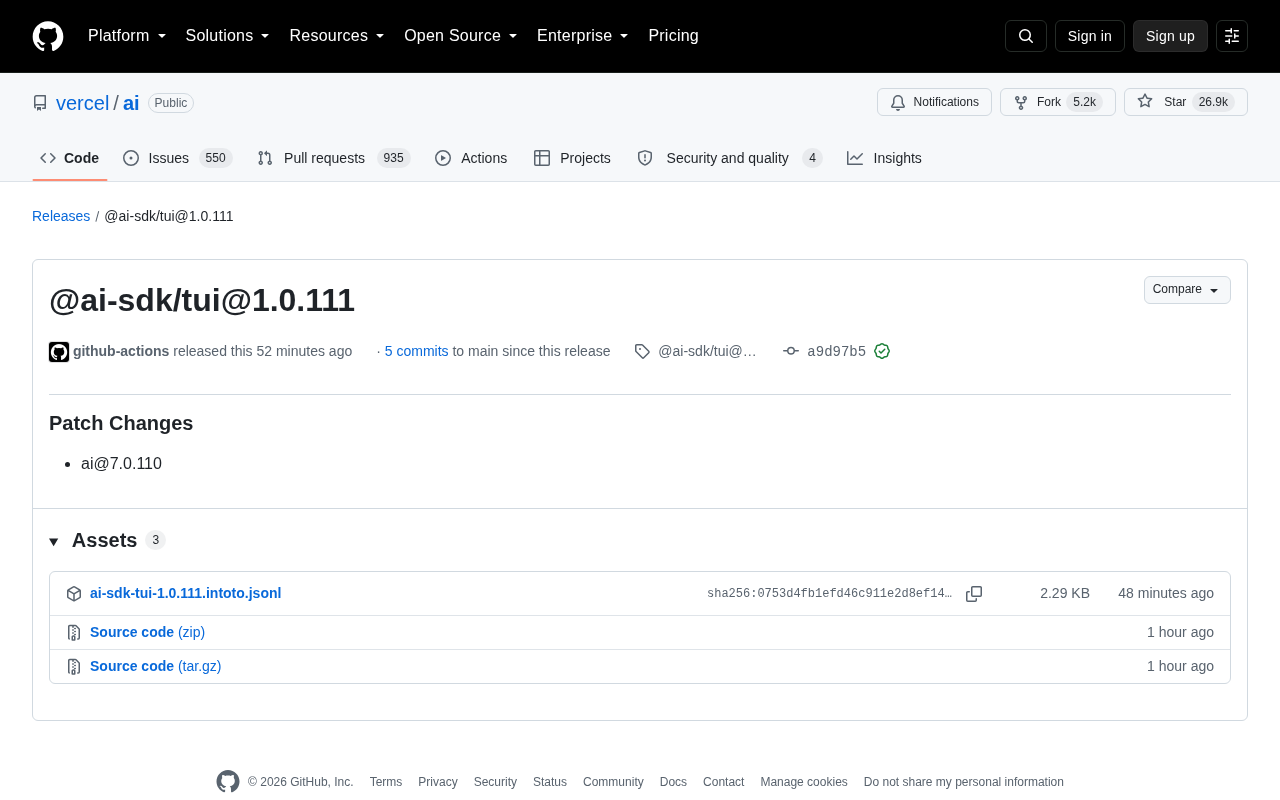
Vercel's ai repository is one of the most active AI application development frameworks in the ecosystem today, having accumulated over 26,900 stars and 5.2k forks — a testament to its influence within the developer community.
GPG (GNU Privacy Guard) signature verification is a standard practice in open-source software release workflows for confirming the authenticity of artifacts. The publisher signs a release using a private key, and users can verify the signature against the corresponding public key (in this case, GitHub's official GPG key ID: B5690EEEBB952194) to confirm the release genuinely comes from an authorized party and has not been tampered with. Combining GitHub Actions automation with GPG signing has become an engineering standard for high-trust open-source projects, effectively guarding against supply chain attacks — where an attacker poisons a dependency package to compromise downstream projects. For AI infrastructure projects in particular, such security mechanisms are especially critical.
What's in This Update
From the release notes, 1.0.111 falls under Patch Changes, with the core change being an upgrade of the underlying dependency to ai@7.0.110.
Patch versions typically mean:
- No breaking changes are introduced
- Known issues are fixed or upstream dependencies are synced
- API backward compatibility is maintained
For developers, this kind of update carries minimal upgrade overhead — you can generally upgrade directly without modifying existing code, while still benefiting from the stability and feature improvements brought by the upstream ai core package.
What Is @ai-sdk/tui
@ai-sdk/tui is a sub-package within the Vercel AI SDK family. TUI stands for Terminal User Interface. It targets developers who want to build interactive AI experiences in command-line environments — think CLI tools, terminal chat assistants, command-line code agents, and similar use cases.
Compared to the more widely known Web/React integrations in the Vercel AI SDK, the tui package fills the gap on the terminal side, allowing developers to reuse the same AI SDK abstractions (such as streaming output, tool calling, and multi-model adapters) to build terminal applications. With the rise of command-line AI tools, the practical value of components like this is only growing.
The Vercel AI SDK as a whole follows a Monorepo architecture, splitting functionality into multiple opt-in sub-packages — for example, @ai-sdk/react for React/Next.js, the core ai package for server-side streaming, and @ai-sdk/tui as discussed here. This design lets developers install only what they actually need, avoiding unnecessary dependency bloat. The ai core package handles the low-level logic for communicating with major LLM providers (OpenAI, Anthropic, Google, etc.), including streaming parsing and tool-calling protocols. @ai-sdk/tui builds on top of this to provide a terminal rendering layer, presenting streaming text, progress states, and other information as TUI components in the command-line interface. As a result, the tui package's versioning closely tracks changes in the ai core package — which explains why this patch update's primary content is simply syncing the upstream dependency.
What This Means for Developers
For project teams relying on the Vercel AI SDK, keeping dependencies up to date helps ensure better stability and security. Since this is a pure patch update that syncs the core ai package, the recommended approach is to validate in a test environment before rolling out to production — even though patch-level risk is low, it's still worth reviewing the changelog when syncing a core dependency.
It's worth noting that the Vercel AI SDK operates at a high iteration cadence, with the version number already at 1.0.111, indicating this sub-package is in active maintenance and rapid development. Frequent minor releases are a common practice in modern open-source infrastructure projects, enabling fast responses to upstream changes and timely bug fixes.
Summary
@ai-sdk/tui@1.0.111 is a typical dependency-sync patch update, with the primary change being an upgrade to ai@7.0.110. It doesn't include any major feature changes, but as part of the ongoing maintenance of Vercel AI SDK's terminal UI component, it reflects the project's healthy update cadence and well-engineered release process. Developers using this package are encouraged to follow the official GitHub Releases page and stay current with new versions.
Related articles

AI Is Not a Replacement: Human-AI Collaboration Through the Lens of Factory Root Cause Analysis
Starting from factory root cause analysis, this article explains how AI accelerates evidence chain construction rather than replacing human experts, exploring the pragmatic implementation logic and business value of 'AI supporting people rather than replacing them.'

AI Agent Decision Auditing: Building an Evidence Chain in Regulated Workflows
Starting from a Reddit discussion, this article analyzes three core issues in AI agent decision auditing within regulated workflows: what fields audit records should contain, how to handle feedback latency for erroneous decisions, and how to continuously calibrate LLM judge consistency with human judgment.

Apple Opens Multiseat Subscription Purchasing: App Subscriptions Can Now Be Sold in Bulk to Businesses and Schools
Apple opens multiseat purchasing for auto-renewable subscriptions: businesses and schools can bulk-buy via Apple Business and Apple School Manager, adding or removing seats anytime. Enabled by default in App Store Connect—developers should verify settings; group purchasing sandbox testing opens October 2026.