Vercel AI SDK Releases @ai-sdk/voyage@2.0.52: Build Migrated to tsdown

Vercel AI SDK's Voyage provider gets a patch migrating its build tool from tsup to Rolldown-based tsdown.
`@ai-sdk/voyage@2.0.52` is a maintenance patch that migrates the build tool from `tsup` (esbuild-based) to `tsdown` (Rolldown-based), while syncing upstream dependencies `@ai-sdk/provider@4.0.20` and `@ai-sdk/provider-utils@5.0.52`. No public API changes or breaking changes are included, making this a low-risk upgrade. The migration is part of Vercel AI SDK's broader build system modernization across its multi-package monorepo, targeting faster CI builds, consistent output formats, and better tree-shaking support.
Vercel's AI SDK ecosystem has a new update: the @ai-sdk/voyage package has released version 2.0.52. This is a patch-level update focused on migrating the build toolchain, along with syncing related dependency updates. For developers using the Vercel AI SDK to integrate Voyage AI embedding models, this is a small but meaningful update that reflects the ongoing engineering evolution of the SDK's underlying infrastructure.
Core Changes in This Release
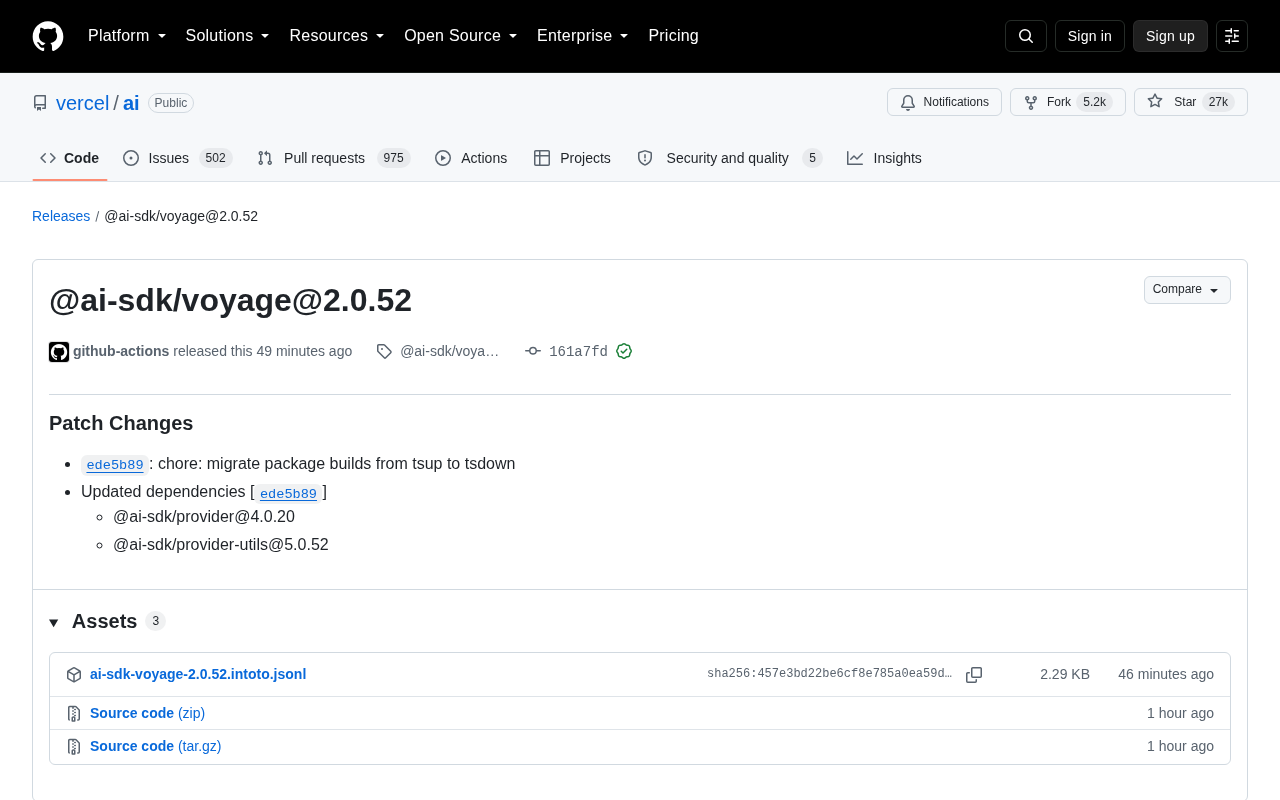
According to the GitHub release notes, @ai-sdk/voyage@2.0.52 contains a single engineering adjustment:
- Build tool migration: The package build process has been migrated from
tsuptotsdown(commitede5b89, tagged as chore).
In addition, two upstream dependencies were updated:
@ai-sdk/provider@4.0.20@ai-sdk/provider-utils@5.0.52
This type of change is a classic "internal maintenance" release — no new public-facing API features or breaking changes. For most users, behavior after upgrading should remain identical, with the main benefits showing up in build output quality and maintainability.
Why Migrate from tsup to tsdown
tsup is a widely used TypeScript bundler in the community, built on top of esbuild, and has long been the default choice for many npm packages. tsdown is a newer build tool powered by Rolldown (a Rust-based Rollup replacement), emphasizing faster build speeds and output quality closer to Rollup's behavior.
For a monorepo like Vercel AI SDK — which includes dozens of provider sub-packages — standardizing and upgrading the build toolchain delivers real engineering value: faster CI builds, more consistent output formats, and better control over tree-shaking and type declaration generation. Bringing the voyage package into this migration is part of a broader modernization of the SDK's build system, not an isolated change — the synchronized dependency updates make it clear that multiple sub-packages are advancing the same toolchain change in concert.
Rolldown is a Rust-based rewrite of Rollup, led by the Vite team, aiming to deliver dramatically faster bundling while maintaining high compatibility with Rollup's plugin ecosystem and output format.
tsdownis a TypeScript-specific bundler built on top of Rolldown — think of it as the spiritual successor totsup(which is based on esbuild), but with tree-shaking granularity and.d.tsgeneration behavior that more closely aligns with Rollup semantics. For a monorepo like Vercel AI SDK with dozens of provider sub-packages, build tool consistency directly impacts CI duration and output predictability, making the gradual migration of sub-packages to a unified toolchain a sound engineering decision.
The Role of the Voyage Integration in AI SDK
@ai-sdk/voyage is the official Vercel AI SDK provider for Voyage AI. Voyage AI is known for its high-quality text embedding and reranking models, commonly used in the vectorization stage of Retrieval-Augmented Generation (RAG) pipelines.
Through this package, developers can access Voyage's embedding capabilities through the Vercel AI SDK's unified interface, seamlessly combining them with other SDK features like text generation and tool calling. This "unified abstraction layer + multiple providers" architecture is central to the Vercel AI SDK's design philosophy — eliminating the need for developers to write custom adapter code for each model provider.
Text embedding is the process of transforming natural language text into high-dimensional vectors, such that semantically similar texts are closer together in vector space. In a RAG architecture, embedding models convert both knowledge base documents and user queries into vectors, enabling similarity-based retrieval of the most relevant context — which is then passed as part of the prompt to the generative model. Reranking is a second-pass precision step applied after initial retrieval to re-score candidate results, typically yielding significant improvements in the quality of context delivered to the generative model. Voyage AI offers industry-leading specialized models for both tasks, with its embedding models performing strongly on academic benchmarks such as MTEB, making them a popular choice in production-grade RAG systems that demand high-precision semantic retrieval.
Should Developers Upgrade Immediately?
For a purely engineering-focused patch update, the upgrade decision is straightforward:
- Since this release involves no API-level feature additions or breaking changes, the upgrade risk is low.
- If your project has strict requirements around build outputs or dependency version pinning, it's recommended to run standard regression tests after upgrading to confirm that bundling and runtime behavior remain as expected.
- Teams using monorepos or centralized dependency management should consider aligning
@ai-sdk/providerand@ai-sdk/provider-utilsto the corresponding versions simultaneously to avoid version mismatches.
Overall, this is a low-risk, maintenance-focused release. It won't change how developers use the package, but the ongoing toolchain improvements will contribute to better build efficiency and stability for the SDK over the long term.
Summary
@ai-sdk/voyage@2.0.52 is a typical under-the-hood maintenance update, centered on migrating the build tool from tsup to tsdown and refreshing dependencies. While it lacks user-facing new features, this kind of sustained engineering investment is exactly what keeps a healthy open-source project thriving over time. For developers relying on the Vercel AI SDK, staying aware of these foundational changes helps with planning upgrade cadence more effectively.
Related articles

Reinforcement Learning Takes On Getting Over It: Distributed Training Strategies Behind 63% Progress
A developer uses deep reinforcement learning to tackle Getting Over It. The agent climbs from the bottom to 63% progress but gets stuck at the anvil. The project is open-sourced, using divide-and-conquer training and CPU-only training, seeking community collaboration to break the bottleneck.

Sigma FP2 Released: The World's Smallest Full-Frame Camera Gets Sensor and Screen Upgrades
Sigma launches the FP2 full-frame camera, retaining its smallest-and-lightest design with three key upgrades: improved sensor, articulating LCD screen, and longer battery life—built for portable video creators.

AAAI 2027 Phase 2 Decisions Imminent: Community Debates Review Fairness and Submission Ecosystem
AAAI 2027 phase 2 review results are imminent, with the Reddit community debating reviewer consistency and process transparency. This article examines pre-decision sentiment, structural tensions in top conference review, and practical strategies for authors.