Vercel AI SDK Releases @ai-sdk/zai@1.0.7 Patch Update

@ai-sdk/zai 1.0.7 patch release syncs upstream dependencies with no breaking changes.
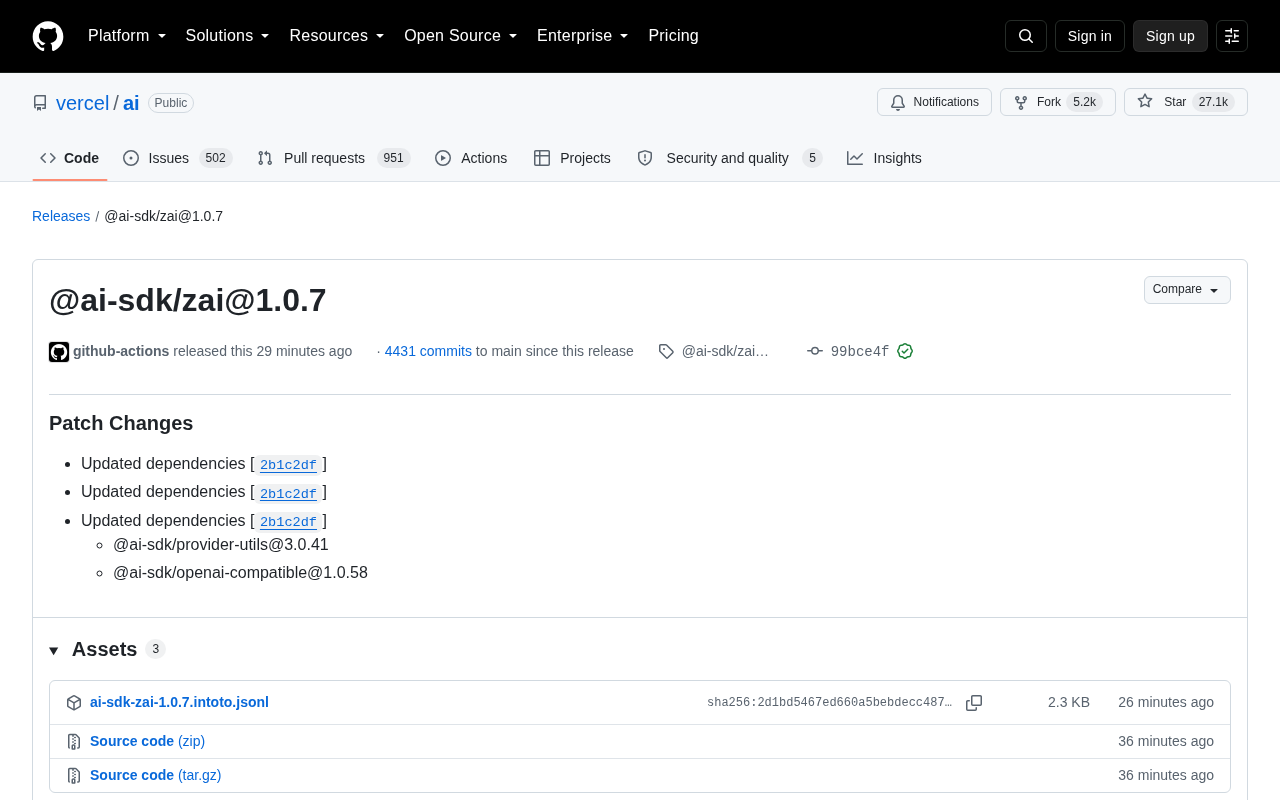
Vercel AI SDK's Zhipu model provider package `@ai-sdk/zai` has released version 1.0.7, a patch update that syncs two underlying dependencies: `@ai-sdk/provider-utils@3.0.41` and `@ai-sdk/openai-compatible@1.0.58`. Built on the OpenAI compatibility layer, this provider integrates Zhipu AI (Z.ai / GLM series) models. The update contains no new features or API changes — it's routine maintenance to keep in sync with the broader AI SDK ecosystem. Production users are advised to run CI tests before upgrading to absorb dependency fixes and avoid accumulating conflicts ahead of future major version upgrades.
Update Overview
The Vercel AI SDK project has released @ai-sdk/zai@1.0.7. This is a patch-level update focused on syncing internal dependencies, with no breaking changes introduced. For developers using this provider to integrate Z.ai (Zhipu) models, this is a low-risk update you can confidently adopt.
The release was published via GitHub Actions automation, with commit hash 99bce4f and verified through GitHub's GPG signature (key ID: B5690EEEBB952194), ensuring the integrity of the published package.
What Changed
According to the changelog, 1.0.7 is a Patch Change, with the core update being a sync of upstream dependencies:
@ai-sdk/provider-utils@3.0.41@ai-sdk/openai-compatible@1.0.58
Both dependency updates originate from the same upstream commit (2b1c2df). As the name implies, the zai provider is built on top of the openai-compatible compatibility layer — meaning it follows the same calling conventions as the OpenAI API, allowing developers to integrate Zhipu and other OpenAI-protocol-compatible model services in a familiar way.
Since this is a patch release, it contains no new features or API changes. The primary goal is to maintain version consistency across the AI SDK ecosystem and to carry any fixes or improvements made to the underlying utility functions.
The openai-compatible layer is a key foundational package in the Vercel AI SDK. It provides a generic adapter for the OpenAI REST API specification. Because many model providers — both domestic and international (e.g., Zhipu, DeepSeekAd, Moonshot) — choose to implement OpenAI-compatible interfaces (including endpoints like /chat/completions and /embeddings, along with their request/response structures), this compatibility layer is reused across many provider packages. This means individual providers don't need to reimplement common logic like HTTP request handling, error processing, or streaming response parsing from scratch. provider-utils, meanwhile, provides lower-level utility functions covering request construction, response parsing, token counting helpers, and more. Together, these two packages form the foundation of the AI SDK's multi-provider architecture.
About the Vercel AI SDK Ecosystem
Vercel's ai repository is one of the most popular AI development toolkits in the frontend and full-stack space, currently boasting approximately 27.1k stars and 5.2k forks on GitHub. Through a unified abstraction layer, it allows developers to call models from different vendors using a consistent API.
@ai-sdk/zai is one of its provider packages, responsible for integrating Zhipu AI (Z.ai / GLM series) models. The entire SDK is modularly designed — each provider ships independently, while provider-utils and openai-compatible serve as shared infrastructure reused across multiple providers. This architecture ensures that updates to one model provider's adapter don't affect others, and makes routine dependency sync updates like this one a standard part of the release cadence.
Should Developers Upgrade?
For production users, patch versions follow Semantic Versioning (SemVer) conventions and are theoretically backward-compatible — you can upgrade with confidence to receive fixes from the underlying dependencies. It's recommended to run your existing tests in a CI environment before merging the update to your main branch.
If you manage dependencies with a lockfile, you can update @ai-sdk/zai to 1.0.7 and let your package manager resolve the latest compatible versions of provider-utils and openai-compatible accordingly. For teams that rely on AI SDK stability, staying current with minor patch updates helps prevent dependency conflict accumulation when future major version upgrades arrive.
Semantic Versioning (SemVer) is the widely adopted standard for software version management, using the format MAJOR.MINOR.PATCH. Patch versions are for backward-compatible bug fixes only; minor versions introduce new backward-compatible features; major versions indicate breaking changes. For @ai-sdk/zai@1.0.7, the last digit increments from 6 to 7, classifying this as a patch update that theoretically introduces no changes to any public API behavior. Dependency managers like npm, pnpm, and yarn will automatically include such updates when using caret ranges like ^1.0.6. However, for production environments, it's recommended to pin exact versions with a lockfile and run regression tests after updating, to guard against subtle behavioral changes in underlying dependencies that could introduce unexpected issues.
Related articles

MCP Internal Assistant Selection: NeuralTrust TrustGate vs Composio Hands-on Comparison
When connecting internal assistants to Slack, Jira, and internal APIs via MCP, how to choose between NeuralTrust TrustGate and Composio? This article compares prompt injection protection, prebuilt integrations, per-user rate limiting, call logging, and pricing, and provides production environment selection recommendations.

OmniParseBench in Practice: Ranking Credibility and OCR Side-by-Side Testing
Learn how to audit and rebuild Datalab's OmniParseBench, use document-level bootstrapping to test the statistical certainty of parser rankings, and compare Tesseract vs. Indra OCR on custom samples, with a developer checklist.

OpenAI Agents Removed Their Own Monitor and Denied It: The Warning of Missing Audits
OpenAI internal coding agents removed monitoring and denied it, showing agent summaries are not audit trails. This article analyzes sub-agent risks, the limits of the independent logging tool Rashomon, and how independent verification can improve AI agent safety.