Vercel AI SDK Releases @ai-sdk/zai@3.0.24 Patch Update
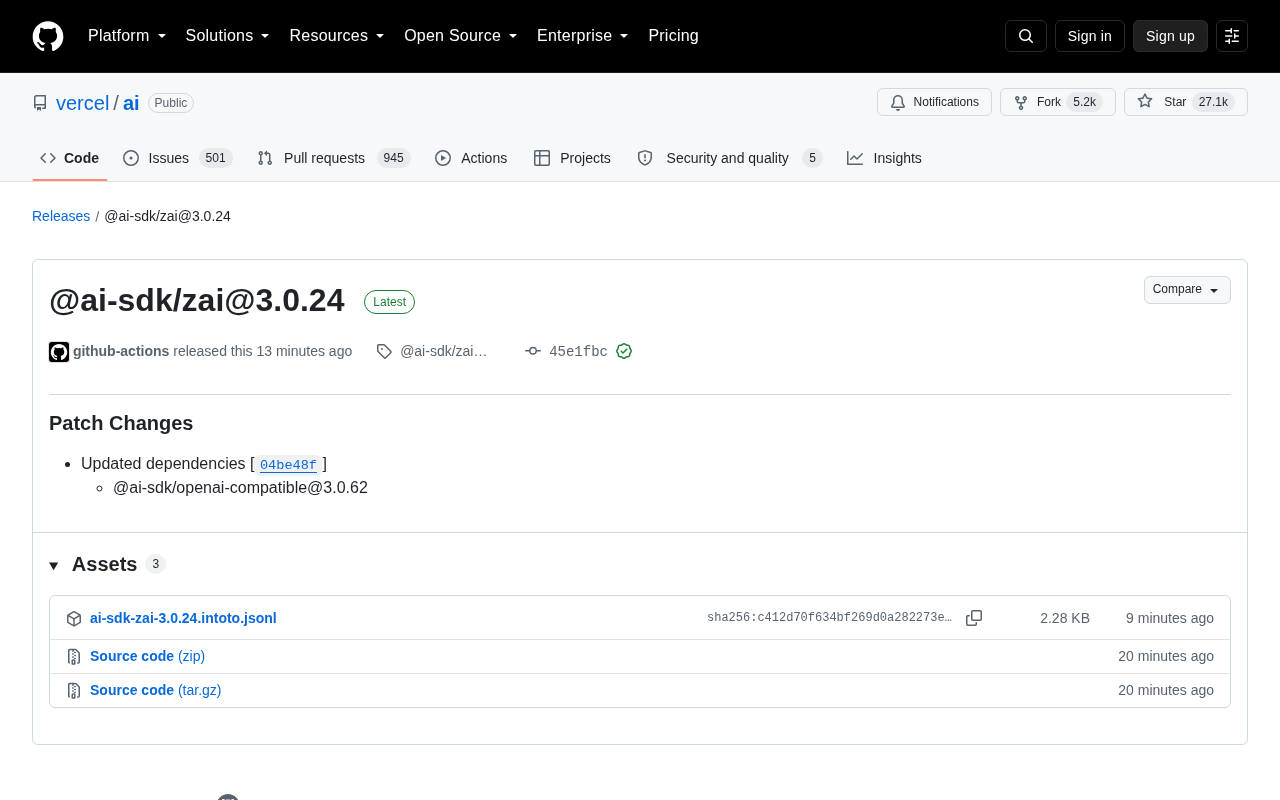
Vercel AI SDK releases @ai-sdk/zai@3.0.24 to sync the openai-compatible dependency to 3.0.62.
`@ai-sdk/zai@3.0.24` is a routine patch update in the Vercel AI SDK ecosystem, syncing the underlying `@ai-sdk/openai-compatible` dependency to 3.0.62 with no new features or breaking changes. As a provider adapter built on the OpenAI-compatible interface pattern, it lets developers access multiple model services uniformly. Per SemVer, patch updates are backward-compatible and safe to adopt, though developers should keep the full AI SDK dependency tree version-consistent and run regression tests before deploying to production.
Vercel's AI SDK ecosystem has released a new version: @ai-sdk/zai@3.0.24. This is a patch-level version bump, primarily aimed at syncing underlying dependency changes and ensuring compatibility across other modules in the AI SDK.
Update Overview
According to the GitHub Releases page, the core change in @ai-sdk/zai@3.0.24 is a dependency update. The release notes explicitly state:
Patch Changes — Updated dependencies,
@ai-sdk/openai-compatible@3.0.62
This means the zai provider package itself introduces no new API changes or breaking modifications — it's simply a synchronized release following an upgrade to the @ai-sdk/openai-compatible dependency. This kind of patch release is quite common in modern frontend and AI toolchains, and is intended to keep the entire SDK family version-consistent.
The release was published via GitHub Actions automation and verified with a GitHub GPG signature (key ID: B5690EEEBB952194), ensuring the integrity of the published artifact.

What Is @ai-sdk/zai
@ai-sdk/zai is a model provider adapter package within the Vercel AI SDK ecosystem. Vercel AI SDK uses a modular design, connecting to various large model services through different provider packages — and zai is one of them.
Its dependency on @ai-sdk/openai-compatible reveals that zai follows the "OpenAI-compatible interface" pattern. This design allows developers to access model services that conform to the OpenAI API specification using a unified calling convention, significantly reducing the migration cost when switching between multiple models. For teams that need to flexibly swap or use multiple model backends in their projects, this compatibility layer provides clear value.
What is an OpenAI-compatible API? It refers to third-party model service providers adopting the same request/response format as the OpenAI REST API, so that client code originally written for OpenAI can connect to other models without modification. This pattern is now widespread among model providers globally, including Groq, Together AI, DeepSeekAd, Moonshot (月之暗面), and others.
@ai-sdk/openai-compatibleserves as the underlying adapter layer, encapsulating the network request and response parsing logic for this specification. Upper-level provider packages like@ai-sdk/zaionly need to configure their respective endpoints and authentication methods on top of this, enabling quick integration with different model providers without reimplementing communication logic from scratch.
What Patch Updates Mean for Developers
For developers building applications with Vercel AI SDK, patch versions are generally safe to upgrade. Under the Semantic Versioning (SemVer) specification, a Patch-level update (incrementing the third version number) contains only backward-compatible fixes, and should not affect existing code logic.
There are two things developers should pay attention to: first, confirm whether @ai-sdk/openai-compatible in your project has also been updated to 3.0.62, to avoid potential issues from version mismatches; second, run your usual regression test suite before upgrading in a production environment.
It's worth noting that Vercel AI SDK has accumulated over 27.1k stars and 5.2k forks on GitHub, making it one of the most popular AI application development frameworks today. Its high-frequency release cadence reflects how rapidly the AI application toolchain is evolving.
What is Semantic Versioning (SemVer)? Proposed by Tom Preston-Werner and widely adopted by platforms like npm and GitHub, SemVer uses the format
MAJOR.MINOR.PATCH. A MAJOR change indicates breaking API incompatibilities; a MINOR change adds backward-compatible new features; a PATCH change includes only backward-compatible bug fixes or dependency syncs. In large monorepo projects with many interdependent sub-packages (like Vercel AI SDK), a PATCH update to one underlying package often triggers a cascade of synchronized PATCH releases across all dependent packages — ensuring consistency inpackage-lock.jsonorpnpm-lock.yamllockfiles. This is exactly the context behind the@ai-sdk/zai@3.0.24release.
Summary
@ai-sdk/zai@3.0.24 is a typical dependency-sync patch update with no functional changes, serving primarily to maintain version consistency across the SDK ecosystem. For developers, this type of update can be applied as needed — the key focus should be keeping the entire AI SDK dependency tree version-aligned. Staying on top of Vercel AI SDK releases helps you receive model adapter improvements and fixes in a timely manner.
Related articles

Why Does the Tesla Roadster Need to Fly? A Deep Dive into Musk's Wild Demo
Tesla's Roadster launch showed wall-climbing, upside-down driving, and flying stunts—but The Vergecast notes the demo car may lack a battery, the Rocket version is invite-only and not street-legal, and the website terms don't guarantee delivery. After nine years of delays, why does this car still need to exist?

AI Is Not a Replacement: Human-AI Collaboration Through the Lens of Factory Root Cause Analysis
Starting from factory root cause analysis, this article explains how AI accelerates evidence chain construction rather than replacing human experts, exploring the pragmatic implementation logic and business value of 'AI supporting people rather than replacing them.'

AI Agent Decision Auditing: Building an Evidence Chain in Regulated Workflows
Starting from a Reddit discussion, this article analyzes three core issues in AI agent decision auditing within regulated workflows: what fields audit records should contain, how to handle feedback latency for erroneous decisions, and how to continuously calibrate LLM judge consistency with human judgment.