Vercel AI SDK Releases Patch Update for @ai-sdk/rsc

Vercel AI SDK releases @ai-sdk/rsc 1.0.272 patch, focusing on dependency sync with no breaking changes.
Vercel AI SDK has released `@ai-sdk/rsc@1.0.272` as a patch update, paired with the core package `ai@5.0.270`. The changes focus on dependency alignment across multiple upstream commits, introducing no breaking changes. `@ai-sdk/rsc` is a module built for React Server Components, enabling server-side generative AI integration with streaming UI rendering and AI state passing — a key building block for Next.js App Router AI applications. With 4,420 commits and a version number already at `1.0.272`, the SDK reflects Vercel's high-frequency, incremental engineering culture. Existing users can safely upgrade and are advised to review the core package changelog.
Vercel's AI SDK project has released @ai-sdk/rsc@1.0.272. This is a patch-level release focused primarily on dependency updates, coming from a popular open-source project with over 27,000 stars and 5,200 forks on GitHub.
What's in This Update
According to the release notes, @ai-sdk/rsc@1.0.272 is a Patch Change that syncs several upstream dependency updates, referencing multiple commits including 1849a5f, 5381c08, 06e8d1c, 58d303f, and 430ae0a. It ships alongside a corresponding update to the core package ai@5.0.270.
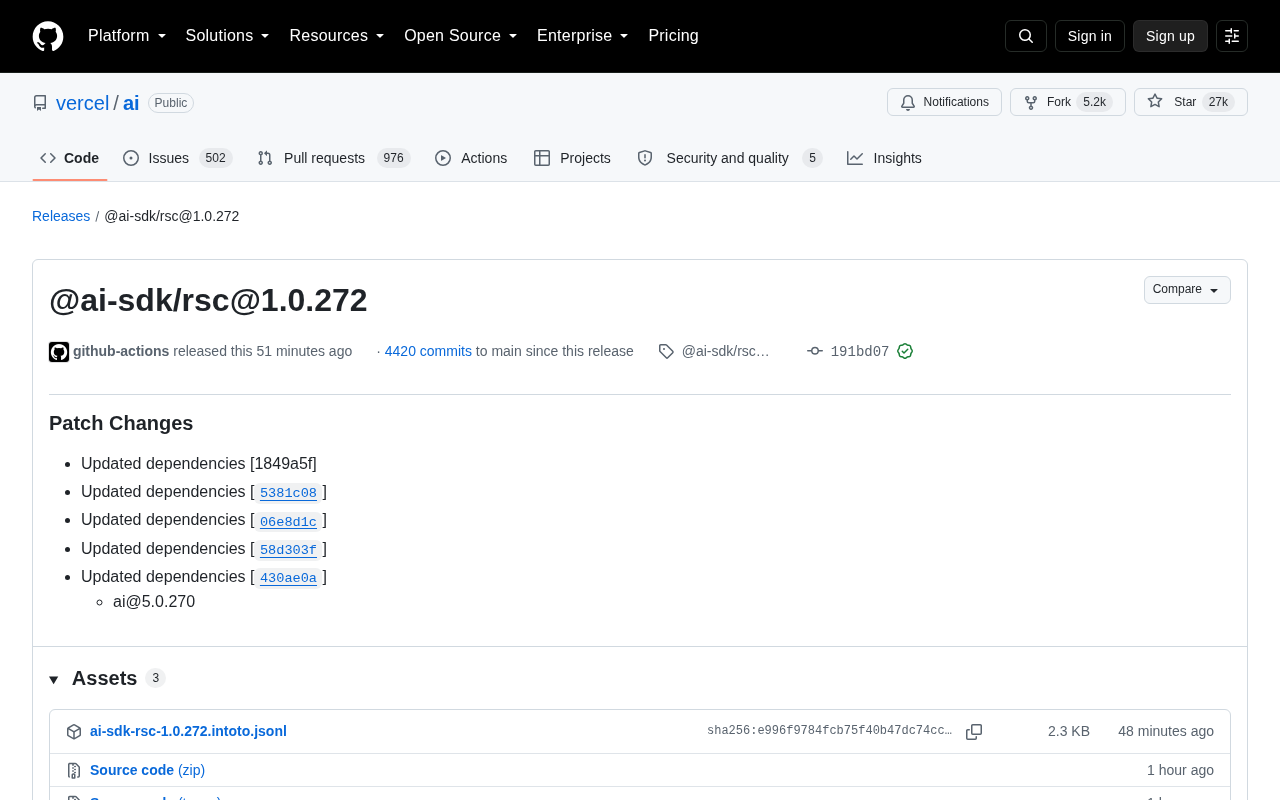
Patch releases like this typically introduce no breaking changes. Their primary purpose is to keep version alignment across the main package and its sub-packages, address potential issues, and improve overall stability. This version was published with a verified GitHub GPG signature (key ID: B5690EEEBB952194), ensuring the release is trustworthy.
What Is @ai-sdk/rsc
@ai-sdk/rsc is the module within the Vercel AI SDK family specifically designed for React Server Components (RSC). It enables developers to integrate generative AI capabilities more naturally within server components — for example, streaming AI-generated UI and passing serializable AI state between the server and client.
For teams building AI applications with the Next.js App Router, this package serves as a bridge that maps large language model output directly to React components. It's a key piece of infrastructure for building streaming conversational interfaces and dynamic AI-driven UIs.
React Server Components (RSC) is a new component model introduced in React 18 that allows components to render on the server and directly access backend resources (databases, file systems, internal APIs) without exposing that logic to the client. Unlike traditional server-side rendering (SSR), RSC can handle data fetching and UI rendering without increasing the client-side JavaScript bundle size — server components themselves are never "hydrated" in the browser. This characteristic aligns naturally with AI applications: LLM calls are inherently server-side operations (API keys need protection, latency must be managed), and streamed tokens can be progressively pushed to the client via RSC's streaming mechanism, achieving a "generate and display simultaneously" experience.
@ai-sdk/rscbuilds on this foundation by wrapping utility functions likestreamUIandcreateStreamableUI, allowing developers to transform LLM output into interactive React component streams with minimal code.
Release Cadence and Engineering Practices
The version numbers themselves tell an interesting story. @ai-sdk/rsc has reached 1.0.272, while the core ai package sits at 5.0.270. Such dense patch numbers indicate that Vercel has adopted a high-frequency, incremental release strategy for the AI SDK — the project's main branch has accumulated 4,420 commits in total.
This rapid, small-step update cadence is typical of active open-source infrastructure projects. While individual dependency sync updates may be limited in scope, they collectively ensure compatibility across all sub-packages in the SDK ecosystem and reduce the risk of version conflicts when developers upgrade.
The Vercel AI SDK uses a Monorepo + Changesets version management approach. Changesets is a versioning tool designed for multi-package repositories that allows contributors to attach "changeset" files to PRs, describing whether a change is a patch, minor, or major update. Once merged into the main branch, the CI pipeline automatically aggregates all pending changesets, bumps version numbers for affected sub-packages in bulk, and publishes them to npm. This mechanism explains why multiple sub-packages (such as
@ai-sdk/rscand the coreaipackage) can maintain highly synchronized version numbers — even if a sub-package has no direct code changes, if its upstream dependency is updated, Changesets will still trigger a version bump to ensure the entire ecosystem's dependency graph remains consistent.
What Developers Should Do
For developers currently using the Vercel AI SDK, patch releases like this are generally safe to upgrade to. It's recommended to keep an eye on the corresponding core package update (in this case ai@5.0.270) and review the full changelog before upgrading to confirm the specific changes to associated dependencies.
Since this release note only lists commit references for dependency updates without detailing the functional impact of each change, developers looking to understand the specific fixes will need to dig further into the relevant commit details or the core package's release history.
Related articles

Why Does the Tesla Roadster Need to Fly? A Deep Dive into Musk's Wild Demo
Tesla's Roadster launch showed wall-climbing, upside-down driving, and flying stunts—but The Vergecast notes the demo car may lack a battery, the Rocket version is invite-only and not street-legal, and the website terms don't guarantee delivery. After nine years of delays, why does this car still need to exist?

AI Is Not a Replacement: Human-AI Collaboration Through the Lens of Factory Root Cause Analysis
Starting from factory root cause analysis, this article explains how AI accelerates evidence chain construction rather than replacing human experts, exploring the pragmatic implementation logic and business value of 'AI supporting people rather than replacing them.'

AI Agent Decision Auditing: Building an Evidence Chain in Regulated Workflows
Starting from a Reddit discussion, this article analyzes three core issues in AI agent decision auditing within regulated workflows: what fields audit records should contain, how to handle feedback latency for erroneous decisions, and how to continuously calibrate LLM judge consistency with human judgment.