Vercel AI SDK Releases typesafe-ai 3.0.11: Build Tool Migration to tsdown

Vercel AI SDK typesafe-ai 3.0.11 migrates its build tool from tsup to the Rust-based tsdown.
`@ai-sdk/typesafe-ai@3.0.11` is a patch-level engineering maintenance update, with the core change being a migration of the build pipeline from `tsup` (esbuild-based) to `tsdown` (built on Rust-powered Rolldown). The switch is transparent to end users with no breaking changes, but may yield improvements in bundle size, type declaration quality, and tree-shaking. Dependencies `@ai-sdk/provider` and `@ai-sdk/provider-utils` were also bumped in sync, reflecting the Vercel AI SDK's monorepo + changesets version management strategy.
Version Overview
The Vercel AI SDK ecosystem has received another minor update — @ai-sdk/typesafe-ai@3.0.11 is now officially released. This is a patch-level update, with the core change being a migration of the package build pipeline from tsup to tsdown. While it may look like a routine maintenance task on the surface, understanding these underlying changes can help developers who build type-safe AI applications with this SDK better track the evolution of its toolchain.
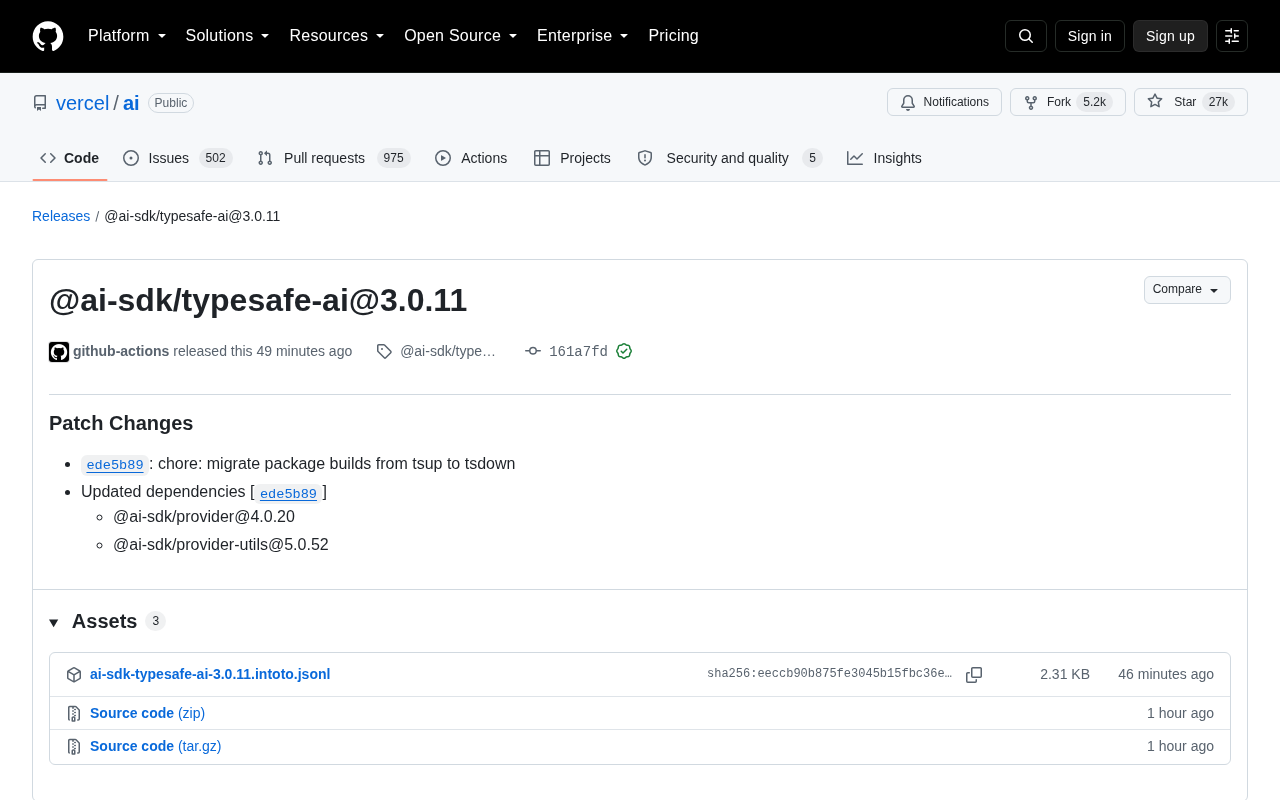
Vercel's AI repository currently has over 27k stars and 5.2k forks, making it one of the most active AI application development frameworks in the JavaScript/TypeScript ecosystem. This release was automated via GitHub Actions and verified with a GitHub GPG signature (key ID: B5690EEEBB952194), ensuring the trustworthiness of the published artifacts.
Key Change: From tsup to tsdown
The pivotal commit in this update (ede5b89) is labeled as an engineering maintenance task: chore: migrate package builds from tsup to tsdown.
tsup has been the go-to zero-config bundler for TypeScript library authors over the past few years, powered under the hood by esbuild. tsdown, on the other hand, is a newer build tool built on top of Rolldown — a Rust-based rewrite of Rollup — designed for faster build speeds and improved type declaration generation. This kind of migration has become increasingly common in the open-source community recently, reflecting a broader shift in the TypeScript toolchain toward high-performance, Rust-powered solutions.
For end users, switching build tools is generally transparent — installation and usage remain unchanged, but you may see subtle improvements in bundle size, type declaration quality, or tree-shaking effectiveness.
Rolldown is a next-generation JavaScript bundler led by the Vite core team, written in Rust, and designed to be a high-performance alternative to Rollup while maintaining API compatibility. Thanks to Rust's natural advantages in memory management and concurrency, Rolldown can offer several times — or even tens of times — faster build speeds compared to JavaScript-runtime-based tools for large projects. tsdown is built on top of Rolldown specifically for TypeScript library bundling scenarios. It inherits tsup's developer-friendly approach while upgrading the underlying engine to Rust. This trend aligns with the rise of tools like Biome (replacing ESLint/Prettier), SWC (replacing Babel), and Turbopack (replacing Webpack), all part of the broader "Rust-ification" wave sweeping the frontend toolchain.
Dependency Updates
Alongside the build migration, related dependency packages were also updated in sync:
@ai-sdk/provider@4.0.20@ai-sdk/provider-utils@5.0.52
These two are foundational packages in the AI SDK, responsible for provider abstraction interfaces and shared utility functions respectively. Their versions are kept in lockstep with typesafe-ai, which is a typical example of Vercel AI SDK's monorepo + changesets management strategy. This design ensures consistency across the entire SDK ecosystem during version upgrades, reducing the likelihood of developers running into version conflicts.
Changesets is a version management and release tool designed specifically for monorepos (a single repository managing multiple packages). When submitting changes, developers attach a "changeset" file describing the scope of impact (patch/minor/major) and a change description. At release time, the tool automatically aggregates all pending changesets, calculates the correct new version numbers for each package, and generates CHANGELOGs. The Vercel AI SDK contains dozens of interdependent sub-packages. Using a monorepo + changesets combination ensures that when a low-level package (such as provider or provider-utils) changes, all packages that depend on it are precisely bumped in sync — avoiding the hard-to-debug runtime errors that can arise from a tangled version matrix.
Practical Impact for Developers
If you're currently using @ai-sdk/typesafe-ai, upgrading to 3.0.11 can essentially be treated as a safe patch update with no concern about breaking changes. A patch version bump (third digit increment) signals that it follows semantic versioning and includes only backward-compatible fixes and internal improvements.
For library authors who pay attention to toolchain choices, this migration is also a noteworthy signal: if your project is still using tsup, it's worth checking whether tsdown has matured enough for production adoption. Watching the technical decisions made by a project of Vercel's scale can provide valuable reference points for your own engineering choices.
Summary
@ai-sdk/typesafe-ai@3.0.11 is a purely engineering-maintenance update with no new features, but it reflects two broader trends: first, TypeScript build tooling is undergoing a new performance-driven generational shift; and second, the Vercel AI SDK maintains a high-frequency, stable release cadence. For teams relying on this SDK, staying current with these small version updates is a good way to continuously benefit from underlying optimizations.
Related articles

Gemini 4 Argon Hands-On: AI Builds Board Games, Constructs Temples, and Trains Robots Autonomously
Gemini 4 Argon hands-on roundup: AI autonomously builds a desk racetrack and temple in Blender, writes a ray tracing engine, trains a humanoid robot to sink 7 shots, plus API pricing and developer access.

The Magic Octagonal Coin: Why Only 9% of People Can Predict Its Flip?
Only 9% of people can correctly predict the Magic Octagon coin flip. This article explains its spatial rotation mechanism, common cognitive pitfalls, and a new hypothesis based on Relevance Theory, exploring the limits of human spatial reasoning.

Sam Altman: AI Is Entering the Era of Scientific Discovery — Math Breakthroughs Will Replicate in Biology and Energy
Sam Altman says AI is entering the era of scientific discovery — math breakthroughs will replicate in biology, materials science, and energy to help develop new drugs and energy sources.