Vercel AI SDK's Z.ai Adapter Releases Patch Update

Vercel AI SDK's Z.ai adapter releases 3.0.46 patch, only syncing dependencies with no API changes.
In the AI SDK ecosystem maintained by Vercel, the Z.ai adapter package @ai-sdk/zai has released patch version 3.0.46. This update adds no new APIs or features; the only substantive change is dependency synchronization: @ai-sdk/provider-utils bumped to 5.0.74 and @ai-sdk/openai-compatible bumped to 3.0.84. These two dependencies belong to the shared foundation layer of the entire AI SDK ecosystem, handling common utilities for the provider abstraction layer and OpenAI-compatible protocol request/response processing respectively, so the upgrade essentially propagates fixes from the shared layer to the Z.ai call path. The article notes that the patch version has zero intrusion into application code—developers don't need to change calling patterns, and the benefits lie in indirect layers like streaming parsing and error mapping. The release was completed by GitHub's automated pipeline with a verified signature, following a standard process. Information currently comes only from a single release page, lacking independent cross-verification, but release authenticity is supported by first-hand evidence. Overall judgment is a low-risk maintenance upgrade; recommend locking versions and running tests before following up.
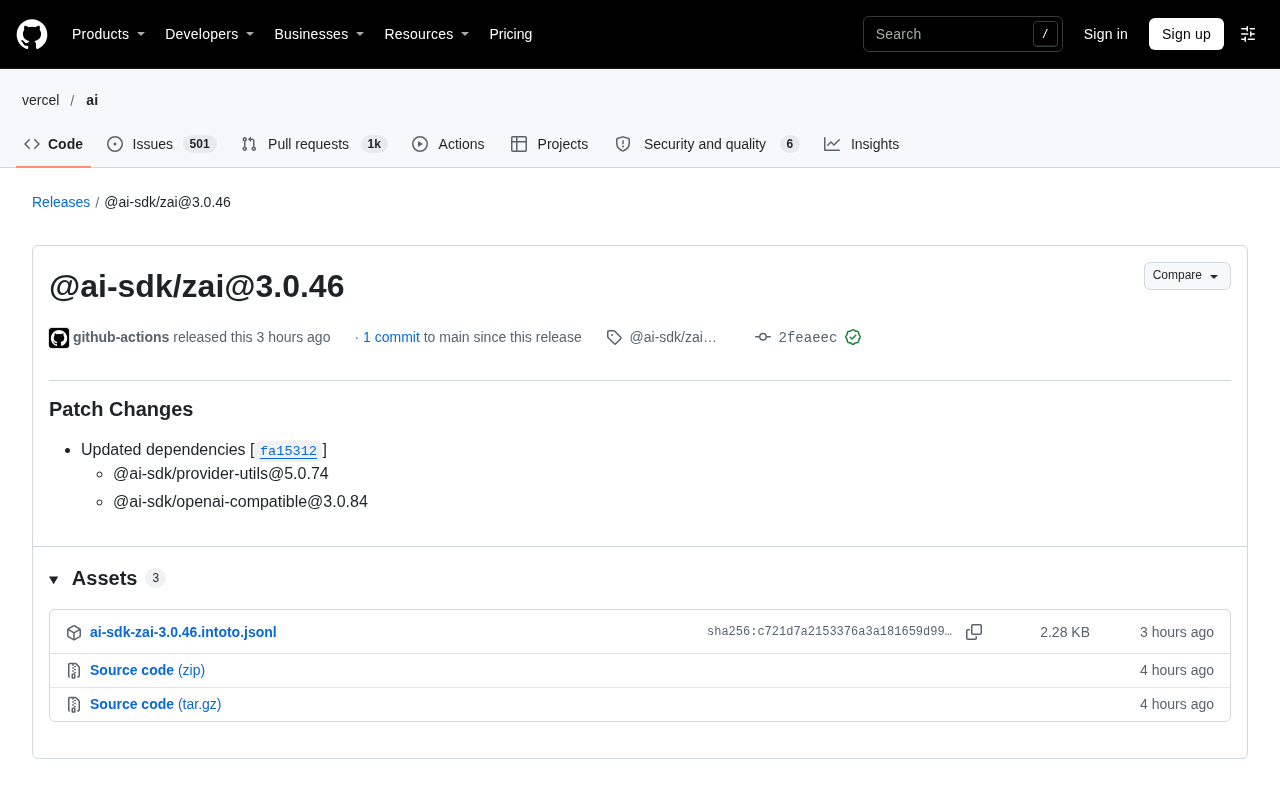
In the AI SDK ecosystem maintained by Vercel, the Z.ai adapter package @ai-sdk/zai has released version 3.0.46. This is a standard patch version iteration (Patch Changes), with the core change focused on synchronizing the dependency tree, without introducing new APIs or capabilities. For developers using AI SDK to connect to Z.ai models, this type of update typically means fixes from the upstream shared utility layer trickle down to this adapter, making it a low-risk upgrade.
What This Update Actually Changed
According to the release note, the only substantive change in 3.0.46 is dependency updates: @ai-sdk/provider-utils bumped to 5.0.74, and @ai-sdk/openai-compatible bumped to 3.0.84. The commit consists of a single commit and carries a GitHub verified signature (GPG key ID: B5690EEEBB952194), indicating the release process still follows the official automated pipeline.
You may not have noticed that neither of these dependencies is Z.ai-specific; they are the shared foundation layer for the entire AI SDK. provider-utils handles common utilities for the provider abstraction layer, while openai-compatible carries the request/response handling for the OpenAI-compatible protocol. The Z.ai adapter reuses generic logic through the latter, so this upgrade essentially propagates changes from the shared layer rather than making custom modifications specific to Z.ai.
What No API Changes Means
Patch versions don't ship new interfaces, so there's zero intrusion into application code. After upgrading, developers don't need to change any calling patterns; the inputs and outputs of interfaces like generateText and streamText remain stable. The real benefit lies in the indirect layer: if upstream provider-utils or openai-compatible fixed certain edge cases (such as streaming parsing, error mapping, or request header handling), those fixes automatically apply to the Z.ai call path without you needing to manually patch anything.
Vercel AI SDK and the Provider Adapter Mechanism
Vercel AI SDK is an open-source toolkit for uniformly calling large models in JavaScript/TypeScript applications, with core entry points including functions like generateText, streamText, and generateObject. It adopts a "core + adapter" structure: the core package (ai) only defines unified calling interfaces, while each model service provider implements protocol integration through an independent provider package, such as @ai-sdk/openai, @ai-sdk/anthropic, and the @ai-sdk/zai mentioned in this article. This design allows developers to switch or mix multiple models without changing business code—just replace the provider instance. Adapter packages are typically published as independent npm packages with their own semantic version numbers, which is why you see numbers like 3.0.46 that don't correspond one-to-one with the main library's version.
Patch Version Semantics in SemVer
In the Semantic Versioning (SemVer) specification, the three segments of a version number MAJOR.MINOR.PATCH represent incompatible changes, backward-compatible feature additions, and backward-compatible bug fixes, respectively. 3.0.46 is a PATCH increment, which by convention should not contain breaking changes or new APIs—this is the basis for judging it as a "zero-intrusion, low-risk upgrade" in this article. However, in practice, dependency-sync patches can sometimes indirectly change behavior—if an upstream dependency's fix involves error code mapping or streaming chunk processing, the output details observed by callers may change. Therefore, it's still recommended to run tests rather than blindly upgrading.
Why Adapter Dependency Synchronization Is Worth Noting
AI SDK uses a layered design where provider adapters only handle protocol mapping, leaving the heavy lifting to shared dependencies. The benefit of this structure is that the same bug only needs to be fixed once across multiple providers like OpenAI and Z.ai; the cost is that any issue in a lower-level package spreads along the dependency chain. So while patch versions may seem uninteresting, they are precisely a signal of dependency health—maintainers are continuously tracking upstream, and the adapter hasn't fallen out of sync with the main library.
For production environments, the upgrade decision can be lightweight: lock versions, run existing tests, and observe whether streaming output and error handling work properly. If your project also uses other OpenAI-compatible adapters, these packages likely share the same batch of dependency versions, and upgrading them together can actually reduce duplicate versions in the dependency tree.
Upgrade Recommendations
Use your package manager to bump @ai-sdk/zai to 3.0.46, and check whether @ai-sdk/provider-utils and @ai-sdk/openai-compatible are raised to the corresponding versions. If mixed with other AI SDK packages, it's recommended to unify dependency versions to avoid type or runtime inconsistencies caused by multiple instances of the same package.
OpenAI-Compatible Protocol and the openai-compatible Package
@ai-sdk/openai-compatible is a generic adapter foundation provided by AI SDK for connecting to third-party services that implement OpenAI Chat Completions-style interfaces. Since many domestic and international model vendors (including Z.ai) are API-compatible with the OpenAI specification—same /chat/completions path, same structure of messages array, same SSE streaming return format—there's no need to hand-write protocol parsing logic for each one. You just extend this foundation and override a few differences (such as baseURL, model list, and authentication headers). The benefit is that complex logic like request construction, streaming incremental parsing, tool call assembly, and error response mapping is maintained in only one place. The cost is that any behavior change in the foundation package affects all compatible providers simultaneously, so cross-provider consistency must be watched during upgrades.
provider-utils and Layered Abstraction
@ai-sdk/provider-utils is the shared utility layer for AI SDK providers, offering foundational capabilities like schema validation, streaming response parsers, request retry and timeout, safe JSON parsing, and error type definitions. It isn't tied to any specific vendor but consolidates recurring generic patterns in provider implementations into reusable functions. Adapter packages have a direct dependency on it, so its patch updates (like 5.0.74) often fix parsing robustness or type definition issues in edge cases, and these fixes automatically benefit all downstream adapters along the dependency chain. Understanding this layering explains why you'll almost never see "Z.ai-specific" changes in a Z.ai adapter's release log.
Multi-Source Cross-Verification Perspective
This information comes from a single release page (RSS source), with no other independent sources providing additional details about this version. GitHub's verified signature and automated release records constitute first-hand evidence of release authenticity; as for the specific content of the dependency updates (what commit fa15312 changed), the release note doesn't elaborate, so only a qualitative judgment based on version numbers is possible. No information contradicting the official release has been found, but neither can further corroboration of the version's actual effects be obtained from secondary channels.
Summary
3.0.46 is a purely maintenance-oriented release: dependency synchronization, zero API changes, low upgrade risk. It brings no new features but ensures the Z.ai adapter stays in sync with the AI SDK shared layer. For teams prioritizing stability, this type of patch can be followed at a regular cadence; for teams evaluating AI SDK multi-provider solutions, it can also be seen as an observation point that the ecosystem is still actively maintained.
One-line Summary
Vercel AI SDK's Z.ai adapter releases 3.0.46 patch, only syncing dependencies with no API changes.
Related articles

VERS: Editing Activation Explanations to Halve Reasoning Model Tokens
VERS guides reasoning models by editing activation explanations, cutting 45.8% of tokens on GSM8K with only a 0.82 pp accuracy drop and transferring to larger models, but losing accuracy on competition problems.

Finding Errors Is Not Enough: Selective Model Escalation for Entity-Targeted Sentiment Analysis
This study explores selective model escalation for entity-targeted sentiment analysis, comparing data collection ordering, uncertainty-driven re-examination, and model routing—finding that minority-class priority only helps at very small data volumes, the oracle upper bound far exceeds actual gains, and escalation must be tailored to each dataset.
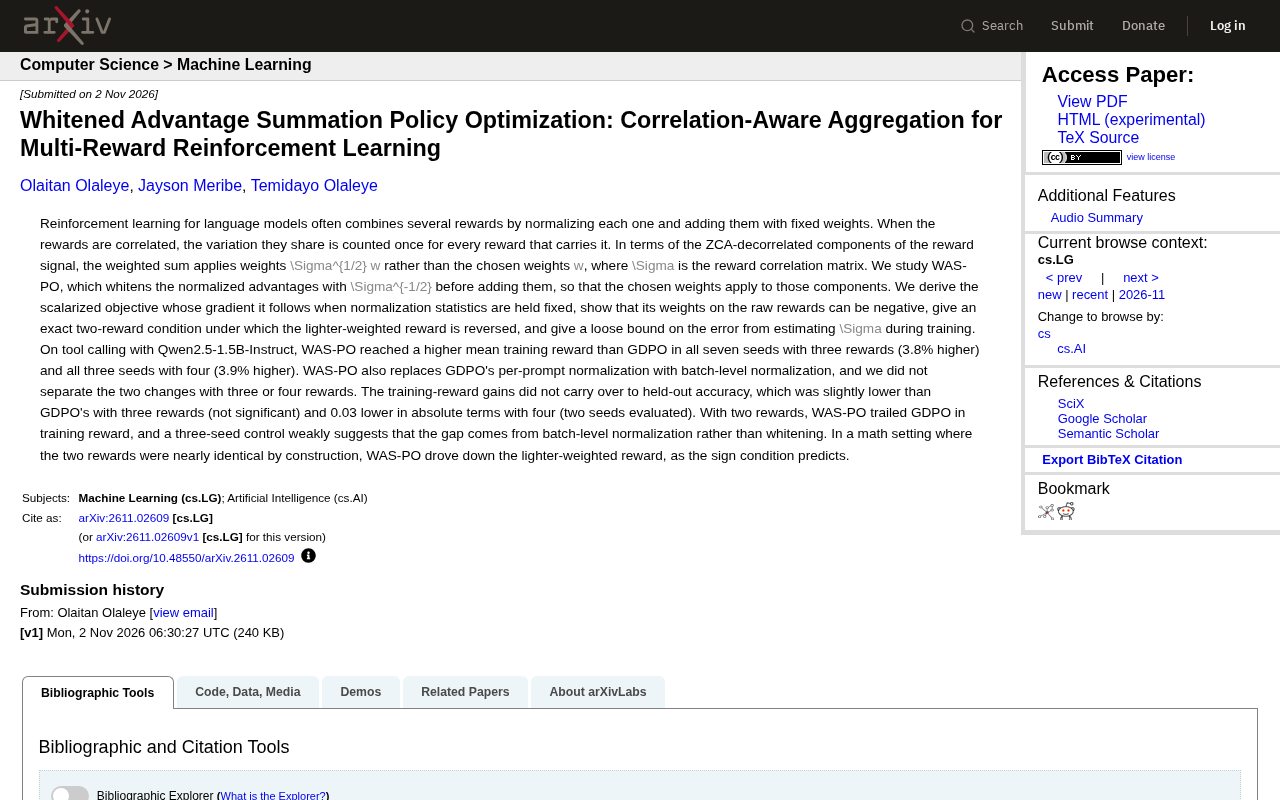
WAS-PO: Using Whitened Advantages to Solve the Correlation Trap in Multi-Reward Reinforcement Learning
WAS-PO paper proposes whitening advantages to correct correlation bias in multi-reward RL: when rewards are correlated, naive weighted summation effectively applies Σ^{1/2}w instead of w. Experiments show training reward improves steadily, but held-out accuracy does not improve in sync, and under two rewards it actually falls behind.