Vercel AI SDK TogetherAI Adapter 3.0.45 Update Analysis
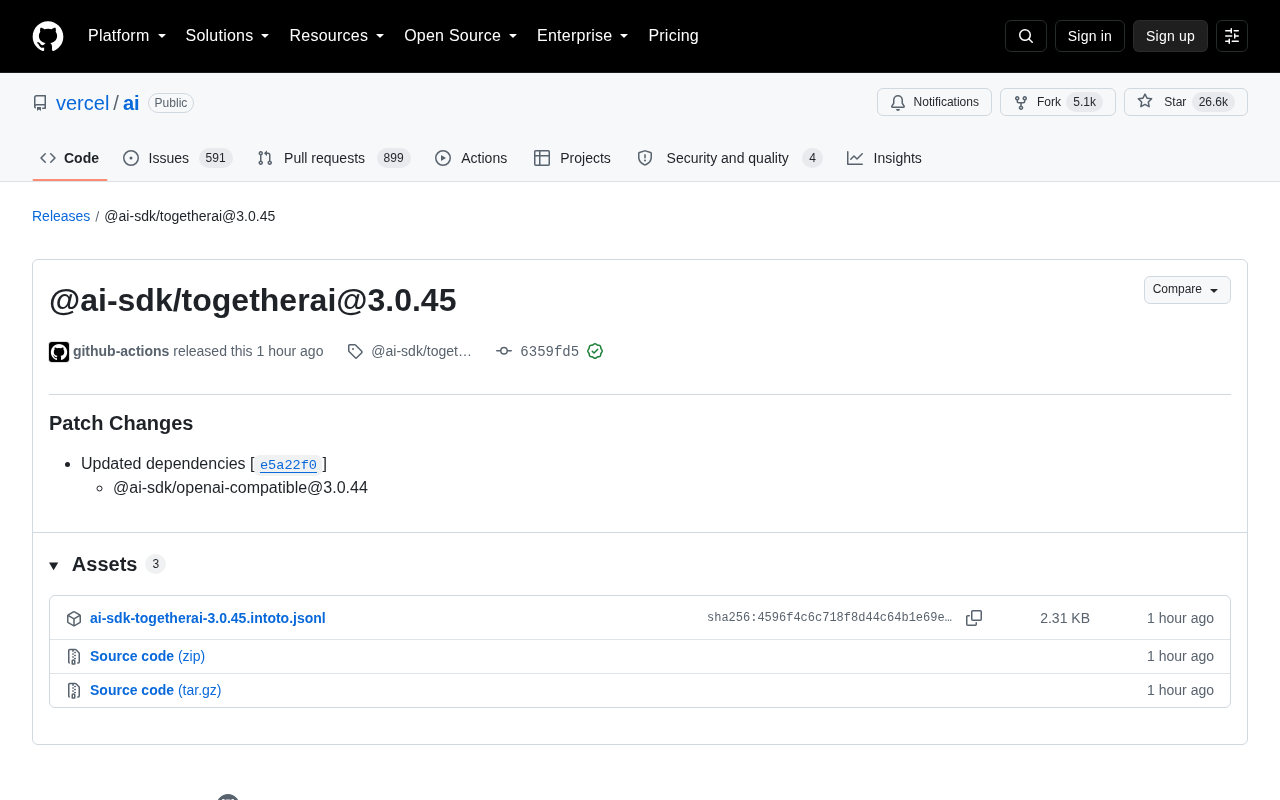
Vercel AI SDK's TogetherAI adapter 3.0.45 syncs its OpenAI-compatible dependency in a routine patch update.
The @ai-sdk/togetherai@3.0.45 patch update upgrades its internal @ai-sdk/openai-compatible dependency to 3.0.44. While lightweight, this release highlights Vercel AI SDK's architecture of unifying multi-provider access through an OpenAI compatibility layer, its automated monorepo release pipeline with GPG signing, and the value of keeping AI SDK dependencies current in production environments.
Overview
Vercel's officially maintained AI SDK recently released the @ai-sdk/togetherai@3.0.45 version update. This is a Patch-level iteration primarily focused on dependency synchronization. As a popular open-source project on GitHub with over 26.6k Stars and more than 5.1k Forks, every update to the Vercel AI SDK deserves attention from frontend and full-stack developers.
Vercel AI SDK is an open-source toolkit led by Vercel, the parent company of Next.js, designed to provide JavaScript/TypeScript developers with a standardized solution for integrating large language models. It was initially released as the ai package and later evolved into a massive monorepo (single-repo, multi-package) architecture containing core runtimes, UI components, and dozens of adapter packages for different model providers. The project's core value lies in abstracting LLM interaction patterns—such as streaming text generation, Tool Use, and Structured Output—into a unified API, so developers don't need to write different integration code for each model provider.
This update was automatically published by GitHub Actions on September 4th and authenticated through GitHub's verified signature (GPG key ID: B5690EEEBB952194), ensuring the integrity and trustworthiness of the release artifacts. GPG (GNU Privacy Guard) signing is a digital signature mechanism based on public-key cryptography, widely used for verifying software release integrity. In the GitHub context, when a commit or release includes a GPG signature, GitHub verifies it using the publisher's pre-registered public key and displays a "Verified" badge on the interface. This mechanism effectively prevents supply chain attacks—where attackers impersonate project maintainers to publish versions containing malicious code. In recent years, following the SolarWinds incident and multiple package hijacking events in the npm ecosystem, software supply chain security has become a high-priority concern in the industry, making GPG signature verification a standard practice for mature open-source projects.
Detailed Update Breakdown
Dependency Synchronization: The Core of This Update
According to the release notes, the Patch Changes in @ai-sdk/togetherai@3.0.45 primarily involve updating an internal dependency—upgrading @ai-sdk/openai-compatible to version 3.0.44 (corresponding to commit e5a22f0).
While this change may seem minor, it reflects an important architectural philosophy in the Vercel AI SDK: unifying the integration approach for multiple model providers through an OpenAI compatibility layer. The OpenAI compatibility layer refers to an interface protocol that follows the OpenAI Chat Completions API specification. Thanks to OpenAI's first-mover advantage in the LLM API market, its API format—including the /v1/chat/completions endpoint, message role definitions, and streaming SSE response format—has become the de facto industry standard. Numerous inference service providers and open-source frameworks, including TogetherAI, Fireworks AI, DeepInfra, vLLM, and Ollama, have chosen to be compatible with this protocol, allowing client code to switch between different providers simply by changing the base URL and API Key. The @ai-sdk/openai-compatible package in Vercel AI SDK is precisely an engineering encapsulation of this de facto standard, handling common logic such as request construction, response parsing, streaming processing, and error mapping, so that each provider adapter only needs to focus on its own specific configuration and extensions.
As an inference platform aggregating a large number of open-source large models (such as Llama, Mixtral, Qwen, etc.), TogetherAI's official adapter is built directly on top of the openai-compatible base package.
Why a Patch-Level Update
Following the Semantic Versioning (SemVer) specification, a Patch version (i.e., a change in the third digit) typically indicates backward-compatible bug fixes or dependency adjustments, without introducing Breaking Changes. Semantic Versioning is a version numbering convention proposed by GitHub co-founder Tom Preston-Werner, formatted as MAJOR.MINOR.PATCH. MAJOR is incremented for incompatible API changes, MINOR is incremented for backward-compatible new features, and PATCH is incremented for backward-compatible bug fixes. In the npm ecosystem, SemVer works closely with version range symbols in dependency declarations (e.g., ^3.0.44 means compatible with updates within the 3.x.x range), enabling package managers to automatically resolve safe update ranges. Strict adherence to SemVer is the foundation of trust in the open-source ecosystem—when a package declares its update as Patch-level, downstream consumers should be able to upgrade with confidence without worrying about breaking changes.
Therefore, upgrading from 3.0.44 to 3.0.45 for existing projects is a safe and low-risk operation, and developers can simply run npm update or pnpm up.
This type of cascading update driven by underlying compatibility packages is a typical characteristic of the Vercel AI SDK monorepo architecture. Monorepo (single repository) is an engineering practice where multiple related projects or packages are managed within the same version control repository, widely adopted by tech giants like Google, Meta, and Microsoft. Vercel AI SDK uses pnpm workspace and Changesets toolchain to manage its monorepo. Under this architecture, when an underlying shared package (such as @ai-sdk/openai-compatible) changes, Changesets automatically detects the dependency graph, identifies all affected upstream packages, and generates corresponding version changes for them. Subsequently, the GitHub Actions CI/CD pipeline automatically completes a series of steps including version number incrementation, CHANGELOG generation, npm publishing, and GitHub Release creation. This highly automated release process ensures version consistency across packages, avoiding the omissions and version mismatches common in manual releases.
When the base package openai-compatible changes, multiple provider adapters that depend on it (such as TogetherAI, Fireworks, DeepInfra, etc.) will synchronously publish corresponding patch versions.
The Positioning and Value of the TogetherAI Adapter
What Problem Does It Solve
@ai-sdk/togetherai is the officially provided TogetherAI platform adapter for the Vercel AI SDK. Founded in 2022 by Stanford University professor Ce Zhang and others, TogetherAI focuses on providing high-performance, low-cost inference services for open-source large models. Unlike providers such as OpenAI and Anthropic that center on closed-source models, TogetherAI's business model is built on the open-source model ecosystem—it significantly reduces inference costs for popular open-source models like Llama 3, Mixtral, Qwen, and DeepSeek through proprietary inference optimization technologies (including FlashAttention integration, customized CUDA kernels, and model parallelism strategies). The platform also offers Fine-tuning services, allowing users to train custom versions on open-source base models. For teams that want to maintain data sovereignty and model controllability while enjoying the convenience of cloud inference, TogetherAI is a highly attractive option.
With this adapter, developers can seamlessly switch to various open-source models offered by TogetherAI using a coding style nearly identical to calling OpenAI models. This significantly reduces the cost of migrating between different model providers and makes a "multi-model strategy" much more feasible in production environments.
Engineering Advantages of a Unified Abstract Interface
The most prominent design highlight of the Vercel AI SDK is its unified abstract interface. Regardless of whether the underlying model is from OpenAI, Anthropic, Google, or an aggregation platform like TogetherAI, the way developers call core methods like generateText and streamText remains consistent. This design decouples application-layer code from specific model implementations, providing teams with a solid engineering foundation to flexibly balance considerations across cost, performance, compliance, and other dimensions.
The practical value of this abstraction layer is especially evident in production environments. For example, an enterprise application might use TogetherAI's Llama models in high-concurrency scenarios to reduce costs, switch to OpenAI's GPT-4o when top-tier reasoning capabilities are needed, and choose a specific provider deployed in the European region when handling EU user data. With Vercel AI SDK's unified interface, these switches only require changing model configuration—no business logic code needs to be rewritten.
Practical Implications for Developers
Keeping Dependencies Up to Date
Although this update involves minimal changes, it reminds us of a good engineering practice: staying current with AI SDK and adapter version iterations. In the rapidly evolving landscape of AI applications, underlying SDKs are released at a high frequency. Timely updates not only provide bug fixes but also ensure compatibility with the latest model capabilities and API changes.
For team collaboration, it's recommended to incorporate dependency updates into your regular technical debt management workflow. You can leverage automated tools like Dependabot or Renovate Bot to regularly generate Pull Requests for dependency updates, combined with CI testing pipelines to verify compatibility, thereby maintaining an update cadence while controlling risk.
A Healthy Signal for the Open-Source Ecosystem
From a broader perspective, the Vercel AI SDK's complete workflow of automated publishing via GitHub Actions and GPG signature verification demonstrates the engineering standards expected of a mature open-source project. Frequent and stable patch releases are a direct reflection of project activity and maintenance quality—an important source of confidence for teams using it in production environments.
Summary
@ai-sdk/togetherai@3.0.45 is a typical dependency-synchronization patch update, with the core change being the upgrade of the underlying openai-compatible package to version 3.0.44. While the change itself is lightweight, it reflects the Vercel AI SDK's architectural approach of centering on an OpenAI compatibility layer to unify multi-provider integration. For developers using TogetherAI's open-source models, this is a low-risk upgrade that can be confidently applied. Teams are advised to regularly check dependency versions and take full advantage of the stability and compatibility benefits that come with rapid SDK iterations.
Key Takeaways
Related articles
Vercel AI SDK Svelte 4.0.277 Release Update Breakdown
In-depth breakdown of Vercel AI SDK Svelte 4.0.277 patch release core changes, including dependency sync, framework adaptation mechanisms, and upgrade advice.
Unsloth v0.1.803 Update: Auto Context Compaction and LAN Remote Access Explained
Unsloth v0.1.803-beta merges 170+ PRs, introducing auto context compaction, native LAN remote access, and Dynamic v3.0 quantization to enhance local LLM deployment.
Rubric-Based Alignment for Knowledge QA: A Paradigm Shift from Preferences to Principles
Explore rubric-based alignment for LLMs: a new approach using fine-grained rewards across composition, grounding, and instruction-following to transform implicit preferences into explicit principles.