Vercel AI SDK Update: Fixing Race Conditions in React Completion Requests
Vercel AI SDK patches race conditions and broken cancellation state in React streaming completions.
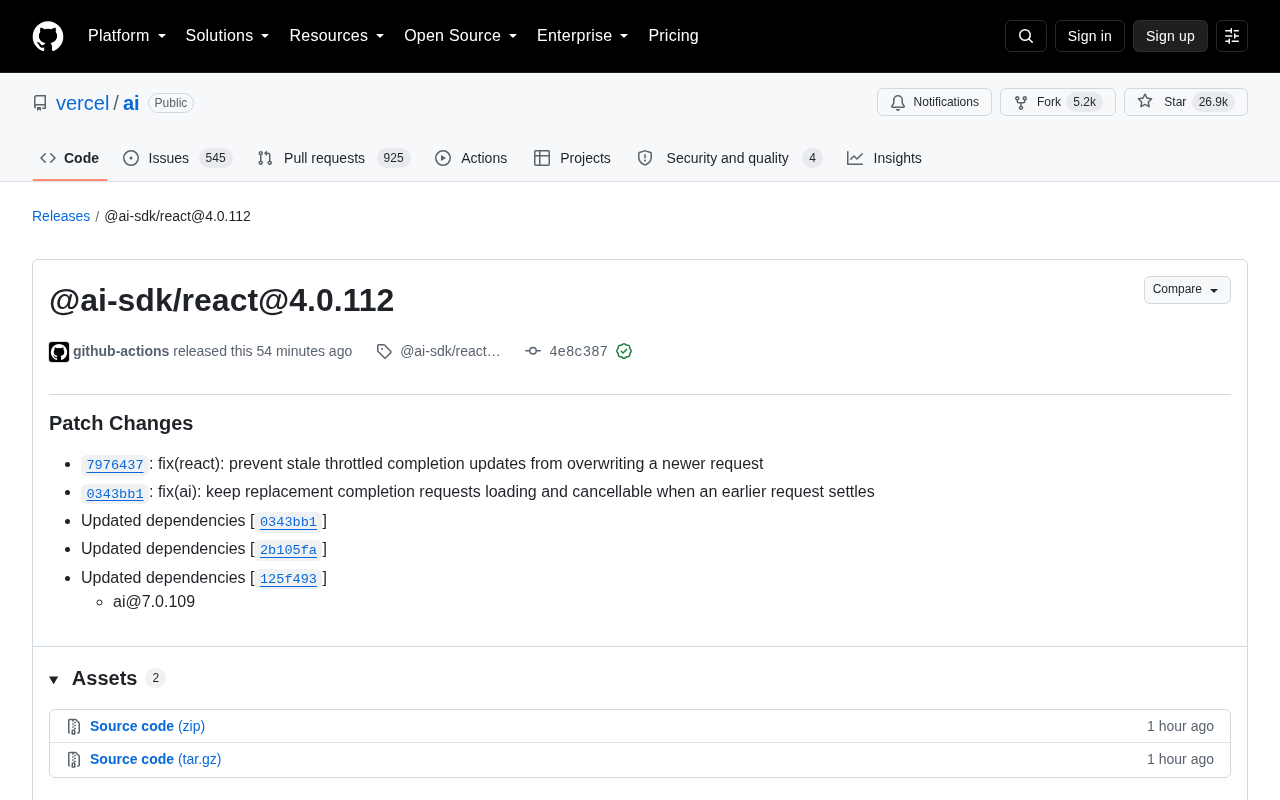
@ai-sdk/react@4.0.112 is a patch-level maintenance release paired with ai@7.0.109, targeting two concurrency bugs in streaming completions. It fixes a throttle-induced race condition where delayed callbacks from old requests would overwrite newer results in the UI, and restores correct loading and cancellable state when a new request replaces a settled one. No breaking changes — low-risk upgrade recommended for all useCompletion users.
Release Overview
Vercel's widely adopted AI SDK has shipped @ai-sdk/react@4.0.112, a patch release. With over 26.9k stars on GitHub, AI SDK has become one of the go-to tools for frontend developers integrating large language models. While this is a minor version bump, it targets concurrency issues that can arise when handling streaming completions on the React side — issues that have a direct impact on real-world application stability.
This release also bumps the core dependency ai@7.0.109 in lockstep. It's a standard patch-level fix with no breaking changes, so upgrading is straightforward.
What Was Fixed
According to the official Patch Changes, this release addresses two bugs related to request lifecycle management:
Fix: Stale Throttled Updates Overwriting Newer Requests
The first fix (commit 7976437) resolves a classic race condition: when completion content updates the UI through a throttle mechanism, a delayed update from an earlier request could overwrite the result of a newer one.
In chat or completion apps, users often fire off multiple requests in quick succession. If a throttled callback from an older request fires after a newer request has already returned, the UI ends up showing stale content. This kind of issue is especially noticeable in high-frequency interaction scenarios. The fix ensures the UI always reflects the state of the most recent request.
A race condition is a classic concurrency problem: when multiple async operations share the same state and the final outcome depends on the order in which they complete, unpredictable behavior can occur. In AI completion scenarios, throttling is introduced to reduce UI render frequency and avoid performance jitter caused by high-frequency stream writes — it batches and delays multiple state updates within a short window into a single execution. But this "deferred execution" creates a hidden risk: if the user fires a second request before the first throttle window has triggered, that first deferred callback will still execute later and overwrite the newer request's result with stale data. The core idea behind this fix is to check the request version or timestamp before the throttled callback executes — if a newer request is detected, the callback is discarded, ensuring the UI always reflects only the latest request.
Fix: Preserve Loading and Cancellable State for Replacement Requests
The second fix (commit 0343bb1, also applied to the core ai package) addresses request replacement logic: when an earlier request has already settled, a new replacement completion request should still maintain its loading state and remain cancellable.
The previous implementation could incorrectly reset state once the old request completed, causing the new request to fail to display a loading indicator or to be interrupted properly. After this fix, cancellability and loading indicators are correctly maintained in replacement scenarios — which is critical for interaction flows that involve frequent interruptions and re-submissions, such as real-time conversations.
In streaming AI applications, "request replacement" refers to a user initiating a new request before the previous one has finished — the SDK needs to abandon the old request and switch to processing the new one. "Settled" is a Promise term meaning the Promise has reached a terminal state of either fulfilled or rejected and will not change further. The problem was that when an old request settled, some implementations would incorrectly set the global loading flag to
false, or clear theAbortControllerreference bound to the cancel operation — leaving the immediately following new request in an incorrect state of "not loading and not cancellable" right from the start.AbortControlleris a native browser API that enables interruptible network requests by passing asignaltofetchcalls; it's the standard approach for managing request lifecycles in modern web applications. This fix ensures that when a new request takes over from an old one, it independently maintains its own state without being affected by the old request's settlement logic.
Why These Fixes Matter
Streaming responses and concurrent request management are among the core challenges of building AI applications. LLM responses are typically returned incrementally as a stream, while users may trigger new actions mid-response — creating a naturally complex landscape of interleaved async requests.
Much of Vercel AI SDK's appeal lies in how it encapsulates this complex state management into clean React Hooks. But that also means the SDK's internal handling of edge cases — race conditions, throttling, cancellation — directly determines the stability of the applications built on top of it. Both fixes in this release point to the same category of problem: request ordering and state consistency. This reflects the team's ongoing effort to polish the kinds of details that are easy to overlook but have a real impact on user experience.
Upgrade Recommendations
This is a pure bug fix release with no new APIs or behavioral changes. If your application uses hooks like useCompletion and you've encountered issues such as the UI showing stale content during rapid successive requests, or requests failing to cancel correctly, upgrading to this version is recommended.
Make sure to also update the companion core dependency ai@7.0.109 to ensure the full fix takes effect. Since this is a patch-level release, the upgrade risk is low and compatibility concerns are minimal.
Summary
@ai-sdk/react@4.0.112 is a pragmatic maintenance update. Both fixes center on concurrency and state management in streaming completions. For developers building conversational or completion features on top of Vercel AI SDK, this kind of foundational stability improvement often does more for real-world reliability than new features ever could. Keeping an eye on the SDK's release cadence helps you take timely advantage of these quiet but meaningful improvements.
Related articles

AgentCore in Practice: Connecting Custom Tools and MCP Servers to Agents
DebuggerCafe tutorial shows how to connect custom tools and MCP servers to Amazon Bedrock AgentCore agents, covering tool contract design, MCP reuse, and production concerns.

816B Parameters Scores Only 39? The Real Cost-Effectiveness of the Open-Source LLM Parameter Race
Meta's 816B Muse Spark Open scores just 39 on Artificial Analysis, while 180B Qwen3.8-Flash-Next scores 40. This article analyzes 11 open-weight models' parameters vs. scores, exploring the real impact of activated parameters, quantized size, and deployment cost.

Aerial Manipulators: The Next Step for Drones from 'Seeing' to 'Changing'
Starting from a Reddit discussion, this article analyzes the technical challenges, potential applications, and deployment bottlenecks of aerial manipulators, exploring the key challenges for drones moving from environmental perception to physical manipulation.