Vercel AI SDK Update: Svelte Package Version 3.0.289 Released

@ai-sdk/svelte releases patch 3.0.289, only synchronizing dependency ai@5.0.289; routine maintenance.
The Vercel AI SDK project's @ai-sdk/svelte has released version 3.0.289, a typical dependency synchronization patch update with only one core change: upgrading the underlying dependency ai package to 5.0.289. The release was automated by GitHub Actions with commit bdbf015, demonstrating the project's mature CI release process. The correspondence between the two package version numbers reflects the unified "core package with sub-packages" versioning strategy, whose value lies in keeping the Svelte adapter layer aligned with the core package and reducing the risk of version drift when multiple packages coexist. The article advises developers to confirm the version constraints of the ai package in their projects before upgrading to avoid incompatibilities; if the project has no specific issues, this update is not an urgent reason to upgrade and can be included in the regular dependency update window.
A Low-Key Synchronization Update
The Vercel AI SDK project recently released version 3.0.289 of @ai-sdk/svelte. According to the GitHub release notes, this is not a feature iteration but a dependency synchronization patch update—the core change is just one item: upgrading the underlying dependency ai package to 5.0.289.
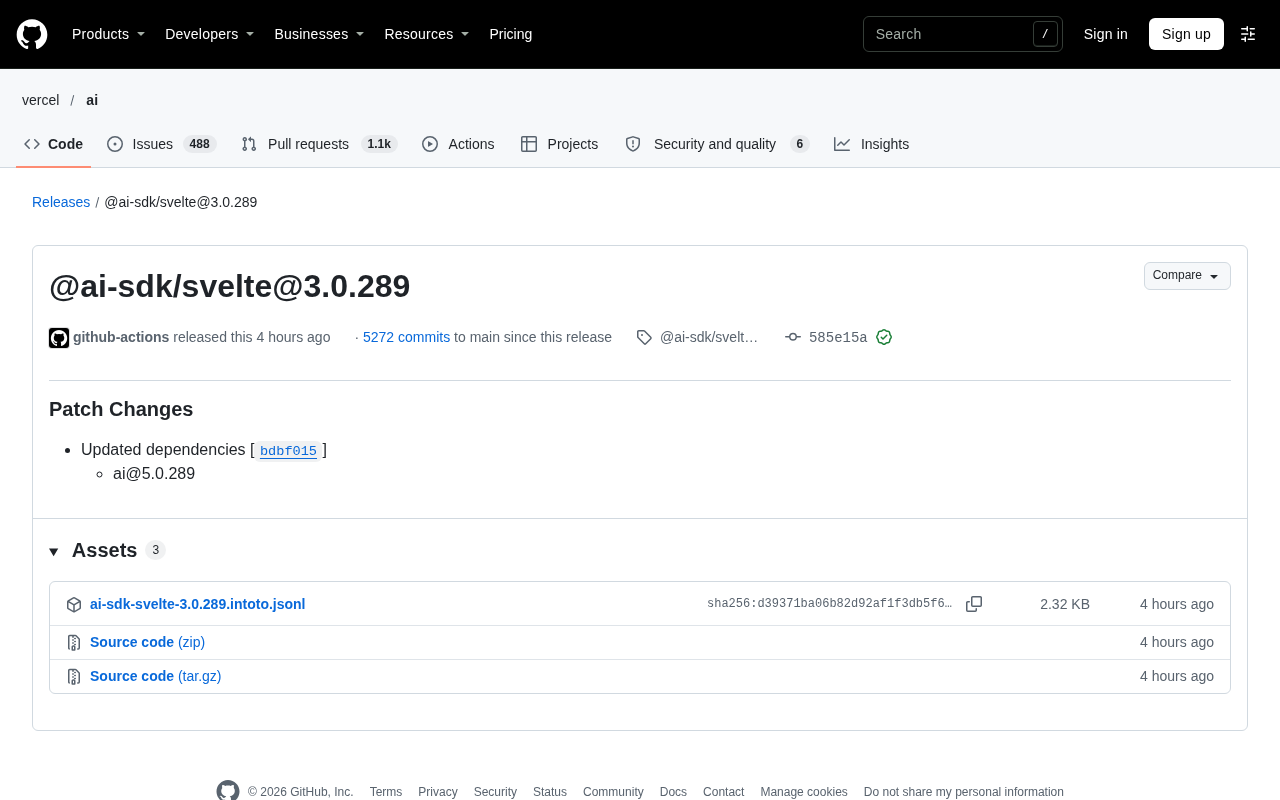
The 3.0.289 and 5.0.289 in the version numbers form a subtle correspondence, indicating that the two packages maintain close linkage in their release cadence. For developers using the Svelte framework to integrate AI capabilities, such updates usually mean upstream fixes or internal consistency maintenance rather than API-level changes.
Vercel AI SDK is an open-source TypeScript toolkit launched by Vercel for integrating large language model (LLM) capabilities into web applications. It unifies the invocation methods of different model providers (such as OpenAI, Anthropic, Google) into a single interface and provides capabilities such as streaming responses, tool calls, and structured output. The entire SDK adopts a layered structure of "core package + framework adapter packages": the ai package carries model invocation and core logic, while @ai-sdk/react, @ai-sdk/vue, @ai-sdk/svelte, etc. are responsible for encapsulating core capabilities into reactive interfaces idiomatic to each frontend framework (such as Svelte's store or rune). Therefore, adapter package versions are usually strictly aligned with the core package, and the version linkage mentioned in this article is a direct manifestation of this architecture.
What This Update Changed
According to the Patch Changes changelog, this release has only one substantive item: @ai-sdk/svelte updated its dependency reference to ai@5.0.289. Commit bdbf015 points to this dependency change.
You may not have noticed that the entire release was completed automatically by github-actions, committed on November 11 at 06:15, and carries GitHub's verified signature. From the figure of 5272 commits, it is clear that the project's main branch has a very active commit history, and the automated release process is already quite mature. Such CI-driven patch versions are often intended to keep downstream packages in sync with upstream core packages as quickly as possible.
Semantic Versioning (SemVer) stipulates that a version number consists of three segments: "major.minor.patch", corresponding respectively to incompatible breaking changes, backward-compatible feature additions, and backward-compatible bug fixes. In this article, the third segments of 3.0.289 and 5.0.289 are both 289, indicating that this is a patch-level release. However, high-frequency release projects like AI SDK often deviate from a strict SemVer cadence—the patch number rapidly expanding to three digits does not mean 289 fixes have occurred, but rather comes more from the mechanical increment of the automated release process. Understanding this helps developers correctly interpret the meaning of such version numbers: when the patch number changes, there is usually no need to worry about API breaking adjustments, but attention should still be paid to actual differences in the dependency tree.
Practical Significance for Developers
For developers currently using @ai-sdk/svelte to build applications, the direct benefit of upgrading to 3.0.289 lies in dependency tree cleanliness and version alignment. When multiple AI SDK sub-packages (such as React, Vue, and Svelte versions) coexist in the same project, version drift may cause runtime issues that are difficult to troubleshoot, and synchronized patch versions can reduce such risks.
From an ecosystem perspective, this "core package with sub-packages" release model reflects the unified versioning strategy of Vercel AI SDK: the ai package serves as the capability foundation, and each framework adapter layer follows with patch versions. The advantage of this strategy is that the upgrade path is predictable, while the cost is that sub-package version numbers expand rapidly—a number like 3.0.289 itself illustrates the high release frequency.
Version drift refers to the phenomenon in which multiple interrelated packages in the same project gradually remain on different versions. In monorepo or multi-package collaboration scenarios, if @ai-sdk/svelte references ai@5.0.289 while other parts of the project lock ai@5.0.260, the package manager may install two copies of ai at the same time, leading to hidden issues such as type mismatches, failed instance checks, or inconsistent runtime behavior. The purpose of synchronized patch versions is to minimize such differences. In practice, tools such as npm ls ai, pnpm why ai, or lockfile review can be used to confirm whether only a single version exists in the dependency tree, thereby predicting potential conflicts before upgrading.
When to Upgrade
If the project locks an older core ai version, rashly upgrading the Svelte adapter package may introduce incompatibilities. Before upgrading, it is recommended to confirm the version constraints of the ai package in the project and check whether there are conflicts with other dependencies. For projects using a lockfile, simply following the regular dependency update process is sufficient.
If the project has not encountered specific issues, this patch update does not constitute an urgent reason to upgrade. It is more like routine maintenance to ensure that Svelte users stay in sync with the AI SDK mainline. Development teams can include it in their regular dependency update window without scheduling a separate upgrade.
Summary
@ai-sdk/svelte@3.0.289 is a typical dependency synchronization release, with no new APIs and no behavior changes. Its core value lies in maintaining version consistency with ai@5.0.289. It reflects the highly automated release process of Vercel AI SDK and also reminds developers to pay attention to version alignment when multiple packages coexist. For most teams, handling it according to the regular dependency update cadence is sufficient.
Related articles

Gemini 4 Neon Leak: A Potential Strong Contender Against Opus 5.5
A Hacker News thread suggests Gemini 4 Neon looks like an Opus 5.5 competitor. This article unpacks the product positioning behind this community signal, shifts in the top-model competitive landscape, and what it means for developers' model selection strategy.

Claude Fable 5.2's Self-Authored Short Film 'Fable' Sparks Discussion
A short film 'Fable,' credited to Claude Fable 5.2 for script, visuals, and directing, appears on Hacker News. This article analyzes the significance of full-pipeline AI creation, community reactions, and what it means for content creators.

Anthropic IPO Pricing: A Signal of AI Giants Going Public
Anthropic's IPO pricing draws attention. This article analyzes its potential impact on AI industry valuation, commercialization paths, and the competitive landscape, and highlights public-market expectations and challenges for AI companies.