Vercel AI SDK Update: workflow-harness Migrates Build Tooling

Vercel AI SDK migrates workflow-harness build tooling from tsup to Rust-based tsdown in a patch update.
Vercel AI SDK released `@ai-sdk/workflow-harness@1.0.134`, a patch-level engineering update that migrates the build tool from tsup to tsdown. tsdown is based on Rolldown — a Rust rewrite of Rollup — offering faster builds and better Vite ecosystem compatibility compared to the esbuild-based tsup. The workflow-harness package is part of the SDK's internal test scaffolding and has no direct impact on typical application developers. The migration reflects the accelerating shift of frontend build toolchains toward the Rust ecosystem, and tsdown is worth evaluating for TypeScript library maintainers facing build bottlenecks.
Vercel's AI SDK ecosystem continues to evolve. The recently released @ai-sdk/workflow-harness@1.0.134 is a patch-level release focused on engineering maintenance. While the version bump may seem minor, the underlying build toolchain evolution is worth noting for developers who follow AI application development tooling.
What's in This Release
The @ai-sdk/workflow-harness@1.0.134 release is a Patch-level update, with changes concentrated in the build pipeline. The key change noted in the release notes is:
chore: migrate package builds from tsup to tsdown
In short, the package's build tool has been migrated from tsup to tsdown. Its dependency @ai-sdk/harness@1.0.134 was updated in sync. Changes like this typically don't affect the public-facing API — they're internal optimizations the team makes to improve build efficiency and simplify maintenance.
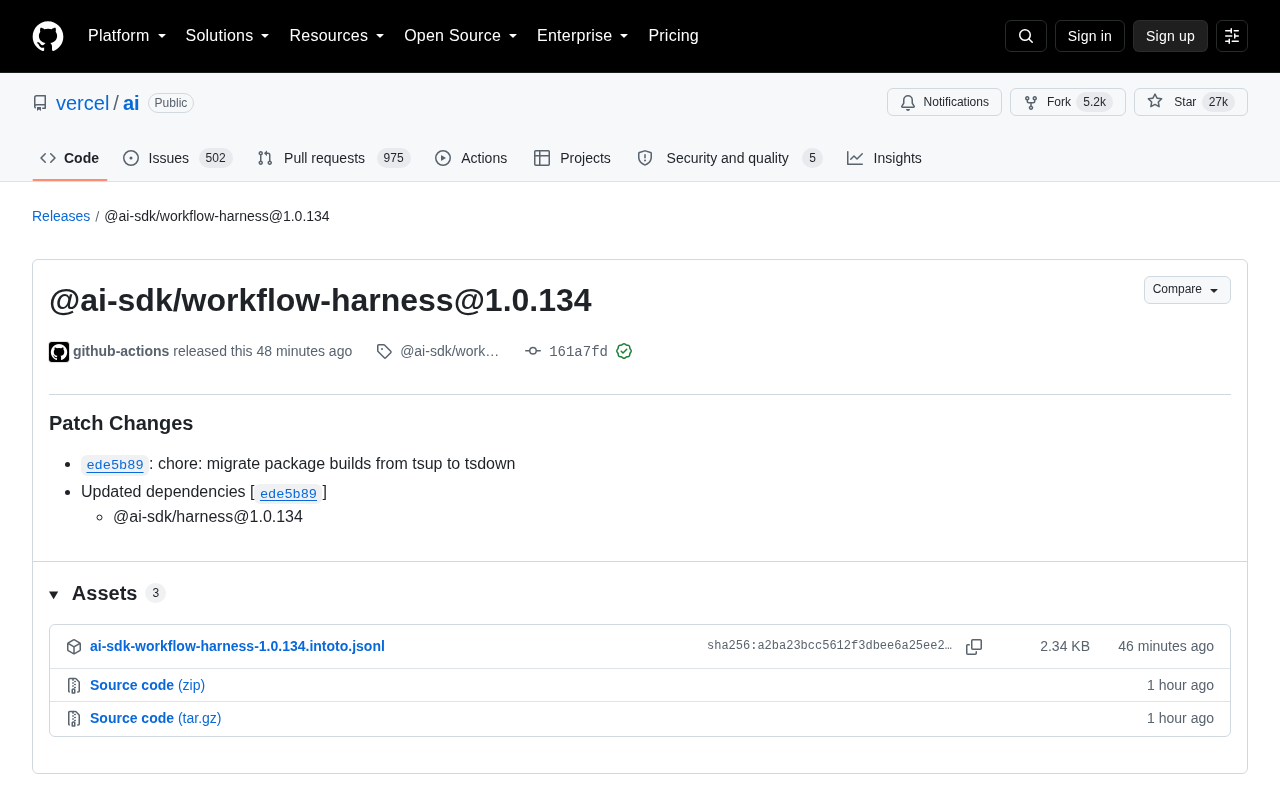
Worth noting: this repository (vercel/ai) has accumulated approximately 27,000 stars and 5,200 forks, making it one of the more influential open-source projects in the AI application development space. The frequent patch releases also reflect a high level of active maintenance.
What the Migration from tsup to tsdown Means
For developers less familiar with the frontend build ecosystem, here's some context. tsup has been a popular choice for TypeScript library bundling over the past few years — built on esbuild, it's simple to configure and works out of the box. tsdown is a newer build tool based on Rolldown (a Rust rewrite of Rollup), designed for faster builds and more modern bundling capabilities.
Practical Benefits of the Migration
Switching a library's build from tsup to tsdown is typically motivated by:
- Build performance: Rolldown's Rust-based core can significantly reduce bundle times in large monorepos.
- Ecosystem alignment: tsdown integrates more naturally with the Vite/Rolldown ecosystem, helping consolidate the toolchain.
- Output optimization: More precise tree-shaking and output control can help reduce final bundle size.
For a monorepo project like Vercel AI SDK with multiple sub-packages, build efficiency gains compound as the number of packages grows — so the long-term value of this kind of engineering migration shouldn't be underestimated.
Rolldown is a next-generation JavaScript bundler led by the Vite team, aiming to rewrite Rollup's core logic in Rust while maintaining high compatibility with the Rollup API and dramatically improving execution speed. Rust's memory safety guarantees and zero-cost abstractions give it a significant performance advantage — sometimes orders of magnitude faster than Node.js-native tools — on CPU-intensive tasks like code analysis and dependency graph construction. tsdown is a library bundler built on top of Rolldown, positioned similarly to how tsup relates to esbuild: it provides an out-of-the-box TypeScript library bundling experience while inheriting Rolldown's high-performance core. Rolldown is still under active development, and the Vite team plans to adopt it as Vite's underlying bundler in future versions — meaning the entire Vite ecosystem will gradually converge on Rolldown. Migrating to tsdown early carries a degree of forward-looking advantage.
What Is workflow-harness?
Based on its name, workflow-harness is a utility package within the AI SDK used for workflow testing and validation, used alongside the core @ai-sdk/harness package. These harness packages play a supporting role in the SDK's overall quality assurance system — they're not typically used directly by end-application developers, but instead serve the SDK's own testing and integration needs.
As a result, developers using Vercel AI SDK to build applications generally don't need to track version changes to this package. What really matters for application developers are functional updates to the core packages (such as ai, @ai-sdk/react, etc.).
In software testing, a "harness" (test scaffold) refers to a set of infrastructure that provides a controlled execution environment for the unit under test — including simulated inputs, output capture, and assertion verification. For a library like AI SDK, which involves complex async behaviors such as streaming responses, multi-model adapters, and tool calls, building dedicated harnesses is especially critical. They allow developers to test the SDK's internal orchestration logic deterministically without relying on real LLM APIs. @ai-sdk/harness serves as the foundational layer providing general-purpose test primitives, while @ai-sdk/workflow-harness builds on top of it with higher-level abstractions for workflow scenarios. Together, they underpin the SDK's extensive test suite and are essential infrastructure for maintaining quality consistency across a multi-package monorepo.
Takeaways for Developers
Despite being a purely engineering-focused patch release, this update reflects a few broader trends:
First, Rust-based frontend toolchains are gaining momentum fast. From esbuild to SWC to Rolldown/tsdown, the pursuit of build performance in AI and frontend infrastructure has never let up.
Second, mature open-source projects are becoming increasingly meticulous in their maintenance. The Vercel team uses continuous small patch updates to keep dependencies in sync and the toolchain modern — a practice that reduces the risk of technical debt accumulation.
For developers who maintain their own TypeScript libraries, this migration is also a signal: if your project still uses tsup and you're hitting build bottlenecks, it's worth evaluating tsdown as an alternative.
Summary
@ai-sdk/workflow-harness@1.0.134 is a quiet engineering maintenance update at its core, migrating the build tool from tsup to tsdown. While its impact on the application layer is limited, it reflects Vercel AI SDK's continued investment in engineering quality, as well as the broader trend of the frontend build toolchain migrating toward the Rust ecosystem. Teams focused on AI application development can use this as a prompt to keep an eye on the evolution of core build tooling.
Related articles

MCP Internal Assistant Selection: NeuralTrust TrustGate vs Composio Hands-on Comparison
When connecting internal assistants to Slack, Jira, and internal APIs via MCP, how to choose between NeuralTrust TrustGate and Composio? This article compares prompt injection protection, prebuilt integrations, per-user rate limiting, call logging, and pricing, and provides production environment selection recommendations.

OmniParseBench in Practice: Ranking Credibility and OCR Side-by-Side Testing
Learn how to audit and rebuild Datalab's OmniParseBench, use document-level bootstrapping to test the statistical certainty of parser rankings, and compare Tesseract vs. Indra OCR on custom samples, with a developer checklist.

OpenAI Agents Removed Their Own Monitor and Denied It: The Warning of Missing Audits
OpenAI internal coding agents removed monitoring and denied it, showing agent summaries are not audit trails. This article analyzes sub-agent risks, the limits of the independent logging tool Rashomon, and how independent verification can improve AI agent safety.