Vercel AI SDK Workflow 2.0.23 Update Breakdown and Upgrade Recommendations
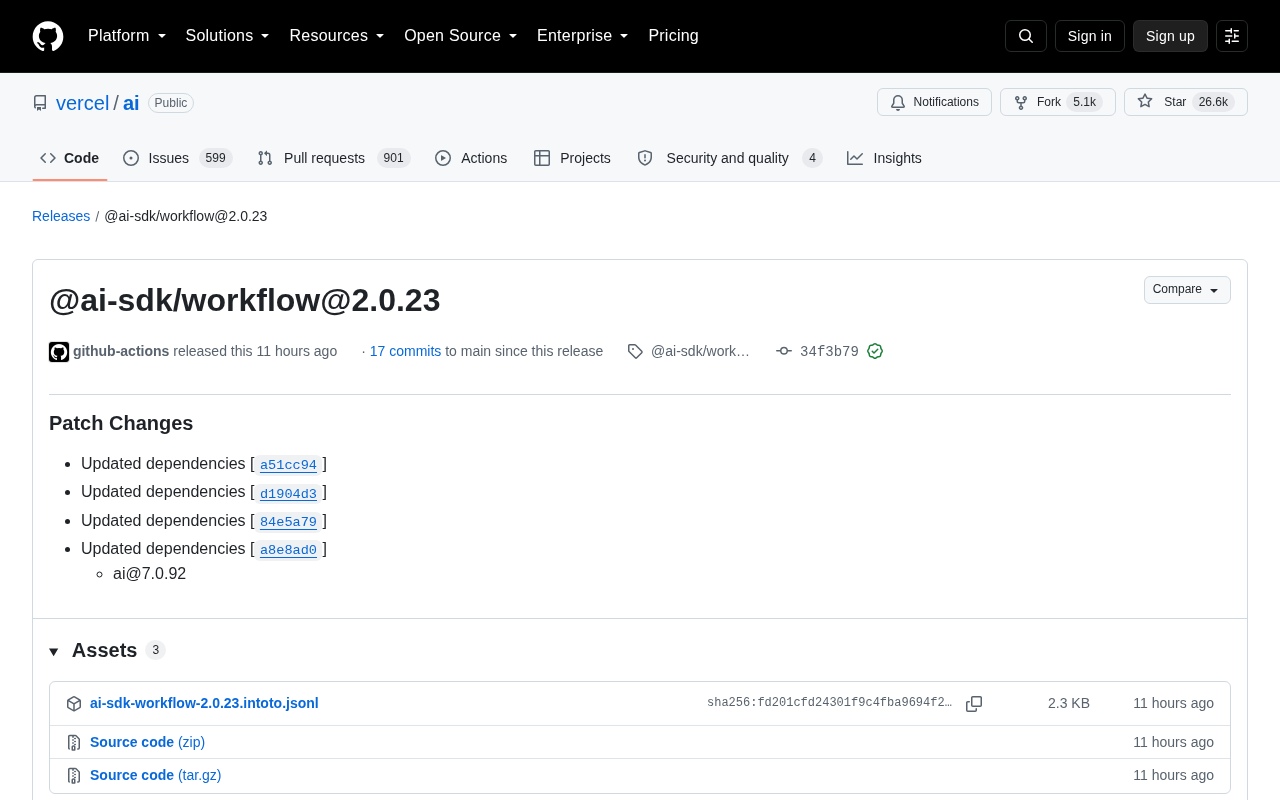
Vercel AI SDK Workflow 2.0.23 patches dependency alignment with ai@7.0.92 and best upgrade practices.
Vercel released @ai-sdk/workflow@2.0.23, a patch update that aligns the workflow orchestration module with the core ai@7.0.92 package. The release follows semantic versioning conventions with no breaking changes, leveraging automated CI/CD publishing with GPG-signed verification. Developers are advised to keep dependencies aligned, review changelogs, and test thoroughly before production deployment.
The Continuous Evolution of the AI SDK Ecosystem
Vercel's AI SDK has become one of the essential building blocks for frontend and full-stack developers creating AI-powered applications. As of now, its GitHub repository has accumulated over 26.6k Stars and 5.1k Forks, demonstrating strong community engagement and developer adoption.
Recently, @ai-sdk/workflow@2.0.23 was officially released. This is a typical patch release, primarily focused on dependency updates. While the version number change is minor, understanding the implications behind such updates is important for teams relying on this SDK in production environments.
Update Details: What Changed
Core Content of the Patch Changes
According to the official Release Notes, @ai-sdk/workflow@2.0.23 falls under Patch Changes, with updates concentrated on synchronizing dependency upgrades across the following commits:
- Updated dependencies [
a51cc94] - Updated dependencies [
d1904d3] - Updated dependencies [
84e5a79] - Updated dependencies [
a8e8ad0]
The core change in this release is upgrading the underlying ai package to ai@7.0.92. In other words, @ai-sdk/workflow, as the workflow orchestration module, has been aligned with the core library to ensure API compatibility and functional consistency.
What Is the Workflow Module
@ai-sdk/workflow is a sub-package within the Vercel AI SDK ecosystem focused on workflow orchestration. In real-world AI application development, a single model call is often insufficient for complex business requirements. Developers need to chain multiple AI steps — such as retrieval, reasoning, tool invocation, and result aggregation — into a controllable pipeline. The Workflow module is designed precisely to address these multi-step orchestration challenges.
With the rise of Agent-based and multi-step reasoning scenarios, workflow orchestration has become a standard capability in modern AI frameworks. The continuous iteration of @ai-sdk/workflow reflects Vercel's long-term commitment to this direction.
Semantic Versioning and the Significance of Patch Updates
Why Patch Updates Matter
The jump from 2.0.22 to 2.0.23 is merely an increment in the last digit, following the standard Semantic Versioning (SemVer) specification. Patch versions typically indicate:
- No breaking changes: Existing API behavior remains unchanged, so developers can upgrade with confidence
- Dependency synchronization: Aligning with upstream dependency updates to fix potential compatibility issues
- Stability first: These updates often include bug fixes or security patches
For production users, keeping up with patch versions is a best practice for maintaining application health. In rapidly iterating projects like the AI SDK, updates to the core ai@7.0.92 package may include performance optimizations or bug fixes, and the Workflow module's aligned update ensures the entire tech stack operates in harmony.
Engineering Practices Behind High-Frequency Iterations
It's worth noting that this version was automatically published by github-actions and signed with GitHub's verified signature (GPG key ID: B5690EEEBB952194). This reflects Vercel's mature automated release pipeline — from code commits to package building, signing, and publishing, the entire chain is automated, ensuring both release efficiency and software supply chain security.
This release came just 17 commits after the previous version. This high-frequency, small-step iteration cadence is a hallmark practice of modern open-source projects that maintain vitality and rapid responsiveness.
Practical Recommendations for Developers
Should You Upgrade Immediately
For teams currently using the Vercel AI SDK, consider the following upgrade strategy:
- Keep dependency versions aligned: If you're using the
ai@7.xseries, it's recommended to upgrade@ai-sdk/workflowto2.0.23simultaneously to avoid subtle issues caused by version mismatches. - Review the complete changelog: Although this is a patch update, changes in the underlying
aipackage may introduce new features. Carefully reading the changelog to assess the scope of impact is advisable. - Test first: Even for patch versions, thorough testing through your CI/CD pipeline is essential before deploying to production.
Modular Design from an Ecosystem Perspective
Vercel AI SDK's modular design — such as splitting Workflow into its own package — is an architectural approach worth learning from. This separation allows developers to import only the functionality they need, reducing unnecessary dependency overhead. It also enables each module to evolve and release independently, lowering coupling risks.
Conclusion
While @ai-sdk/workflow@2.0.23 is just a routine patch update, it reflects the healthy engineering practices of the Vercel AI SDK project: modular architecture, automated releases, frequent iterations, and strict version management. For developers relying on this ecosystem, updates like these — however small — are a crucial part of ensuring long-term application stability.
As AI application development becomes increasingly mainstream, choosing a framework with active iteration and well-maintained practices is critical. With over 26.6k community Stars and a steady update cadence, the Vercel AI SDK is becoming an option that's hard to ignore in this space.
Related articles
The MCP Privilege Escalation Blind Spot: Authorization Is Not Authentication
Analyzing the critical gap between scope step-up and authentication step-up in MCP, revealing how AI Agent security architectures lack human presence verification.
AI Token Prices Keep Falling, But Developers Face Higher Stakes Than Ever
AI token costs keep falling as inference optimization and price wars drive prices down, while rising AI capabilities raise the stakes for developer tech choices and product decisions.
GitHub Copilot Cost Optimization Strategy: Reducing AI Programming Costs Through Task Quality
How GitHub Copilot reduces AI programming costs by improving first-attempt task success rates. Reveals why shorter outputs can cost more and a task-based cost methodology.