Vercel AI SDK Workflow 2.0.54 Released: Reasoning Metadata Now Preserved Across Steps

Vercel AI SDK workflow 2.0.54 fixes reasoning and metadata loss in multi-step Agent workflows.
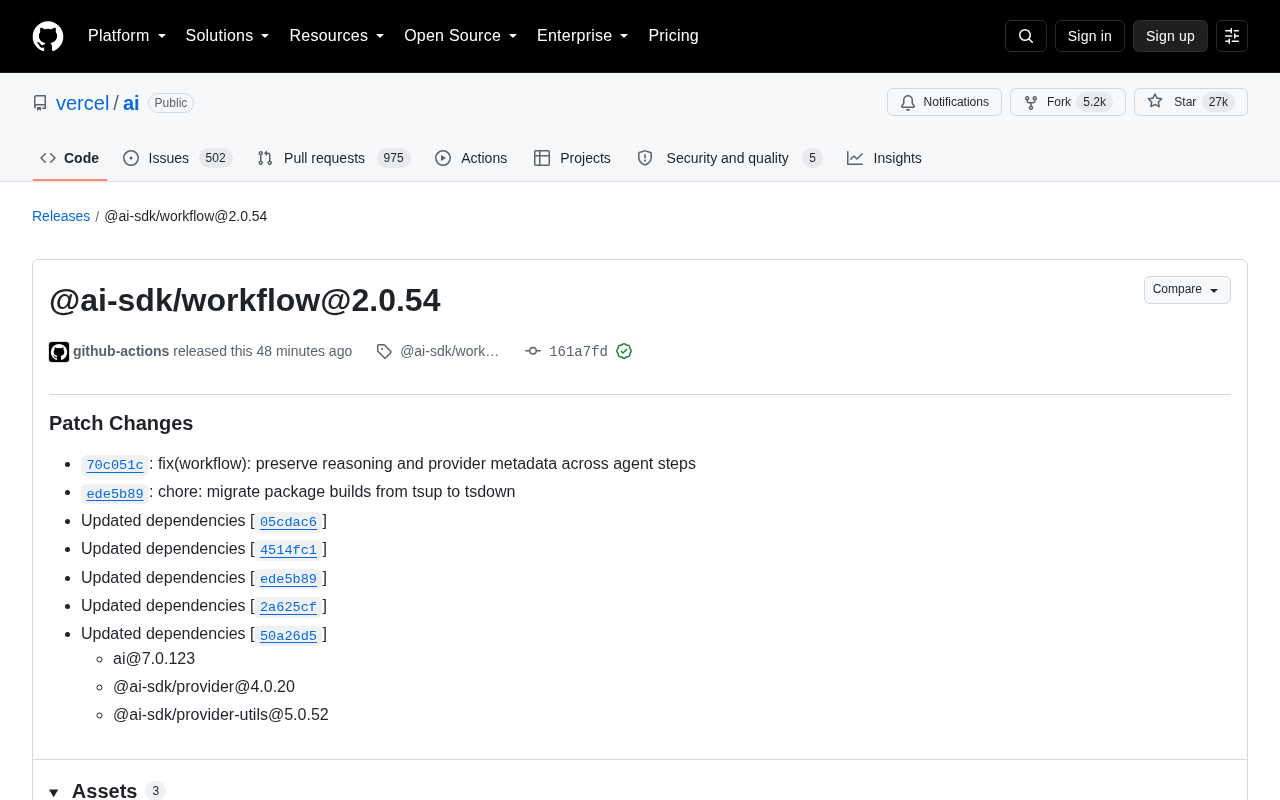
`@ai-sdk/[email protected]` is a patch-level update with two core changes: a fix for reasoning content and provider metadata being lost across multi-step Agent flows, and a build toolchain migration from tsup to tsdown. The former directly benefits apps that rely on chain-of-thought reasoning or need to track model behavior across steps; the latter is an internal engineering optimization. Core dependencies [email protected], @ai-sdk/[email protected], and @ai-sdk/[email protected] are also updated — upgrade them together to avoid version mismatches. No breaking changes.
Vercel's AI SDK ecosystem recently received a minor version update. @ai-sdk/[email protected] has been officially released as a patch version. While the version bump is modest, the two changes it contains have real-world implications for developers building multi-step Agent workflows.
Core Changes in This Release
This patch version includes two key changes that address genuine pain points in Agent workflow development.
Preserving Reasoning and Metadata Across Agent Steps
The most noteworthy fix is fix(workflow): preserve reasoning and provider metadata across agent steps. In multi-step Agent orchestration scenarios, a complete task often spans multiple sequential reasoning steps. In previous versions, the model's reasoning process and provider metadata could be lost during step transitions, leaving subsequent steps without full context.
For applications that rely on chain-of-thought reasoning or need to track model behavior, metadata continuity is critical. It affects not only debugging and observability but also the quality of the final output. This fix ensures that reasoning content and provider metadata are correctly propagated and preserved throughout the entire Agent step chain — an improvement aimed squarely at engineering reliability.
What is provider metadata? Provider metadata refers to the additional information that AI service providers attach to their responses — things like token usage, model version, cache hit status, and safety filter results. The structure varies by provider: Anthropic may return detailed breakdowns of input/output tokens, OpenAI may include
finish_reasonandsystem_fingerprint, and Google Gemini has safety scoring fields. In multi-step Agent workflows, each step generates its own metadata. If this information is lost between steps, developers can't accurately tally the total cost of a task, trace anomalous behavior in specific steps, or pinpoint which step triggered a content filter. The loss of reasoning is even more critical — for models that support extended thinking, such as o1 and Claude 3.7 Sonnet, the reasoning process carries the model's intermediate decision path. If a subsequent step needs to reference the thinking logic from a prior step, losing that content directly undermines task coherence and output quality.
Build Toolchain Migration from tsup to tsdown
The second change is chore: migrate package builds from tsup to tsdown, moving the package build pipeline from tsup to tsdown. This is an internal engineering adjustment that most users won't need to think about. tsdown is a newer build tool that typically offers improvements in bundling speed, output size, or type declaration generation. Migrations like this are often made to standardize build tooling across a monorepo and reduce maintenance overhead.
tsup vs. tsdown: Both are TypeScript package build tools built on top of esbuild, but they differ in maturity and direction. tsup is the more established option in the ecosystem, supporting multiple output formats (ESM, CJS, IIFE) and type declaration generation, and is widely used by open-source libraries. tsdown is a newer alternative led by the Rolldown (a Rust rewrite of Rollup) team. It also leverages esbuild under the hood but makes targeted improvements in tree-shaking precision, correctness of type declaration output, and integration with the Vite ecosystem. For a monorepo project like the Vercel AI SDK, unifying the build tool reduces configuration inconsistencies across packages and lowers maintenance burden. End users typically won't notice this kind of change, but more precise tree-shaking can help reduce final application bundle sizes.
Dependency Upgrades
As one piece of the broader Vercel AI SDK ecosystem, updates to @ai-sdk/workflow are typically accompanied by synchronized upgrades to core dependencies. This release updates the following:
[email protected]— the core AI SDK package@ai-sdk/[email protected]— the provider abstraction layer@ai-sdk/[email protected]— provider utility toolkit
This tight dependency coupling means that if you're using the workflow module in your project, it's best to upgrade the core ai package at the same time to avoid compatibility issues from version mismatches. The build tool migration (ede5b89) also appears in the dependency update list, indicating this was a coordinated change across multiple packages.
What This Means for Developers
From a version number standpoint, 2.0.54 is a patch-level release. Following semantic versioning, it should contain no breaking changes, making the upgrade cost relatively low. That said, the reasoning metadata preservation fix carries significant value for specific use cases.
If you're building any of the following types of applications, it's worth evaluating an upgrade soon:
- Multi-step Agent orchestration that depends on the reasoning process at each step
- Applications that need to track provider-returned metadata across steps for logging, monitoring, or cost accounting
- Applications using models that support reasoning output (e.g., models with chain-of-thought capabilities)
The Vercel AI SDK currently has approximately 27k stars and 5.2k forks on GitHub, making it one of the go-to tools for building AI applications in the TypeScript ecosystem. Its high release cadence reflects the growing importance of Agent and workflow orchestration in AI application development.
Summary
@ai-sdk/[email protected] is a pragmatic patch update. The headline fix addresses the loss of reasoning content and metadata across Agent steps, complemented by an internal build toolchain migration and synchronized dependency upgrades — all oriented toward engineering stability. For Agent applications that rely on multi-step reasoning, this fix alone is a compelling reason to upgrade.
Related articles

Should U.S. College Fraternities Be Banned? A Researcher's Incisive Observations
Why not just ban U.S. college fraternities? A researcher finds the key resistance comes from decision-makers' own fraternity identities and schools' "willful ignorance."

Microsoft Discovery: Accelerating Scientific Discovery with AI Agents
Microsoft's Discovery platform runs specialized AI agents to help researchers screen and prioritize the most promising compounds and experimental paths, reducing experiments and accelerating scientific discovery.

Cambridge Heavy Industries Secretly Develops Desktop-Scale Nuclear Fusion Device
Cambridge Heavy Industries is secretly developing a desktop-scale laser-driven nuclear fusion device, targeting the equipment supply market for fusion power plants. This article analyzes its miniaturization technology path, commercialization logic, and unique positioning in the fusion startup wave.